Full-Funnel Organic Growth: How SEO, Content & Conversion Fit Together
Table of Contents
Full-funnel organic growth means treating technical SEO, content, and conversion as one system instead of three separate projects. The job isn’t just to rank—it’s to be found, to be understood, to be believed, and to turn the visit into revenue. Most websites leak at the seams between those steps: content that ranks but doesn’t convert, pages that persuade but load too slowly to rank, traffic that arrives but can’t be traced to a single dollar.
Organic is the only channel where a single asset can do all of that at once. One well-built page can be discovered in search, build trust as someone reads, and close the action at the bottom—then keep doing it for years at no incremental cost. That’s the opportunity siloed work leaves on the table. This playbook lays out how the pieces fit together, why they compound when they’re owned as one system, and where to start. It’s the map; each layer below links to a deeper guide.
The Short Version
- Full-funnel organic treats technical SEO, content, and conversion as one system — not three separate workstreams with separate owners.
- Sites leak revenue at the seams: content that ranks but doesn’t convert, pages that persuade but load too slowly to rank, traffic that can’t be traced to revenue.
- The four layers work in sequence: technical foundation → intent-matched content → conversion → measurement. Fix them in that order.
- One well-built page can rank, build trust, and convert — and keep doing it for years. That’s the compounding advantage siloed work can’t replicate.
What “full-funnel” actually means
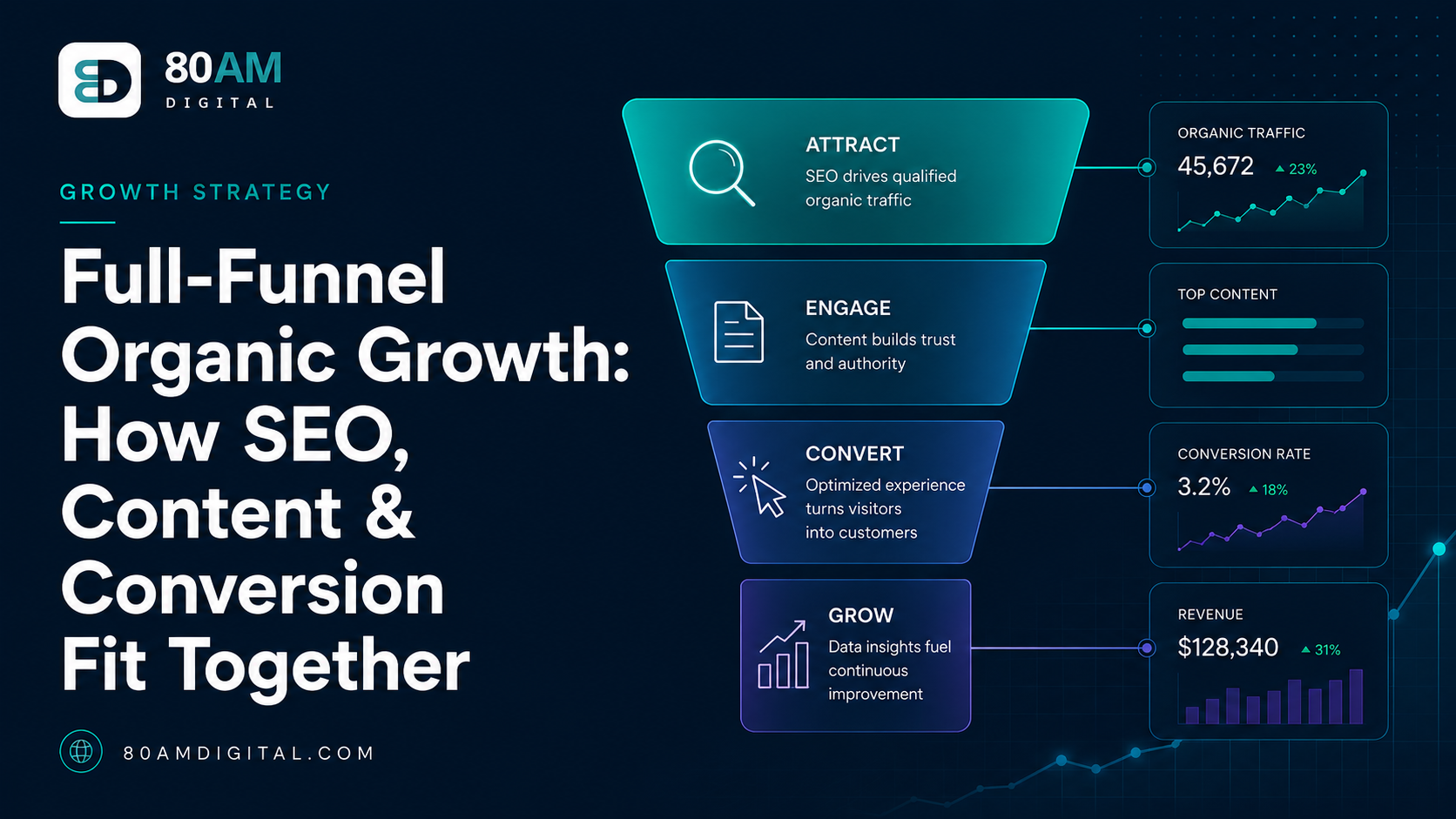
A marketing funnel describes the path from a stranger discovering you to a customer deciding to buy. Organic growth touches every stage of it:
- Discovery — someone searches, or asks an AI, and finds you.
- Consideration — your content answers the real question behind the search and earns trust.
- Decision — the page removes friction and makes the next step obvious.
“Full-funnel” simply means you optimize for the whole path, not one slice of it. Ranking is necessary but not sufficient; a number-one position that nobody clicks, or clicks and bounces, isn’t growth. The work only counts when it ends in revenue.
The trap is that each slice has its own tidy metric—rankings, sessions, time on page, conversion rate—and it’s easy to win one while losing the outcome that pays the bills. A page can rank first, double its traffic, and generate fewer leads than before if the new visitors arrived with the wrong intent. Full-funnel thinking keeps the scoreboard on revenue and treats every other metric as a means to it.
Why siloed SEO, content, and CRO leak revenue
Most brands buy these capabilities separately—an SEO contractor, a content agency, a CRO tool, an analyst—from people who rarely talk to each other. Each does their slice well, and revenue still leaks at the handoffs. The most common leaks:
| When this is strong\u2026 | \u2026but this is weak | What leaks |
|---|---|---|
| Great content | Technical foundation | Pages aren’t crawled, indexed, or fast enough to rank—so the traffic never arrives. |
| Strong rankings | Conversion | Visitors land and bounce. You pay for the traffic in effort and get no revenue. |
| High conversion | Measurement | You can’t tell which pages or topics drive sales, so you can’t double down on what works. |
| SEO and content (run separately) | Shared strategy | Content chases keywords with volume but no buyers; effort goes to traffic that never converts. |
The leaks don’t come from bad work—they come from no shared owner. Silos form because of how capability gets bought: different specialists, vendors, and tools, each measured on a different number. The content team is rewarded for publishing, the SEO for rankings, the CRO tool for test wins, the analyst for clean dashboards. Everyone hits their target and the funnel still loses money, because the spaces between their targets are where revenue actually escapes—and nobody owns those spaces.
The four layers of organic growth
A full-funnel system has four layers. Each depends on the one beneath it, and each has its own deep-dive guide.
| Layer | Its job | Go deeper |
|---|---|---|
| 1. Technical foundation | Make the site crawlable, indexable, and fast | SEO Audit Checklist |
| 2. Content that matches intent | Earn discovery and trust across the funnel | Content Engine |
| 3. Conversion | Turn visits into leads and sales | Traffic but No Conversions |
| 4. Measurement | Know what’s working so you can scale it | Organic-Growth Scoreboard |
Layer 1: Technical foundation
If search engines can’t crawl, render, and index your pages quickly, nothing above this layer matters. This layer covers crawlability and indexing, site structure and internal linking, Core Web Vitals, HTTPS, and clean canonicalization. “Good” looks like: the pages you care about are indexed, your important templates load fast on real mobile devices, and there are no crawl traps quietly wasting Google’s attention.
It’s also where the fastest wins usually hide, because one template fix can lift hundreds of pages at once. The foundation has diminishing returns, though—once it’s solid, more technical work rarely moves the needle, and the leverage shifts upward to content and conversion. Start with the SEO Audit Checklist, and if speed is the issue, the Core Web Vitals playbook.
Layer 2: Content that matches intent
Discovery now happens in two places: classic search results and AI answer engines. Content earns both when it’s organized into topic clusters, written to match real search intent, and structured to be quoted. The shift worth internalizing is from keywords to topics and entities—you’re no longer targeting a phrase, you’re demonstrating genuine coverage of a subject your buyers care about.
“Good” here isn’t volume; it’s coverage of the questions your buyers actually ask, mapped across the funnel so there’s a relevant page whether someone is just learning or ready to buy. See how to build it in the Content Engine guide, and how to earn AI citations in How to Get Cited by AI Search.
Layer 3: Conversion
Traffic is a cost until it converts. This layer is about message clarity, page structure, proof, and removing friction at the point of action—so the visitor a search engine sent you becomes a lead or a sale. It’s the layer most “SEO” work ignores entirely, and the one that most directly moves revenue, because a conversion gain multiplies the value of every visit you already earn.
Diagnosing it is a matter of asking, page by page, whether the right visitor arrived, whether the page is clear, whether it’s believable, and whether anything is in the way. The full method is in Traffic but No Conversions.
Layer 4: Measurement
Without measurement you’re guessing. This layer connects rankings and traffic to events, conversions, and revenue, so you know which topics and pages are pulling their weight and which to cut. It’s what closes the loop: the other three layers are open-loop activity until measurement tells you what worked and feeds the next round of priorities. Get it wrong and you’ll keep funding whatever is easy to count instead of whatever drives sales. See the Organic-Growth Scoreboard.
A worked example: one page through the funnel
Take a single service page targeting a clear buying-intent query. Here’s how the four layers stack on that one URL:
- Technical. The page was slow and buried four clicks deep, so it sat on page three. You speed up the template and link to it from a relevant pillar. Now it’s crawled, fast, and eligible to rank—say it moves to the bottom of page one.
- Content. The copy talked about your process; the searcher wanted to know if you solve their problem and what it costs. You rewrite it to answer the real question and cover the related sub-questions. It climbs from position nine to four, multiplying clicks.
- Conversion. Those new visitors hit a vague headline and a buried “contact us.” You lead with the outcome, add proof, and make one next step obvious. A larger share of the same traffic now enquires.
- Measurement. You tracked the enquiry as an event tied to revenue, so you can see the page went from near-zero to a steady source of leads—and you repeat the exact pattern on the next page.
No single fix did it. A faster page nobody could find still earns nothing; great rankings into a confusing page still bounce. The result came from all four, on one URL, in order.
How the layers compound
The reason full-funnel beats best-in-class silos is simple math: the layers multiply, they don’t add. A modest gain at each one stacks on top of the others rather than beside them. To make that concrete—these numbers are illustrative, but the shape is real:
| Layer improved | Modest lift | Cumulative effect on revenue |
|---|---|---|
| More pages indexed and eligible to rank | +30% | 1.3× |
| Better rankings → more clicks | +30% | 1.7× |
| Higher conversion rate | +20% | 2.0× |
Where to start: sequence, not everything at once
Full-funnel doesn’t mean fixing everything simultaneously. It means working in the right order so each layer supports the next:
- Fix the foundation. Clear the crawl, indexing, and speed issues that cap everything else.
- Stop the biggest leak. If you already have traffic that doesn’t convert, fix conversion before chasing more traffic.
- Build content that compounds. Cover your buyers’ questions in clusters that rank and earn citations.
- Measure and repeat. Find what worked, scale it, prune what didn’t.
In practice, a first 90 days usually looks like: a week or two to audit and baseline, so you know which layer is actually holding you back; the next month on the foundation plus the single biggest leak; and the rest building the content-and-measurement loop on the pages that matter most. The point of sequencing is leverage—you spend early effort where it unlocks everything downstream, instead of spreading it thin across a generic checklist.
How this works across business models
The four layers are the same everywhere; what changes is where the biggest leak tends to sit. A few patterns we see:
- DTC and ecommerce. Most growth hides in category and collection pages and technical health—not the blog. The common leak is thin category pages and slow templates. More in SEO for DTC & ecommerce.
- Lead-gen B2B. Volume matters less than the handful of buyers who convert. The leak is usually content pitched too high in the funnel and weak proof on the pages that close. See SEO for lead-gen B2B.
- SaaS. Content works best tied to the product and real use cases. The leak is traffic that never connects search intent to what the product does. See SEO for SaaS.
Different industries, the same system—which is why a team that has run it across several can spot the leak faster than one that only knows a single vertical.
What this looks like under one roof
The hard part of full-funnel growth isn’t any single layer—it’s the coordination between them. When the same team owns the technical foundation, the content, the conversion work, and the measurement, the handoffs disappear. Content is briefed with conversion and technical constraints already in mind. Technical fixes are prioritized by revenue impact, not ticket count. Everything runs off one roadmap, and there’s a single answer to “is this working?” Nothing falls through the gap between vendors, because there is no gap.
That’s how we work at 80AM Digital: one studio handling the full funnel for brands whose website has to earn its keep. Our team has run organic growth across DTC sports, telecom, and hardware—different industries, the same system—so the playbook travels. We can own the whole funnel or plug into the team you already have.