How to Build a Content Engine That Compounds
Random posts don’t grow traffic; systems do. Learn how to build a content engine — clusters, briefs, cadence and refreshes — that compounds over time.
Table of Contents
A content engine is a repeatable system—not a publishing calendar—built from four components: topic clusters that build topical authority, content briefs that produce rankable drafts, a sustainable cadence you can hold through a busy quarter, and a refresh cycle that extends the life of every post you publish. Without the system, you’re publishing. With it, you’re compounding.
The difference shows up at month nine, not month one. A team publishing randomly may have more articles by then; a team running an engine has pages that reinforce each other, clusters that register topical authority, and a measurement layer that tells them which work is converting. This playbook covers how to build each component, how they connect, and where to start.
The Short Version
- A content engine has four components: topic clusters, content briefs, a sustainable cadence, and a refresh cycle — they have to work together or they don’t compound.
- Publishing more without cluster structure is what causes the plateau most content programmes hit by month three.
- Cluster depth — not article count — is what builds topical authority and makes rankings stick.
- Measure by cluster keyword positions and conversion-path clicks, not total traffic or post count.
Why most content programs plateau
Most content programs start well. A post ranks, traffic ticks up, someone gets excited and schedules six more. Then growth flattens. New posts stop ranking. Old posts decay. Publishing faster helps briefly, then stops helping. The plateau isn’t bad luck—it has three consistent causes.
- Orphaned content. Posts with no internal links in or out. Google finds them; readers and authority don’t flow through them.
- Intent mismatch. Topics chosen for search volume rather than for what the reader actually wants to do after reading—learn, compare, decide, act.
- No refresh cycle. A post from 18 months ago may have been accurate and complete then. Freshness signals have eroded it since, and competitors have published on the same topic.
The core insight
Content doesn’t compound because you publish more. It compounds because each new piece makes the whole cluster stronger — more links, more topical coverage, more authority flowing to the pillar.
The four components of a compounding content engine
These four components aren’t sequential steps—they run in parallel once the engine is built. But if you’re building from scratch, this is the order that makes sense.
Content engine: four components
Component 1: Topic clusters
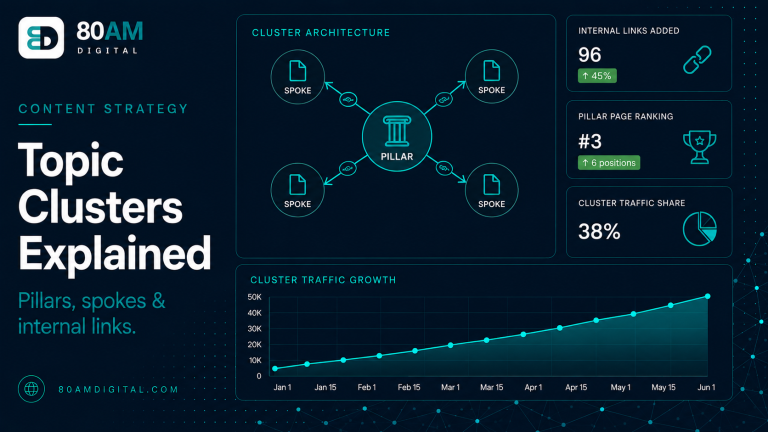
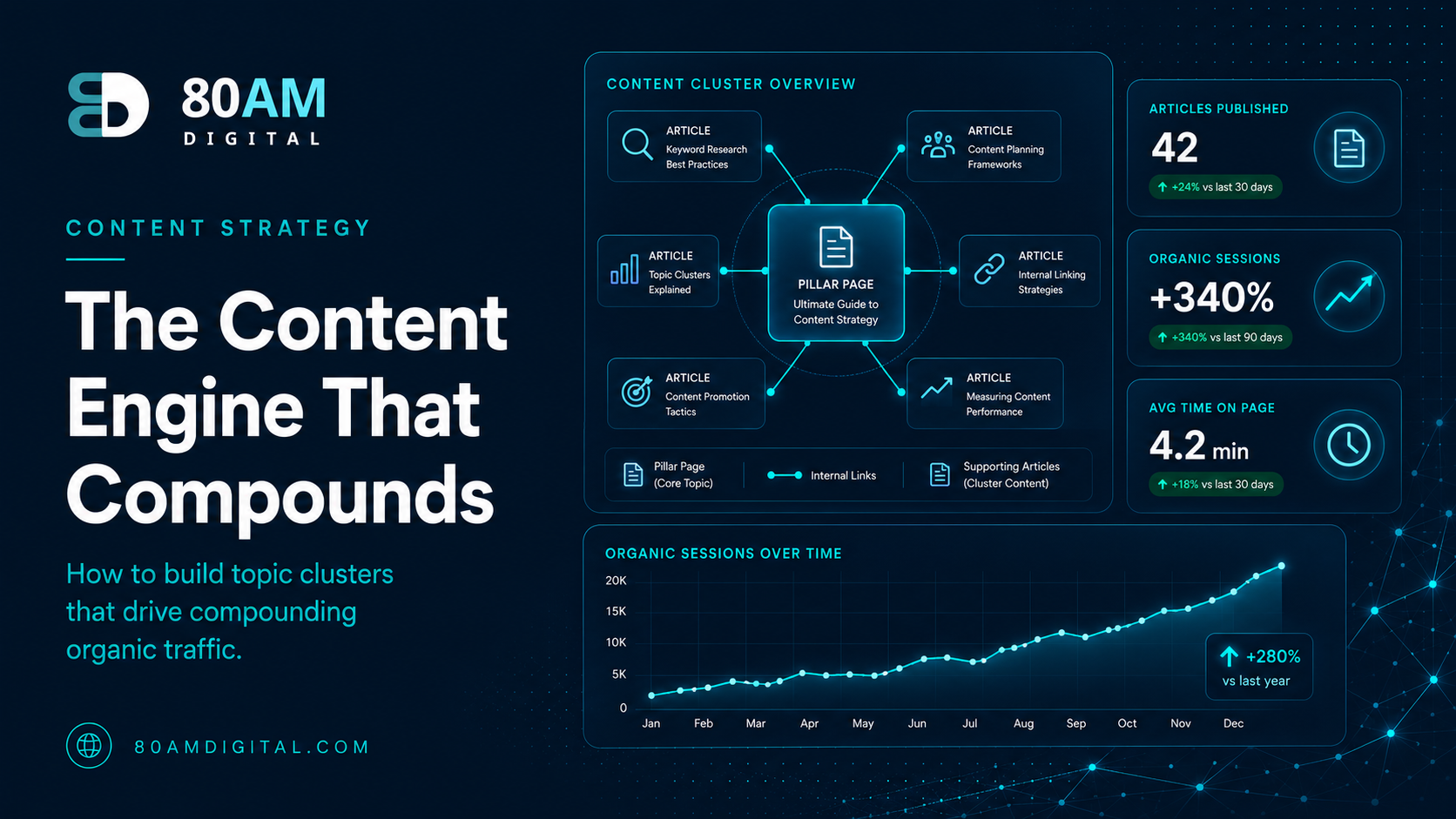
A topic cluster is a pillar page — comprehensive, evergreen, the definitive resource on its theme — surrounded by supporting “spoke” articles that cover sub-topics at the same level of expertise. Every spoke links up to the pillar; the pillar links back down to each spoke. Authority flows both ways.
The cluster structure solves two problems at once. For Google, it signals topical authority — you’ve covered the entire subject space, not just one keyword. For AI answer engines (ChatGPT, Perplexity, AI Overviews), the cluster provides multiple cross-referenced signals that identify you as the authoritative source. Our guide on how to get cited by AI search covers that connection in detail.
Hub-and-spoke cluster model
comprehensive / evergreen
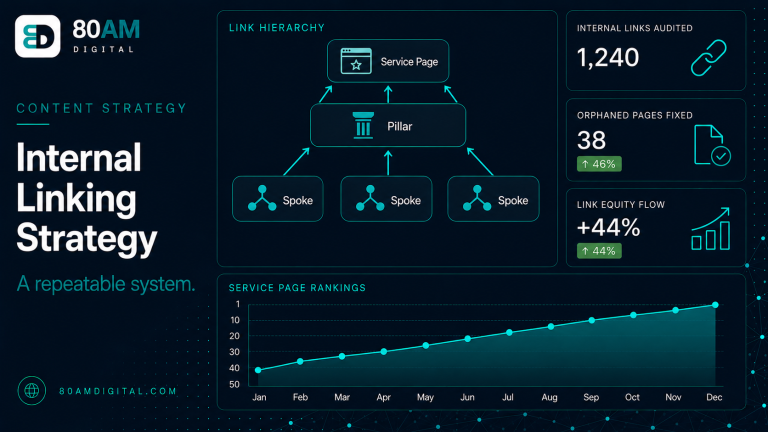
Every spoke links up to the pillar. The pillar links down to each spoke and out to at least one money page.
Rules for a cluster that actually compounds
- One cluster per theme — not per product or keyword. “Technical SEO” is a cluster; “canonical tags” is a spoke. Building a cluster per keyword produces 40 thin pillars instead of six strong ones.
- Publish the pillar first. Spokes need a destination. Ten spokes without a pillar leaves them without an internal-link home — and leaves the pillar without the incoming equity the spokes would provide.
- The pillar answers the whole question; the spoke answers a sub-question in more depth. Neither makes the other redundant. They’re different entry points into the same authority space.
- Cross-link clusters where intent overlaps. A post on Core Web Vitals (technical cluster) should link to the conversion cluster when it covers how speed affects conversion rates. Clusters aren’t silos.
Component 2: Content briefs that get rankable first drafts
A brief does one thing: eliminates the structural decisions a writer has to make mid-draft. If you receive a draft and have to rewrite the lead, restructure the sections, or rethink the CTA, the brief failed. A good brief front-loads that thinking so the draft comes back ready to edit — not rebuild.
Eight fields cover most of what’s needed to nail structure on the first pass:
Keep briefs in a shared doc or spreadsheet — one row per article. Once you have 20 briefs queued, you can write (or commission) in batches without losing the thread of the cluster architecture you’re building.
Component 3: A cadence you can actually hold
The compounding effect is a function of time and consistency, not volume. A team publishing two well-briefed posts per month for 18 months will outperform a team that publishes eight in January and three in February. The engine stalls when momentum breaks — and momentum breaks when the pace wasn’t realistic to begin with.
Organic traffic accumulation: consistent pace vs. burst-and-gap
Illustrative — both programs published the same number of posts over 9 months
Picking a rate that’s actually sustainable
Pick the rate one tier below what feels achievable today. The goal is to never miss a month. A missed month in a content program costs more than the missed posts — it breaks the signal of consistency that both Google’s crawl scheduling and your team’s own momentum depend on.
Component 4: The refresh cycle
Content decays. A post that ranked at position 4 eighteen months ago is losing ground now — competitors have published on the same topic, the SERP has shifted toward different formats, and your own site has grown while that post stagnated. The refresh cycle is what keeps the engine running after the initial build.
The cycle is a scheduled quarterly pass through each cluster — checking which posts have declined and are worth refreshing before they become a drag on the pillar’s authority rather than a contributor to it.
Content lifecycle: signals and decisions
When to refresh versus write new
How the four components create the compounding effect
Each post you publish adds three things to the cluster simultaneously: a new entry point for readers with that specific question, a new internal link directing authority toward the pillar, and a new data point for AI answer engines mapping your site as the authoritative source on this topic. Those three effects stack across every post you’ve published and every post you’ll publish next.
The compounding part isn’t a metaphor. Six months in, a cluster with eight well-linked posts sitting on page two will collectively move toward page one — not because of a single backlink or on-page tweak, but because the accumulated authority in the cluster has crossed a threshold. The pillar and its spokes start appearing together in AI citation results. New posts join a cluster that already has standing instead of starting from scratch.
Why sequence matters
Publishing 30 unrelated posts gives you 30 posts. Publishing 30 posts inside a three-cluster system gives you a content engine. The architecture is what makes the difference — not the volume.
Getting started: what to do in the first 90 days
If you’re building from a blank slate, the 90-day sequence is straightforward. If you have existing content, run a quick audit before building — you may have pillar-worthy posts and strong spokes hiding in your archive that just need to be connected.
90-day content engine build
- Define 2–3 clusters (start small)
- Choose one pillar per cluster
- Identify 5–8 spoke topics per cluster
- Build your first 10 briefs
- Audit existing content for orphans
- Publish pillar 1
- Publish 2–3 spokes for cluster 1
- Establish internal link structure
- Set up Search Console tracking
- Queue 10 more briefs
- Publish pillar 2
- Add 2–3 more cluster 1 spokes
- Cross-link clusters where intent overlaps
- First monthly review: what’s moved?
- Set Q2 refresh calendar
If you already have content: a quick audit first
If you’ve been publishing for a while, your archive is both an asset and a liability — strong posts drag on weaker ones when they share crawl budget. Before building the engine, spend a day inventorying what you have.
Pull every published URL into a spreadsheet with its 90-day traffic (GA4), average position (Search Console), and word count. Then classify each post into one of four buckets:
- Keep and connect: ranking well, fits a cluster, just needs a pillar to link up to.
- Refresh: had rankings that have slipped, or covers the right intent but is thin or outdated.
- Merge: two posts covering the same topic — consolidate into the stronger URL and 301 the other.
- Cut: no traffic, no rankings, no strategic value — 301 to the closest relevant page.
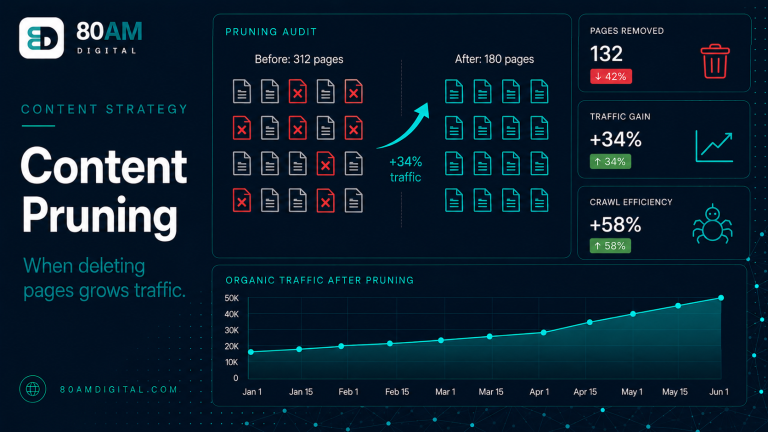
Most sites find roughly 25–30% keep-and-connect, 30–35% worth refreshing, 10–15% that should be merged, and the remainder cuttable. Pruning the bottom tier often produces a measurable rankings lift on its own — Google stops distributing crawl budget across weak pages and concentrates it on the strong ones. The full approach is in our SEO audit checklist.
Measuring a content engine (and knowing when it’s working)
A content program without a measurement layer is just publishing. The engine isn’t complete until you know which metrics reflect compounding — and which are vanity numbers that will mislead you into the wrong decisions.
Skip total sessions, total posts published, and social shares. They tell you you’re active — not that the engine is working. Active and compounding are different things. The complete measurement stack is covered in our full-funnel organic growth playbook.
Frequently asked questions
The system is straightforward once it’s running. The hard part is the first cluster — defining it tightly enough to build real topical authority, building briefs before deadline pressure hits, and holding the cadence through the first few months when rankings haven’t moved yet and it’s tempting to chase something faster.
If you want to start from a clear picture of what your site actually needs — which clusters have the most opportunity, which existing content is worth keeping, and what the right publishing sequence is — an organic growth audit is the first step we use with every new engagement.