Category and Collection Pages: The Most Undervalued Content You Own
Category and collection pages can rank and convert better than blog posts—yet most are thin. Learn how to turn them into real, intent-matching content.
Table of Contents
Category and collection pages sit at the intersection of search intent and commercial value — and they’re almost always underoptimised. A blog post ranking well for an informational query might earn 500 organic sessions per month with a 2% conversion rate. A category page ranking well for a commercial investigation query (“women’s trail running shoes” or “organic supplements for sleep”) might earn 300 sessions with a 6% conversion rate and a higher average order value. The blog post feels more “SEO” because it’s content; the category page is treated as a navigation element.
That’s the undervaluation. Category pages are content — and they can be the highest-value SEO content on many sites.
The Short Version
- Category pages match commercial-investigation intent directly — they often convert far better than blog posts, but get treated as navigation rather than content.
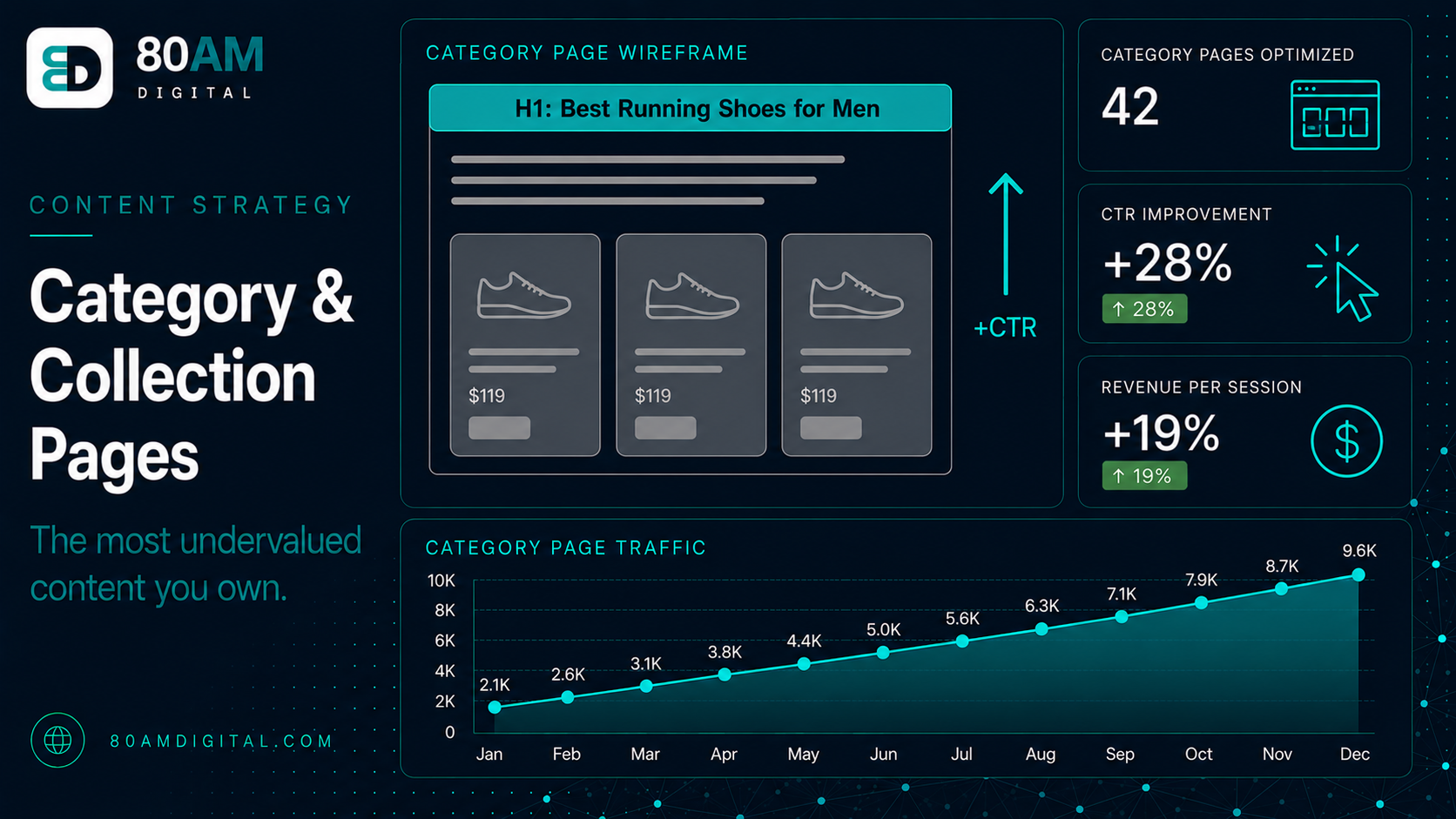
- The fix is five specific changes: search-language H1/title, unique intro copy, an FAQ, contextual internal links from blog content, and structured data.
- Templated intro copy that only swaps the category name provides zero differentiation signal — each category needs genuinely unique text.
- This is leverage on pages that already exist and are already indexed — no new content creation required, just improving what’s there.
Why category pages win for commercial intent
Commercial investigation queries — “best [product type],” “buy [product category],” “[product type] for [use case]” — are searched by people who are evaluating options. They want a curated set of relevant products or services, presented in a way that helps them decide. A category page does exactly this; a blog post has to simulate it. Google tends to show category pages for these queries because they directly satisfy the intent, while blog posts are often ranked for the informational variants of the same topic.
What most category pages get wrong
The typical category page: a page title (“Trail Running Shoes”), a product grid, and either no body copy or 200 words of template text at the bottom of the page that nobody reads. This is thin by SEO standards — there’s nothing on the page that would help Google understand the topical relevance beyond the title and the product names.
The improvements that move rankings:
| Change | Why it matters |
|---|---|
| H1/title in search language | Matches how buyers actually phrase the query, not brand language |
| Unique intro copy (100-200 words) | Gives Google topical signal beyond the title and product names |
| FAQ section | Answers pre-purchase questions and qualifies for FAQ schema |
| Contextual internal links | Builds the category page’s authority signal from related content |
| Structured data (ItemList/Product) | Supports enhanced SERP displays and rich results |
- H1 and title tag matching search language: “Trail Running Shoes for Women” not “Women’s Trail Running Footwear Collection.” Use the language searchers use, not brand language.
- Introductory copy above the product grid: 100–200 words answering “what is this category, who is it for, and what should I know before buying.” This content is visible, relevant, and gives Google something to evaluate beyond product names. The text should be original — templated copy that swaps only the category name provides no signal.
- FAQ section: Category-level questions (“How do I choose trail running shoes?” “What’s the difference between trail and road shoes?”) answer pre-purchase queries in the search result and give Google FAQ schema to work with. These are the questions buyers are asking before they buy.
- Internal links to the category from relevant content: Blog posts covering related topics should link to the category page with contextual anchor text. A post on “training for your first trail run” should link to the trail running shoes category. These internal links build the category page’s authority signal.
- Structured data: ItemList schema on category pages can earn enhanced SERP displays. Product schema on individual product listings within the category supports rich results.
Content category pages (not just ecommerce)
The same principle applies to blog category archives on content sites. A WordPress category page for “Technical SEO” that lists 40 posts is often thin by default — it gets indexed and may rank for broad category queries, but with no content of its own, it’s at a disadvantage against a dedicated pillar page. Either improve the category archive page with original introductory content, or noindex it and build a dedicated pillar page that can be properly optimised. Having both compete for the same broad category query is internal competition that benefits neither.
For how category pages connect to the broader content strategy, see topic clusters explained. For technical ecommerce SEO including category page canonicalisation, see technical SEO for ecommerce.
The leverage in numbers
Why this is high-leverage work
A worked example: one category page, before and after
An outdoor retailer’s “Trail Running Shoes” category page ranked position 14-18 for its primary keyword for over a year, with a product grid and a single boilerplate paragraph reused across 30+ categories with only the product noun swapped. The page received roughly 90 organic sessions a month.
The team rewrote the intro with 180 words specific to trail running shoe selection (grip pattern, rock plates, drainage for wet trail conditions), added a 5-question FAQ on selection criteria, added ItemList schema, and linked to the category from three existing blog posts about trail running that had no commercial links at all. Eight weeks after indexing, the page had moved to position 6-9 for its primary keyword and organic sessions had risen to roughly 240 a month — a change driven entirely by editing one existing page, with no new content created.
Frequently asked questions
The pages that are already there, already indexed
Category pages don’t require new content creation — they require improving pages that already exist, are already indexed, and are already competing for commercial queries. The SEO leverage is high: a few hundred words of genuine category content, better structured data, and stronger internal linking can move category pages from page 2 to page 1 without creating a single new article.
If you’d like a review of your category pages’ current state and what’s preventing them from ranking, get in touch.