How to Map Content to the Buyer Journey
Traffic that never converts usually means content mapped to the wrong stage. Learn how to align topics to awareness, consideration and decision intent.
Table of Contents
A content library that’s all awareness and no consideration is a traffic machine with no conversion path. A library that’s all BOFU without TOFU content to bring people in has strong conversion intent but no audience. Most content programmes are imbalanced — often skewed toward the awareness content that’s easiest to ideate and furthest from commercial intent.
Mapping content to the buyer journey isn’t about covering every stage for its own sake. It’s about understanding where your specific buyers spend time in their decision process, what questions they ask at each stage, and whether the content you’ve built answers those questions with a path to the next stage.
The Short Version
- Most content libraries skew TOFU-heavy because awareness content is easiest to produce and furthest from commercial intent.
- Every piece needs a deliberate next step — a TOFU article with no link to MOFU content is a dead end, not a funnel.
- Buyers don’t move linearly through stages — the model is for gap analysis and planning, not predicting individual paths.
- BOFU content (service pages, case studies, pricing) should stay open, not gated — friction at the decision stage costs more than it protects.
The three stages and what they’re actually asking
| Stage | What the buyer is asking | Content’s job |
|---|---|---|
| Awareness (TOFU) | “Why isn’t my site getting traffic” — problem-aware, no solution category identified yet | Be found, demonstrate expertise, point toward consideration content |
| Consideration (MOFU) | “How to run an SEO audit,” “agency vs. freelancer” — evaluating approach and options | Show your specific methodology, build enough trust to be recognised as credible |
| Decision (BOFU) | “Hire SEO consultant,” “audit pricing” — ready to act, making a final choice | Convert — remove friction, address objections, clear CTA |
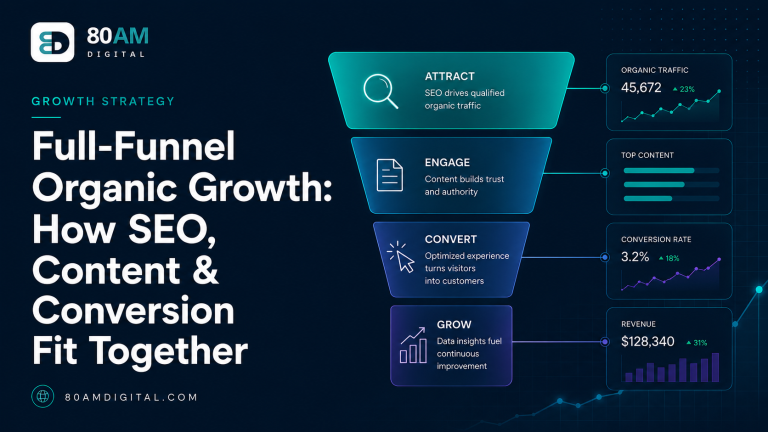
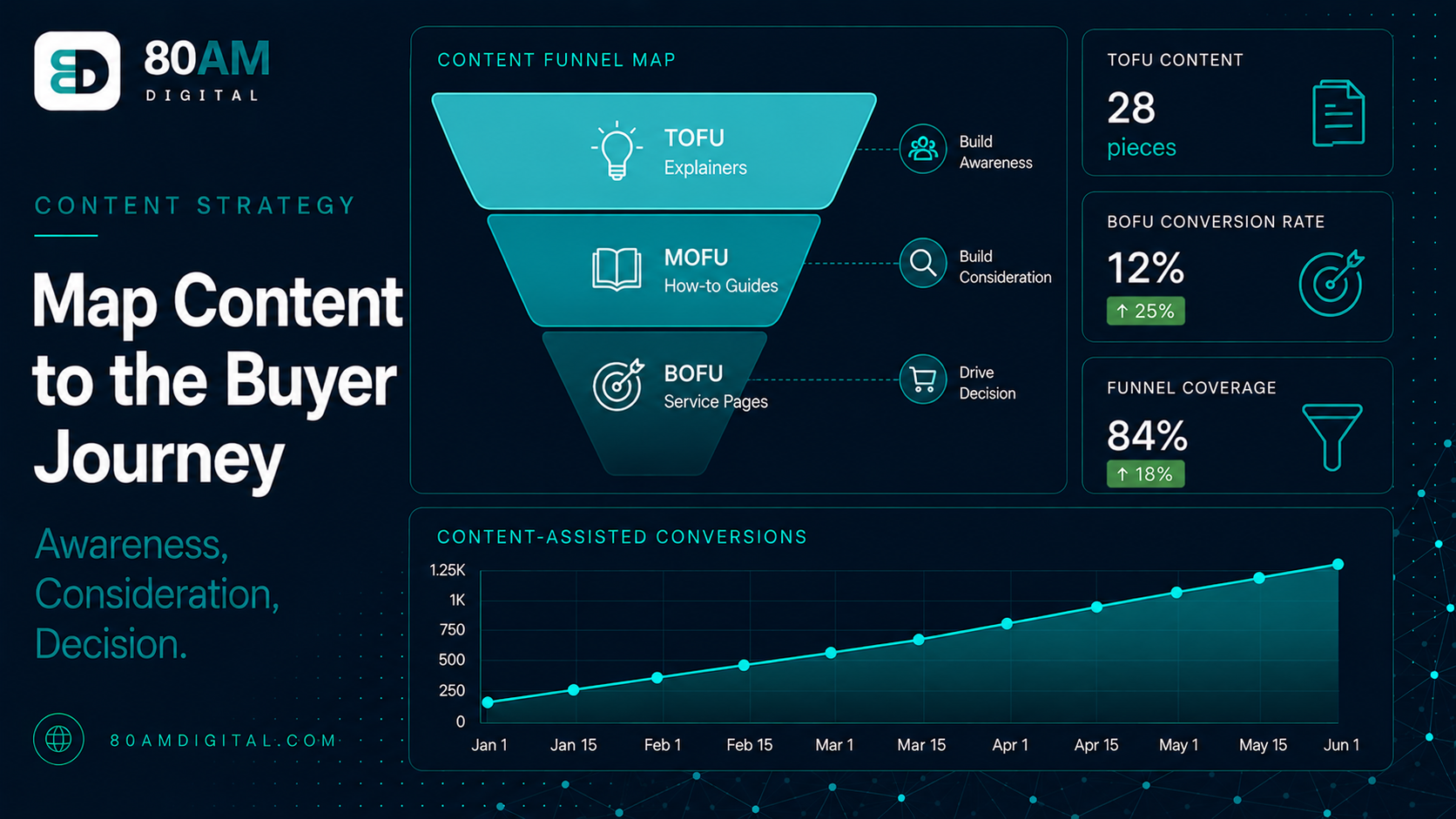
Awareness (TOFU): The buyer is experiencing a problem or has a question but hasn’t yet identified a solution category. Searches are problem-aware: “why isn’t my site getting traffic,” “how to get more organic leads,” “what is website conversion rate.” Content at this stage earns reach and builds topical authority — it’s discoverable, but it’s not directly converting anyone. The job of TOFU content: be found, demonstrate expertise, and point toward MOFU content that addresses what comes next.
Consideration (MOFU): The buyer knows what they’re looking for but is evaluating their options and approach. Searches become more specific: “how to run an SEO audit,” “content strategy for ecommerce,” “seo agency vs freelancer.” Content at this stage attracts buyers who are closer to a decision. The job of MOFU content: show your specific approach, demonstrate depth, and create enough trust that the buyer recognises you as a credible solution before they contact anyone.
Decision (BOFU): The buyer is ready to act and is making a final choice. Searches are transactional or comparative: “hire SEO consultant,” “seo audit service pricing,” “80AM Digital review.” Content at this stage is your service pages, case studies, pricing guides, and comparison pieces. The job of BOFU content: convert. Remove friction, address objections, and make the CTA clear.
Auditing your current funnel balance
Pull your full content inventory and categorise each piece by funnel stage. Look at the distribution:
- If 80%+ of your content is TOFU, you’re building awareness but have limited conversion infrastructure. Add MOFU content that connects the problem-aware searcher to your specific solution approach.
- If you have TOFU and BOFU but thin MOFU, you’re missing the consideration stage — the stage where buyers form their view of which providers are credible. MOFU content is where trust is built.
- If you have MOFU and BOFU but no TOFU, you’re only reaching people who already know they need your solution. TOFU content expands your addressable audience to the earlier-stage buyers who will eventually need it.
Making the path between stages clear
Mapping content to the buyer journey isn’t just about having content at each stage — it’s about the path between them being visible and intentional. A TOFU article that earns a visitor but has no link to a MOFU piece has no next step. A MOFU guide that covers a topic thoroughly but has no CTA or path to the service page leaves buyers without a clear action.
Every piece of content should have a deliberate next step: a link to a related MOFU piece (from TOFU), a link to the relevant service page or contact (from MOFU), or a direct CTA (from BOFU). The internal link structure should create a path through the funnel, not just a collection of disconnected articles.
For the internal linking strategy that creates this path, see the internal linking strategy playbook. For how to structure the content cluster that supports each journey stage, see topic clusters explained.
What an imbalanced funnel costs you
Diagnosing the gap from traffic and conversion data
A worked example: traffic with nowhere to go
A B2B software company had grown organic traffic significantly over 18 months through a content program almost entirely focused on broad, problem-aware topics — “what is X,” “common mistakes with Y,” “signs you need Z.” Traffic numbers looked like a clear success story. Leads did not follow at anywhere near a proportional rate. A funnel audit categorising all 140 published articles found 121 were TOFU, 14 were MOFU, and 5 were BOFU — a ratio wildly skewed toward the stage furthest from revenue.
Rather than writing more TOFU content (the team’s default instinct, since it was working for traffic), they paused new TOFU production for a quarter and built out the MOFU layer: comparison guides, methodology explainers, and “how we approach X” pieces that directly addressed what a buyer evaluating providers would want to see. They also added explicit internal links from the highest-traffic TOFU articles to the new MOFU pieces, rather than leaving those articles as dead ends. Lead volume from organic traffic increased by roughly 35% over the following quarter without any change in overall traffic — the existing TOFU audience simply had somewhere to go for the first time.
Frequently asked questions
Content that earns and converts
The goal isn’t to produce content at every funnel stage for its own sake — it’s to build a library where a buyer can enter at their current awareness level and find a clear path to becoming a client. That path is built from deliberate content mapping, strong internal linking, and BOFU pages that close the gap between interest and action.
If you’d like a funnel audit of your existing content and a plan for filling the gaps, get in touch.