Trust Signals That Actually Build Credibility
Not all trust signals work equally. Logos, awards and accreditations don’t convince buyers the way specific outcomes and transparent process do. Here’s what does.
Table of Contents
Trust signals are the elements of a website that tell a visitor “this is a real, competent, safe business to engage with.” They exist because the default stance of a visitor who finds a business through search is scepticism — they don’t know you, they’ve seen businesses that looked professional but weren’t, and they’re making a decision about spending money or sharing personal information. Trust signals exist to shift that default.
The problem: most websites use trust signals that are easy to implement and low in actual credibility value. Awards from industry bodies that give awards to anyone who applies. Logo walls featuring companies the visitor doesn’t recognise. SSL certificates (which are now standard on every website and signal nothing about the business itself). These are visible but unconvincing. The trust signals that actually move buyers to act are harder to acquire and display — which is exactly why they work.
The Short Version
- Named, quantified outcomes and independently verifiable reviews build real credibility; unrecognisable awards and uncontextualised counters don’t.
- Transparent process and pricing is itself a trust signal — vagueness reads as risk, not sophistication.
- SSL/HTTPS is table stakes and signals nothing on its own; security cues matter only at the actual decision moment (form, checkout).
- Claims without evidence don’t build trust — “leading agency” is a claim, “94 brands, 87% renewal” is evidence.
Trust signals that work (and why)
Specific, quantified client outcomes with named clients: “Northgate Outdoors grew monthly organic sessions from 3,200 to 6,200 in 11 months” is a trust signal of the highest order. It’s specific (named business, exact numbers, defined timeframe), verifiable (the buyer can look up Northgate Outdoors), and outcome-oriented (it describes what the service achieved, not what the service promises). This is more convincing than 20 unattributed testimonials and a wall of logos combined.
Third-party reviews on independent platforms: Google Business Profile reviews, Trustpilot, G2, Clutch, or similar. Third-party platform reviews carry credibility because they’re structurally harder to fake — creating fake Google reviews requires creating fake Google accounts, and the pattern of fake reviews is often visible (all 5-star, all on the same day, reviewer accounts with no other activity). A business with 40 Google reviews averaging 4.8 stars is demonstrably trusted by a real population of previous buyers.
Transparent process and pricing: Showing how you work — a clear description of the engagement process, realistic timeframes, honest scope limitations — is a trust signal because it signals you have nothing to hide. Many service businesses are vague about process because they’re afraid of being compared; buyers interpret vagueness as a risk. Transparency about process (and even about pricing) is a differentiator that builds trust while simultaneously filtering for better-fit clients.
Consistent author identity on content: Content attributed to a named, photographed person with a verifiable professional history (LinkedIn, named bio with specific experience) is more credible than unattributed content. Google’s helpful content guidelines increasingly favour demonstrated expertise — but more importantly, buyers trust individuals more than they trust anonymous brands. A named expert with a visible track record is a significant trust signal for professional services.
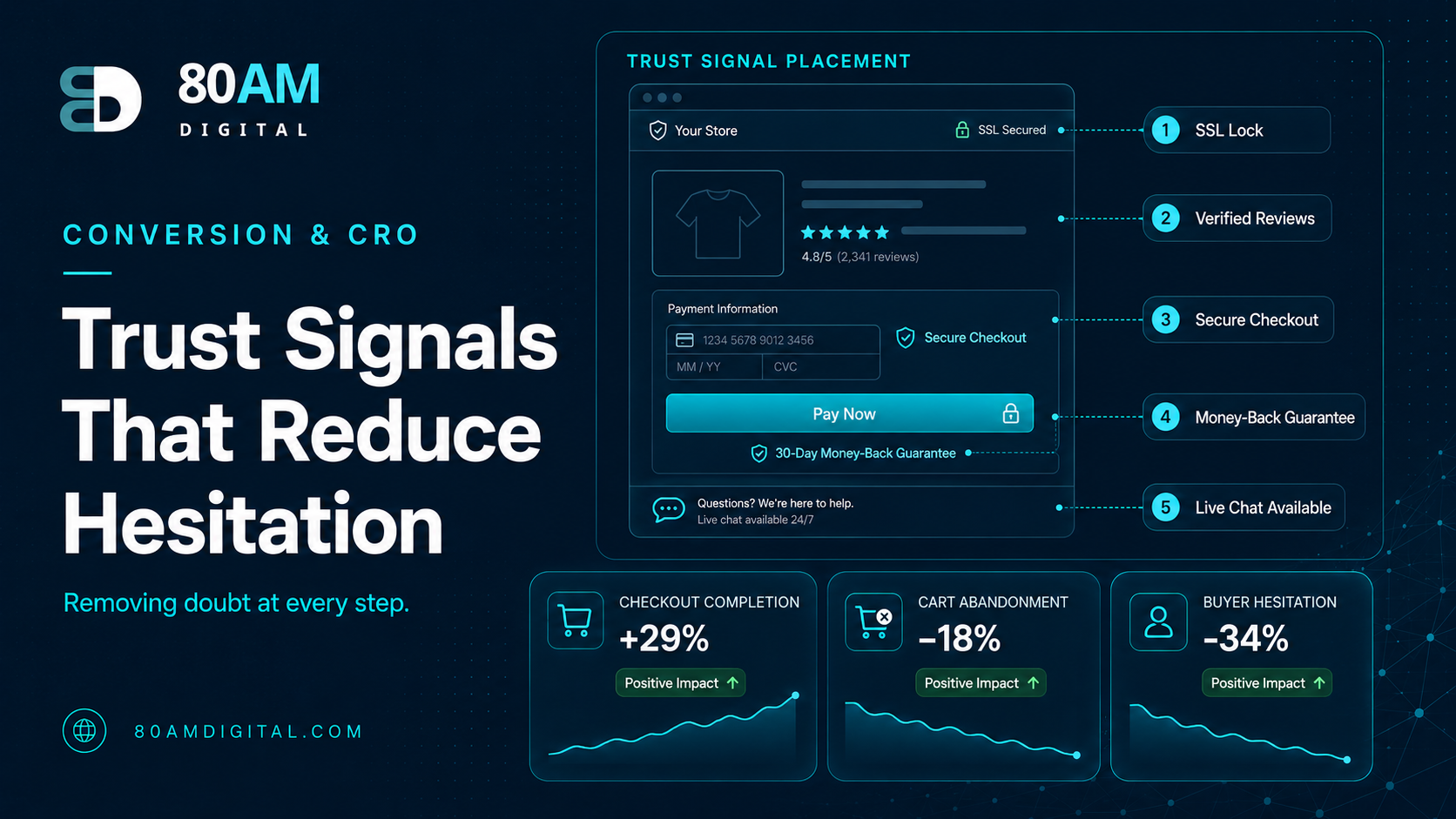
Security and data indicators at the right moment: SSL/HTTPS is table stakes and doesn’t add perceived trust. What does: a privacy note beside the email field (“we don’t share your email”); a payment processor’s seal at checkout (Stripe, PayPal); a GDPR-compliant cookie notice that confirms data isn’t being shared by default. These matter at decision moments — at the form, at checkout — not as decorative elements elsewhere on the page.
Trust signals that don’t work well
| Weak signal | Why it fails |
|---|---|
| Unrecognisable award logos | If the buyer doesn’t know the awarding body, it signals nothing |
| Generic stock photography | Buyers recognise stock photos and discount them on sight |
| Counters without context | “10,000 clients served” raises questions instead of answering them |
- Unrecognisable award logos: “Winner — Best SEO Agency 2024 — [Unknown Industry Directory]” signals nothing. If the buyer doesn’t recognise the awarding body, the award adds visual weight without adding credibility. Include only awards from bodies your target buyer would recognise independently.
- Generic stock photography of teams and offices: Visible stock photos undermine trust — buyers recognise them. Real photos of real people (even if imperfect) are more credible than polished stock images of people who obviously work in a stock photo studio.
- Counters without context: “10,000 clients served” — in how many years? At what service level? For what outcome? A large number without context can raise questions rather than resolve them. “94 ecommerce brands, average 12-month engagement, 87% renewed” is more convincing than a round number with no supporting detail.
For the specific format of high-trust testimonials, see social proof that actually converts. For how trust signals interact with your conversion flow, see traffic but no conversions.
Strong vs. weak signals at a glance
Evidence beats claims, every time
A worked example: replacing weak signals with strong ones
A professional services firm’s homepage carried an SSL badge, a “10,000+ clients served” counter with no context, and three unrecognised regional award logos. None of these were placed near the CTA, and the firm’s actual Google rating (4.9 from 63 reviews) wasn’t displayed anywhere on the site. Direct-traffic conversion sat at 2.1%.
The firm removed the SSL badge and award logos, replaced the counter with “94 clients in the last 3 years, 87% renewal rate,” and added the Google rating with review count directly above the contact form, plus one named case study with quantified results above the fold. No other page changes were made. Over the following two months, direct-traffic conversion rose to 3.6% — driven by replacing decorative, unverifiable signals with specific, checkable ones placed at the actual decision points.
Frequently asked questions
Build trust by showing evidence, not making claims
The fundamental rule of trust signals: claims without evidence don’t build trust. “We’re the leading SEO agency” is a claim; “94 brands, 11-month average engagement, 87% contract renewal rate” is evidence. The latter tells a buyer far more about what it’s like to work with you — and it does so without requiring them to take your word for it. Shift your trust-signal strategy away from self-description and toward verifiable evidence, and the credibility of your site will improve in proportion.
If you’d like help auditing and strengthening the trust signals across your key pages, get in touch.