Social Proof That Actually Converts (and What Doesn’t)
A wall of logos rarely convinces anyone. Learn which kinds of social proof — specific results, real testimonials, proof of use — actually move buyers to act.
Table of Contents
Most social proof on most websites is there because the designer needed something to fill a section. A row of blurred-out logos. A three-star review with no reviewer name. A testimonial that says “Great to work with! 10/10 would recommend” without saying what was being recommended or why. These are social proof by category but not by function — they’re visible, but they convince no one.
Social proof works when it’s specific. The specificity is the proof. Vague praise signals nothing; specific outcomes from named people who had a specific problem signal that the thing you’re selling produces measurable results for real people.
The Short Version
- Named, quantified case studies convert best; vague testimonials and unattributed quotes convince almost no one.
- Most clients will give a testimonial if asked — the limiting factor is specificity, not willingness. Ask three structured questions, not one open-ended one.
- Place proof at points of hesitation (near the CTA, near price) rather than at the top of the page before any hesitation has built.
- Segment proof by buyer type — a testimonial from a comparable business is more persuasive than a generic one, even if the generic one is “better.”
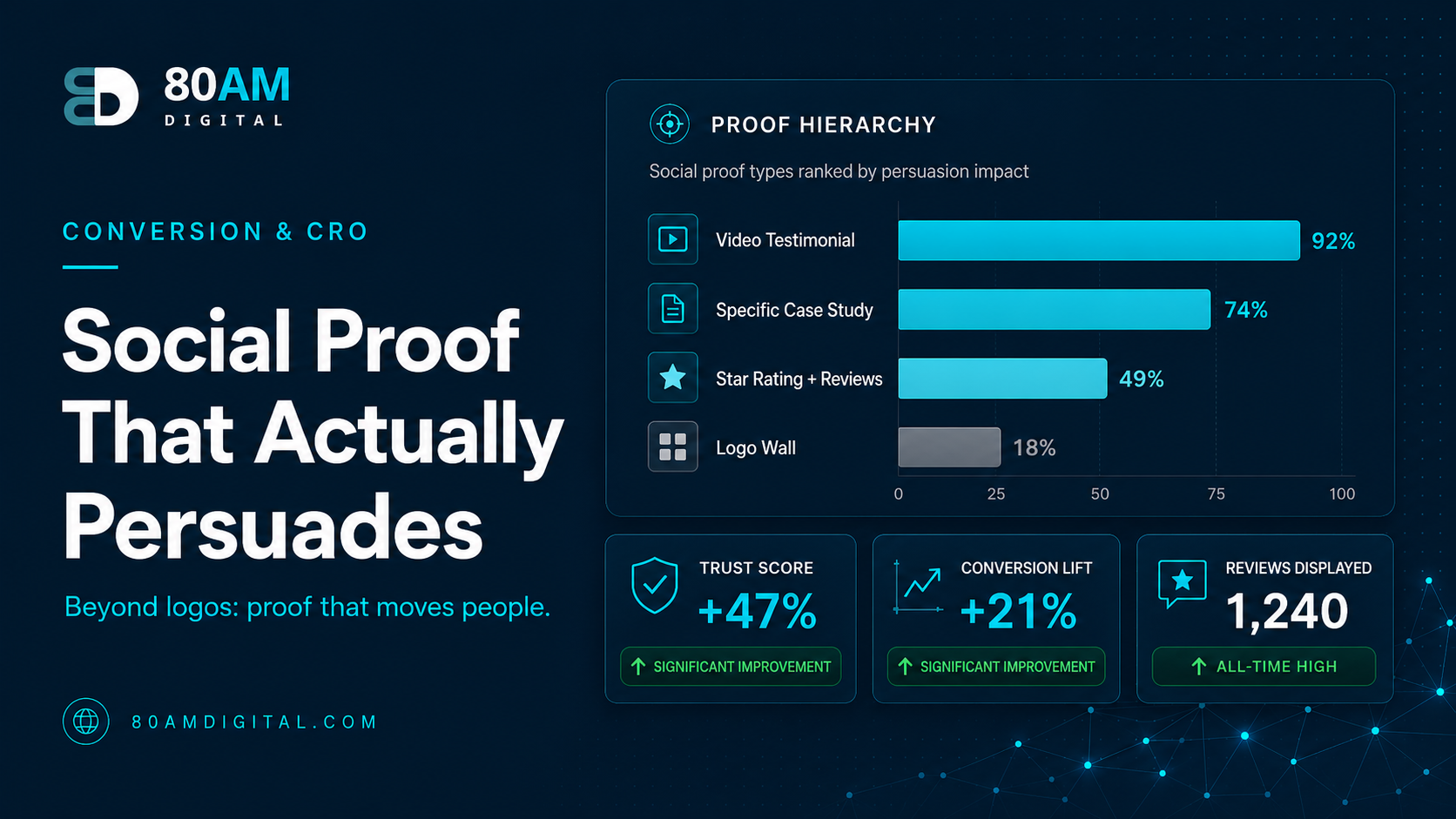
The hierarchy of social proof effectiveness
Not all social proof is equal. From most to least effective:
| Format | Why it converts (or doesn’t) |
|---|---|
| 1. Named, quantified case study | Verifiable, specific before/after with a real business name |
| 2. Named testimonial, specific problem/outcome | Real person, specific detail, tied to the provider |
| 3. Platform review with real account | Independent and harder to fabricate |
| 4. Usage statistics | Useful only if specific and well-defined |
| 5. Logo wall | Weakest alone — works best when logos match the buyer’s category |
- Named case study with specific, quantified results: “Northgate Outdoors grew organic revenue 94% in 11 months — from 3,200 to 6,200 monthly sessions, with the same team.” This is the highest-trust format because it names the business, quantifies the before and after, and specifies a timeframe. It can be verified. It answers the implicit question “will this work for a business like mine?” directly.
- Named testimonial with a specific problem and specific outcome: “We’d tried two other agencies. Adam found the crawl budget issue inside the first two weeks that both of them had missed — and rankings started recovering within a month.” This quotes a real person, describes the specific problem, and ties the outcome to the provider. The specificity makes it credible.
- Platform review (Google, Trustpilot, G2) with a specific account: Third-party hosted reviews carry independent credibility because they appear to be harder to fabricate. A Google review from a real Google account for a service business adds trust that a testimonial on the company’s own site doesn’t quite match.
- Usage statistics (“Trusted by 1,200 brands”): Useful if the number is large and the category is well-defined. Less useful if it’s not contextualised — “used by 1,200 brands” is more convincing than “used by thousands of businesses.”
- Logo wall: Recognisable logos establish that the provider has worked with credible organisations. The effect is strongest when the logos are recognisable to the target buyer; a logo wall of Fortune 500 companies impresses enterprise buyers and may alienate SMB buyers who assume the service is priced for large organisations.
Getting testimonials that are worth publishing
The limiting factor on effective social proof is usually not willingness — most satisfied clients will provide a testimonial if asked. The limiting factor is specificity. Most unsolicited testimonials are vague (“Great work, highly recommend”) because the client doesn’t know what specific information would be useful. You have to ask for it.
The three-question testimonial request produces better material than an open-ended ask:
- What was the specific problem or situation you hired us to solve?
- What result did you get, and can you put a number on it?
- What would you say to someone who was considering working with us?
Questions 1 and 2 produce the specific material. Question 3 produces the closing endorsement. You can then assemble the response into a structured testimonial that starts with the problem and ends with the recommendation — which is far more persuasive than the answer to question 3 alone.
Where to place social proof
Social proof placed at points of hesitation converts better than social proof placed at the beginning of a page before any hesitation has built. The highest-value placements:
- Immediately above or below the primary CTA: The moment the visitor is deciding whether to click is the moment they most need reassurance that others have clicked and benefited.
- Adjacent to price or commitment: If the page shows a price or asks for a significant commitment, a specific testimonial from someone in a comparable situation reduces the perceived risk.
- In the same category as the visitor’s own situation: A testimonial from “a 12-person B2B SaaS company” is more persuasive to a 12-person B2B SaaS company than a testimonial from an enterprise retailer. Segment your social proof if you serve different types of buyers and show each type the proof most relevant to them.
For the full audit of what’s stopping conversions, see traffic but no conversions. For the technical side of trust signals in combination, see trust signals that actually build credibility.
Strong vs. weak proof, at a glance
What the specificity test catches
A worked example: rewriting one testimonial
An agency’s services page carried this testimonial: “Working with the team was a great experience. Highly recommend to anyone looking for SEO help.” It sat below the hero, attributed only to “E-commerce Client.” No data showed it specifically helped, but the page’s conversion rate on a 3,000-visit sample was 1.6%.
The agency went back to the same client with the three-question request and rebuilt the quote: “We’d lost 40% of our organic traffic after a Google update and didn’t know why. The team found a canonical tag issue within the first audit that three previous consultants had missed. Traffic recovered past pre-drop levels within 10 weeks. If you’re stuck after an algorithm update, this is who I’d call.” — attributed to “Sarah Chen, Marketing Director, Northgate Outdoors,” placed directly above the page’s CTA. Over the following two months, conversion rate on the same traffic source rose to 2.9% — nearly double, from rewriting one testimonial with specifics and moving it next to the decision point.
Frequently asked questions
Specificity is the proof
The goal of social proof is to make the conversion feel safe — to show the visitor that people in their situation have taken this action and benefited. Generic praise doesn’t accomplish this because it doesn’t describe any particular situation or outcome. Specific results from named clients in a comparable situation makes the evidence feel real, applicable, and trustworthy. That’s the standard to apply to every testimonial and case study before publishing it: does this prove anything specific?
If you’d like help structuring your case studies and testimonials for conversion, get in touch.