Message Match: When Your Landing Page Needs to Echo the Ad or Link That Sent Traffic There
Message match is the degree to which your landing page echoes the specific promise that brought the visitor there. When it breaks, conversions drop. Here’s how to fix it.
Table of Contents
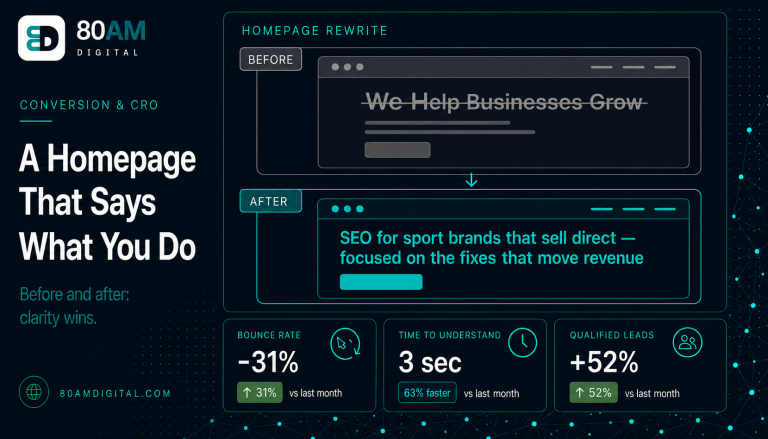
Message match is the degree to which a landing page’s headline, subheadline, and first impression echo the specific promise or claim that brought the visitor to the page. When a visitor clicks an ad that says “SEO audits for B2B SaaS companies” and lands on a generic homepage that says “We grow businesses through digital marketing,” something breaks — the visitor’s expectation was set by the ad, the page doesn’t confirm it, and the default response is to go back and try the next result.
Message match is one of the most consistently impactful conversion variables, particularly for paid traffic. It’s also one of the most common problems on organic landing pages, where a page may rank for one intent but be written for another.
The Short Version
- The landing page headline should mirror the specific claim that brought the visitor there — in paid search that’s the ad copy, in organic it’s the search query intent.
- Three levels exist: category match (broadly right topic), specific match (the exact offer), and intent match (structured for where the visitor is in their decision).
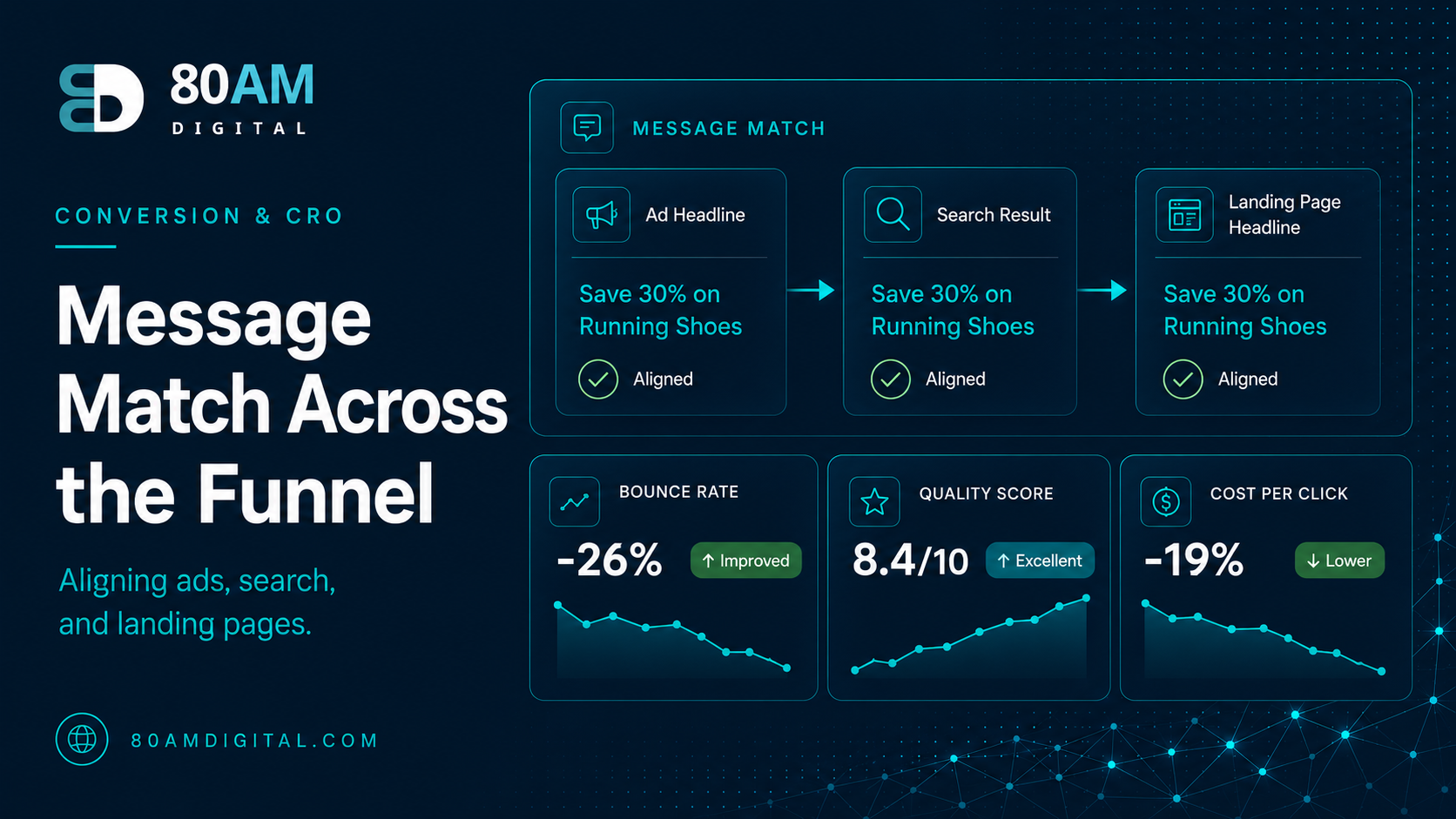
- In Google Ads, message match directly affects Quality Score — and therefore cost per click, not just conversion rate.
- A dedicated landing page typically converts 2-5x better than a homepage for paid traffic, because it can match the specific promise the homepage can’t.
Message match in paid search
In paid search, message match means the headline on the landing page closely mirrors the ad copy. If the ad says “Custom Shopify SEO Audits — Book a Free Audit,” the landing page headline should be “Custom Shopify SEO Audit” or something closely equivalent — not “Digital Marketing Services” or even the broader “SEO Services.” The visitor is in a specific mental state when they click: they want exactly what the ad described. Every degree of drift between ad copy and landing page headline costs conversions.
Dynamic keyword insertion (DKI) in Google Ads allows ad headlines to match the search query automatically. The equivalent on the landing page is dynamic text replacement — tools like Unbounce and Instapage allow the page headline to be updated based on which ad or UTM parameter sent the visitor. For high-volume campaigns, dynamic landing pages can materially improve Quality Score (which affects CPC) and conversion rate simultaneously.
Message match in organic search
In organic search, message match means the page’s H1 and opening paragraph directly address the intent of the queries that send traffic to it. A page that ranks for “how to fix slow WordPress site” but opens with a sales pitch for the company’s WordPress maintenance service has a message match problem — the visitor came for a how-to, not a pitch. They’ll leave.
Check message match for organic pages by going to Search Console → Performance → Pages, selecting the pages with high impressions but low CTR or high bounce rates, and checking which queries are sending traffic. If the queries are informational (“how to,” “what is,” “why does”) and the page opens with a commercial pitch, the message match is broken. If the queries are commercial (“hire,” “price,” “best”) and the page opens with a generic educational introduction, the match is broken in the other direction.
Three levels of message match
| Level | What it requires | When it’s enough |
|---|---|---|
| Category match | Page is broadly about the right topic | Rarely sufficient alone for high conversion |
| Specific match | Page addresses the exact offer/claim, visible in the headline | The target for most paid traffic |
| Intent match | Page is structured for the visitor’s decision stage | Highest level — comparison tables for researchers, strong CTA for buyers |
- Category match: The page is broadly about the right thing. A visitor who clicked an ad for “SEO services” lands on a page about SEO. This is the minimum and often not sufficient for high conversion rates.
- Specific match: The page addresses the specific offer or claim in the source. A visitor who clicked an ad for “technical SEO audit for ecommerce” lands on a page specifically about technical SEO audits for ecommerce stores, with that phrase visible in the headline. This is the target for paid traffic.
- Intent match: The page not only addresses the specific topic but is structured for the right intent. A visitor in “compare options” mode lands on a page with a comparison table; a visitor in “ready to buy” mode lands on a page with a strong CTA above the fold. Intent match is the highest level and the hardest to achieve at scale without personalisation.
For the landing page structures that work at each intent level, see the landing page teardown. For how organic intent alignment affects conversion from search traffic, see traffic but no conversions.
What breaking message match costs you
A conversion problem and a cost problem
A worked example: one ad, one rewritten headline
A B2B SaaS company ran a Google Ads campaign with the headline “Inventory Forecasting for Multi-Warehouse Retailers,” sending all clicks to the homepage headlined “Smarter Supply Chain Software for Modern Businesses.” Quality Score sat at 5/10, CPC was high for the company’s target keywords, and landing page conversion rate was 1.1%.
The team built a dedicated landing page headlined “Inventory Forecasting Built for Multi-Warehouse Retailers” — near-verbatim match to the ad — with a subheadline naming the specific pain point the ad implied (stockouts and overstock across locations) and a single CTA. No other campaign settings or bids changed. Within three weeks, Quality Score rose to 8/10, average CPC fell by roughly 20% for the same keywords, and landing page conversion rate rose to 3.8% — a combined effect of paying less per click and converting more of the clicks that arrived.
Frequently asked questions
The visitor arrives with an expectation. Match it.
Every visitor who arrives on your site has formed an expectation based on what sent them there — the ad, the SERP snippet, the email subject line, the social post. That expectation is set before they see the page. The page’s job is to confirm it, immediately, before anything else. When it does, the visitor is oriented and can move toward conversion. When it doesn’t, the visitor is disoriented and leaves. Message match is that simple — and that important.
If you’d like help auditing message match across your organic and paid landing pages, get in touch.