Programmatic SEO: When It Works and When It Backfires
Programmatic SEO can win at scale—or get you flagged for scaled content. Learn when templated pages add value, and when they cross into spam territory.
Table of Contents
Programmatic SEO is the practice of generating large numbers of pages from a database or template — combining a consistent structure with variable data inputs to target thousands of keyword variations at once. A tool directory with 10,000 integration pages, a real estate site with listing pages for every postcode, a finance comparison site generating a unique page for every credit card vs. every rival card. Done correctly, it’s extraordinarily scalable. Done poorly, it produces exactly what Google’s helpful content systems are designed to demote: thin, templated content with no original value.
Understanding when programmatic SEO works — and when it crosses into scaled spam — is the critical judgment call.
The Short Version
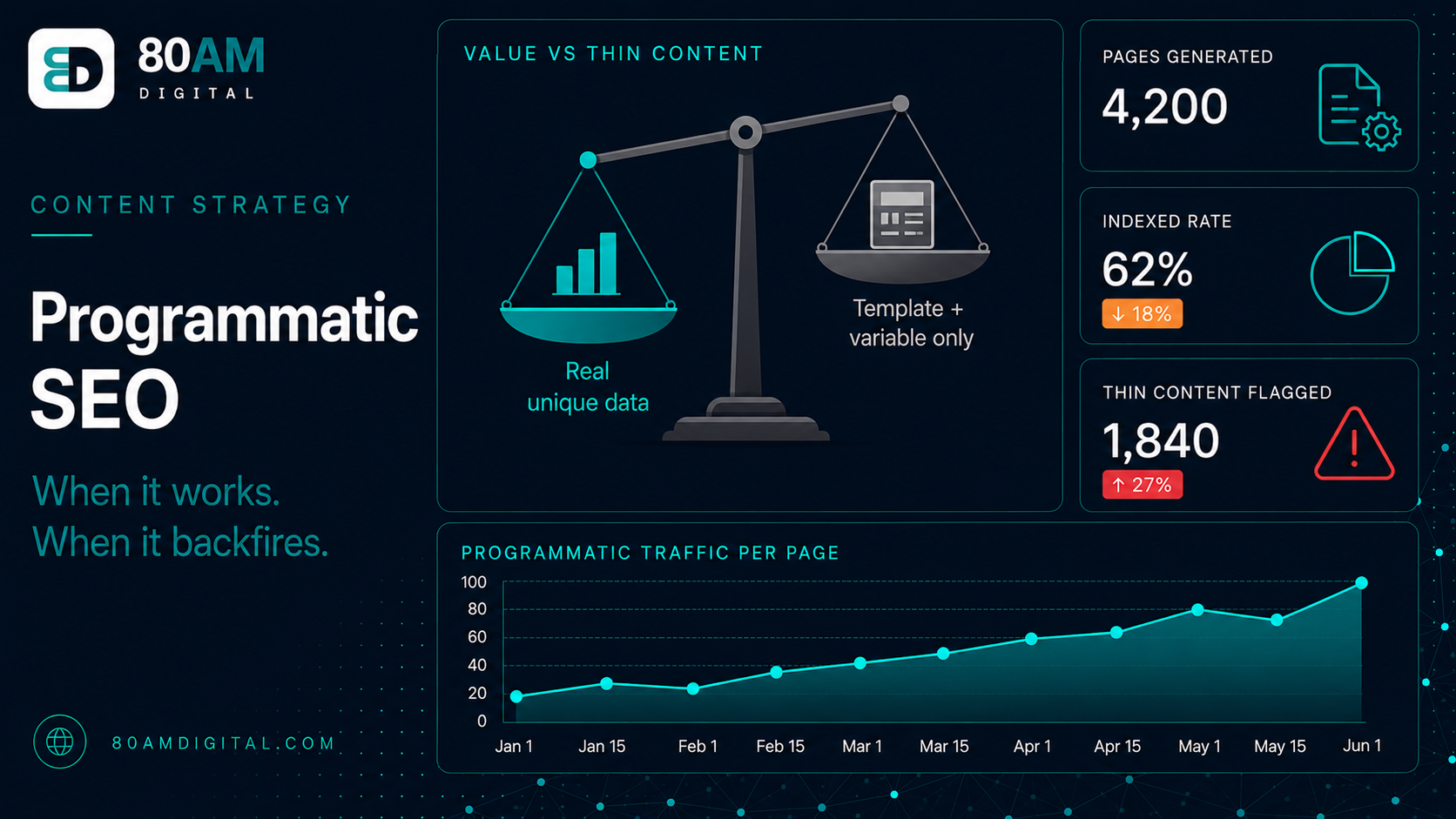
- Programmatic SEO works when real, unique data backs each page — the value comes from the data, not the template.
- Google’s helpful content systems specifically target “scaled content abuse” — large volumes of near-duplicate pages with only a swapped variable.
- The test: would a searcher landing on this specific page be meaningfully better informed than on a competitor’s page about the same topic?
- AI doesn’t change the quality bar — it changes production cost. Thin AI-generated programmatic content is demoted just as readily as thin manual content.
When programmatic SEO works
Programmatic SEO earns rankings when the generated pages have genuine, unique value to the searcher — not just variable text in a template.
The conditions for success:
- Real data backing each page: Zillow’s neighbourhood pages work because each one contains real, unique listing data, pricing history, and school ratings for that specific location. The value comes from the data, not from the template.
- High query volume across variations: “Best [tool] alternatives,” “[City] + [service provider],” “[Product A] vs [Product B]” — patterns where large numbers of specific queries exist and searchers genuinely want unique answers to each variation.
- Sufficiently differentiated pages: Each generated page must be meaningfully different from the others in the set. If the only thing that changes between pages is the variable (city name, product name, integration name) and everything else is identical, the pages are thin duplicates.
- Pages that match the query intent: Programmatic pages ranking for transactional or informational queries need to satisfy that intent. A page generated for “plumber in Manchester” that doesn’t actually provide Manchester plumber listings doesn’t satisfy the query — it just targets the keyword pattern.
When it backfires
Google’s March 2024 core update and its ongoing helpful content systems specifically targeted “scaled content abuse” — large quantities of pages generated primarily to rank for keyword variations rather than to help searchers.
| Works | Backfires |
|---|---|
| Real, unique data per page | Swapped variable only (“best tools for [city]” with no city-specific content) |
| Original analysis or curation | Aggregated public information with no added perspective |
| Differentiated content per page | Thousands of near-duplicate pages with minimal text variation |
| Built to satisfy the searcher | Built to pass a crawl test, useless to an actual reader |
Sites that were ranking on scaled thin content before the 2024 updates saw significant traffic losses. Recovery from a scaled content action requires removing or substantially improving the low-quality pages — which, at scale, can be a significant undertaking.
The programmatic SEO test
Before building a programmatic content system, apply this test to a sample page: if someone searches for the specific query this page targets and lands on it, are they meaningfully better informed than if they’d landed on a competitor’s page about the same topic? Does the page contain information that couldn’t be found more usefully elsewhere?
If yes: the programmatic approach has merit. If no: the pages are thin and the risk of algorithmic demotion is high. The distinguishing factor is always whether the generated content serves the searcher or just targets the keyword.
For how content quality signals interact with broader site quality, see people-first content. For the content strategy that doesn’t rely on scale, see how to build a content engine that compounds.
What kind of data actually supports this
Good candidates have this in common
A worked example: 8,000 pages, one quality bar
A B2B software comparison site generated roughly 8,000 “[Tool A] vs [Tool B]” pages from its product database, using a template that pulled in feature lists, pricing tiers, and integration counts for each pairing. Early pages performed well because the underlying database genuinely had unique, structured data per product. But as the team expanded coverage to lower-traffic tool pairings with sparse database entries, a growing share of pages ended up with near-identical generic text padding around thin or missing data fields — the template still rendered, but the actual page content for those pairings was barely differentiated from one tool comparison to the next.
Rather than waiting for an algorithmic correction, the team ran their own audit using the page-by-page test: for each tool pairing, did the page contain enough real data to be meaningfully useful, or was it mostly template filler? Roughly 1,200 of the 8,000 pages failed the test outright. Those were noindexed and removed from the sitemap rather than left live, while the underlying database was prioritized for backfilling missing data on pairings with genuine search demand before re-indexing them. The remaining ~6,800 pages, all backed by sufficient real data, continued performing without disruption — the cleanup targeted the specific weak segment rather than treating the whole programmatic system as suspect.
Frequently asked questions
Scale only works when value scales with it
Programmatic SEO is a genuine growth strategy for the right businesses with the right data. For everyone else, it’s a shortcut that leads to a thin content library, algorithmic demotion, and the considerable effort of cleaning it up. The question to answer before building: is the value of each page scaling with the volume — or is only the volume scaling?
If you’re considering a programmatic SEO approach and want a second opinion on whether the opportunity is real, get in touch.