Writing People-First Content That Still Ranks After Google’s Updates
Google’s recent updates reward original, people-first content and punish scaled sameness. Learn how to write for readers and still rank in 2026.
Table of Contents
Google’s series of helpful content updates since 2022 have done one thing consistently: demote content that exists primarily to rank rather than primarily to help. The sites that lost the most traffic weren’t producing deliberately bad content — they were producing content that was technically correct but ultimately generic: well-structured, keyword-rich, and completely interchangeable with hundreds of similar pages.
People-first content is a specific approach that produces pages Google has explicitly stated it wants to surface. This guide explains what it means in practice — not as a philosophy, but as a set of concrete decisions about what to write, how to structure it, and what signals demonstrate genuine expertise.
The Short Version
- Ask the test question honestly: would this content exist if it weren’t intended to rank? If no, it’s search-first, not people-first.
- Google doesn’t evaluate intent directly — it reads engagement and E-E-A-T signals that correlate with genuine quality, and those can’t be faked with surface tweaks.
- AI-assisted content isn’t penalised by default — generic, unedited, mass-produced content is, regardless of whether AI was involved.
- Recovery from a helpful-content hit requires substantive rewrites, not incremental edits — partial improvements tend to produce partial recovery.
What “people-first” actually means
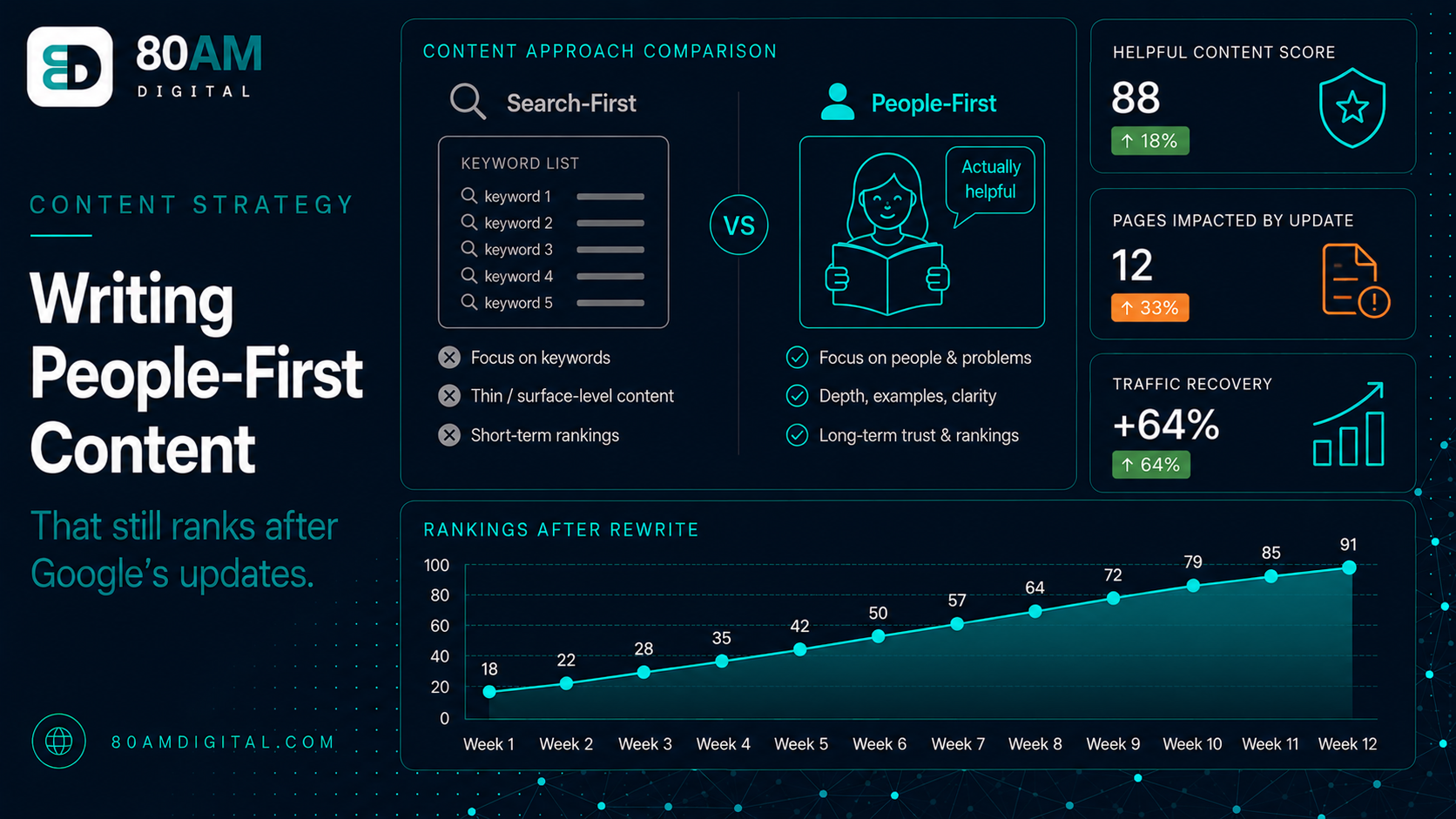
Google’s guidance on people-first content comes down to a central question: would this content have been written if it weren’t intended to rank in search? If the honest answer is no — if the content exists because a keyword gap was identified, not because the writer had something genuinely useful to say — the content is search-first, not people-first.
People-first content shares three consistent characteristics:
- Original perspective or information: It includes something the reader couldn’t easily find by visiting the five other pages currently ranking — a specific example from real experience, a contrarian take with actual reasoning behind it, data gathered by the author, or a framework developed through practice
- Demonstrated experience: The content shows evidence that the author has actually done the thing being described, not just researched it. Specific examples, caveats from real situations, and acknowledgement of cases where the general advice doesn’t apply are all signals of genuine experience
- Reader-first structure: The organisation of the content follows what the reader needs to understand, not what produces the best keyword density or the most heading tags. Sometimes that means addressing the reader’s likely objections before the core argument. Sometimes it means starting with a counterintuitive claim that the content then supports
What the updates have targeted
Understanding what Google is penalising makes it easier to understand what to avoid. The content that’s lost the most ground in recent updates has several patterns in common:
| Pattern | Why it gets demoted |
|---|---|
| Scaled generic content | Large volumes produced at speed without genuine expertise — factually accurate but interchangeable, and Google increasingly detects interchangeability at scale |
| Content written for a topic, not a reader | Comprehensive from an information-architecture view but doesn’t reflect why a specific person searched, or what decision they’re trying to make — “information satisfying” but not “need satisfying” |
| AI-generated content with no editorial value added | Not AI itself, but unedited, generic output — mass production without the original perspective an edit would add |
How to write people-first content in practice
Start with what you actually know
Before researching what’s ranking, write down what you know about the topic from direct experience. What do you know that isn’t obvious? Where does the conventional advice fall short? What would you tell a specific person, not a general audience, if they asked you about this?
That’s your differentiation layer. The research and structure come after — but the content that earns both rankings and trust has that layer of original perspective as its foundation.
Identify the reader’s actual situation
People-first content speaks to a specific reader in a specific situation, not to a general audience with a general interest. “Someone researching keyword research” is too broad. “A founder with a 6-month-old SaaS who has just hired their first content writer and is trying to set a content strategy” is a specific person whose needs, prior knowledge, and specific blind spots you can address.
The more specifically you can identify who is reading and why, the easier it is to write content that serves them — and the more likely the engagement signals (time on page, low bounce rate, return visits) are to reinforce the rankings the content earns.
Include signals of genuine experience
The E-E-A-T framework’s first “E” — Experience — is where many sites’ content falls short. Experience signals look like:
- Specific examples from real situations (“We’ve seen this pattern on sites with over 500 pages — below that threshold, the issue is usually different”)
- Acknowledgement of when general advice doesn’t apply (“This approach works well for service businesses with clear conversion goals; for media sites, the conversion path is different”)
- Caveats and tradeoffs that only someone who’s done the thing would know (“The quickest fix is X, but it has a side effect of Y that most people don’t anticipate”)
These signals don’t have to be elaborate. A single specific, accurate caveat demonstrates more genuine expertise than three paragraphs of generic explanation.
For more on how to build a content system that produces genuinely useful content consistently, see how to build a content engine that compounds.
What recovery actually looks like
What separates partial from full recovery
A worked example: the same topic, two very different pages
Two competing B2B service sites each published a page on “how to choose a fulfillment partner” within a few months of each other. The first was structurally comprehensive — covering selection criteria, pricing models, and a checklist, all factually accurate and well-organized, written by an agency content team that researched the topic for the assignment. The second, from a smaller competitor, was shorter and less polished, but included specific dollar figures from the company’s own switching experience, a paragraph candidly explaining a mistake they’d made evaluating a previous partner, and a caveat about when a 3PL makes more sense than a dedicated fulfillment partner — something the first page didn’t address at all because the writer had no first-hand basis to know it mattered.
Over the following two core update cycles, the shorter, rougher page gradually outranked the more polished one for several of the target queries, despite worse on-page optimization by conventional metrics (slightly thinner content, fewer headings, no schema markup). The team that wrote it hadn’t optimized for any helpful-content signal directly — the original perspective was simply a byproduct of writing from real experience rather than research, which is exactly the distinction Google’s guidance describes.
Frequently asked questions
People-first is a standard, not a style
People-first content doesn’t require a particular tone, format, or length. It requires that every page was made by someone with genuine knowledge of the topic, for a specific person who needs that knowledge, with the goal of actually helping them — not ranking for a keyword.
That’s a higher standard than most content programmes have been held to. But it’s also a more sustainable one — because content that genuinely helps readers earns the signals that protect it through algorithm changes, rather than content that was optimised for signals without the substance to back them up.
If you’d like help auditing your content library for people-first quality signals and identifying which pages need the most attention, see how we approach content strategy.