Turning One Teardown Into a Month of Content
One in-depth teardown can fuel a month of posts, emails and social. Learn how to atomize a single flagship piece into a content cycle without diluting it.
Table of Contents
The teardown — a detailed, original analysis of a real example (a homepage, a landing page, a campaign, a competitor’s content strategy) — is one of the most efficient investments a content programme can make. It requires research and genuine editorial effort once. That effort then generates multiple distinct outputs: the long-form piece itself, focused derivative posts, email content, social posts, and quote cards. Done correctly, one teardown feeds a content calendar for four to six weeks without diluting the original or repeating yourself.
Here’s how to extract maximum value from a single flagship piece.
The Short Version
- Pick flagships with high “atomic density” — many discrete, citable observations, not one long argument — teardowns and original research atomise best.
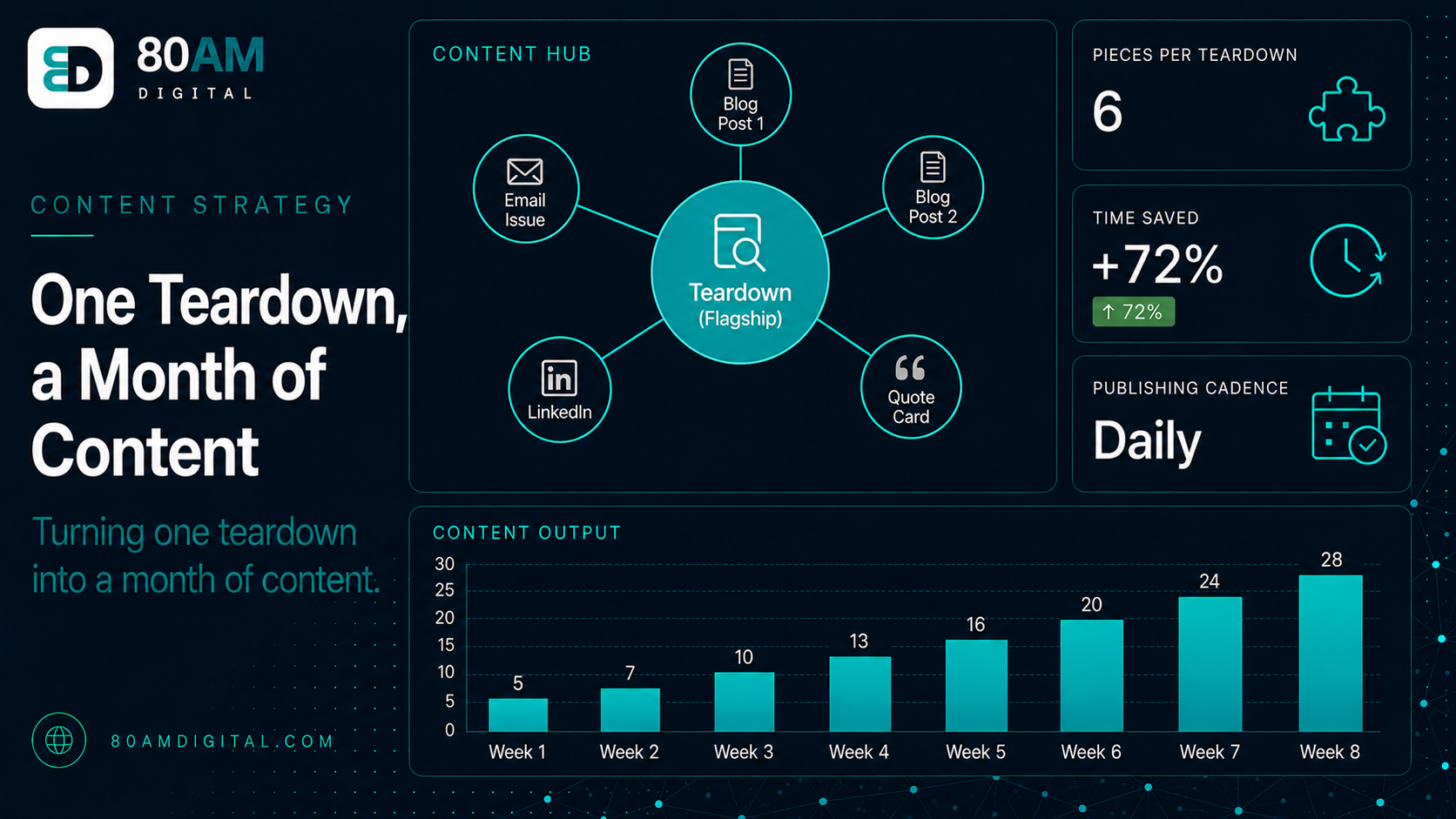
- One 2,000-word teardown can reliably produce the flagship post, 2-3 derivative posts, a newsletter issue, 4-6 social posts, and a quote card.
- Atomisation isn’t copy-paste into a new format — each derivative must be genuinely suited to its channel, not an excerpt that needs the original for context.
- SEO risk only exists for near-duplicate content published on your own domain — off-site repurposing (email, social) carries no SEO penalty.
Start with a high-value flagship
Not every piece is worth atomising. The teardown that produces the most derivative content is one that:
- Contains original observation — something your team noticed, identified, or analysed that doesn’t exist in generic articles on the same topic
- Has multiple discrete components that can be extracted as standalone points — a teardown of a landing page that covers 8 distinct elements produces 8 extractable atomic units
- Covers a topic with genuine audience interest — not just broad content, but something your specific audience has questions about
The landing page teardown format works particularly well because it’s naturally structured: a page has a headline, a subheadline, a hero image, social proof, an offer, objection handling, and a CTA — each of which can be extracted and discussed independently.
The atomisation map
From a single 2,000-word teardown, a typical atomisation produces:
| Output | Timing | Source |
|---|---|---|
| Flagship long-form piece | Week 1 | The full teardown, published in detail |
| 2-3 derivative short pieces | Week 2-3 | Each expands one element of the teardown |
| Email newsletter issue | Week 2 | The single most important insight, written for email |
| 4-6 social posts | Week 1-4 | One per atomic observation in the teardown |
| Quote card / visual | Week 3-4 | The single most quotable takeaway |
- The flagship long-form piece (Week 1): The full teardown published as a detailed blog post or standalone page — this is the original, SEO-optimised piece that earns organic traffic over time
- Two to three derivative short pieces (Week 2–3): Each one takes a single element from the teardown and expands it — “Why this landing page’s headline works (and how to write yours)” drawn from the headline section of the teardown; “The proof strip pattern that builds trust without testimonials” from the social proof section. These can be standalone blog posts or long-form LinkedIn posts depending on your distribution channels.
- An email newsletter issue (Week 2): A summary of the most important insight from the teardown, written directly for the email format — shorter, more direct, with a link to the full piece for those who want the depth.
- Four to six social posts (Week 1–4): Each atomic observation from the teardown works as a standalone social post. “The headline on this landing page does three things at once: [example]” — one post per observation, each with a link back to the full teardown.
- A quote card or visual (Week 3–4): A single takeaway formatted as a shareable image — the most quotable insight from the teardown, designed to be shared without requiring the full-piece context.
What atomisation isn’t
Repurposing isn’t reposting the same text in a different format. A social post that’s just the first paragraph of the blog post isn’t atomisation — it’s copy-paste that provides no additional value to the audience who saw the original. Each derivative piece should be genuinely suited to its format: the email version should read like an email, not a condensed blog post; the social post should work as a standalone observation, not an excerpt that requires the article for context.
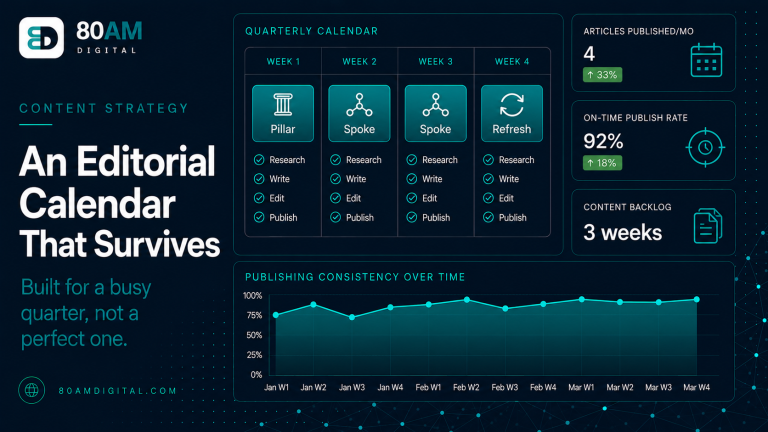
For the broader content planning system, see the editorial calendar and how to build a content engine that compounds.
What one flagship typically yields
From one 2,000-word teardown
A worked example: one landing-page teardown, four weeks
A B2B software company tore down its own pricing page redesign after a successful conversion test, covering eight elements: headline, plan framing, the comparison table, the FAQ placement, the trust-logo strip, the CTA copy, the annual/monthly toggle, and the exit-intent offer. The flagship post (2,100 words) published in week 1, alongside the first social post quoting the headline finding.
In weeks 2 and 3, two derivative posts went out — one expanding on the comparison-table redesign (which had the single biggest measured impact), one on the FAQ placement change — plus a newsletter issue summarising the conversion lift and linking back to the flagship. Five more social posts followed through week 4, each quoting one of the remaining six elements, and a single quote card highlighting the toggle-design finding ran on LinkedIn in week 3. Total new writing time after the flagship: roughly six hours across three weeks, for ten additional pieces of distributed content.
Frequently asked questions
One good piece, many touchpoints
The teardown-and-atomise model doesn’t shortcut the work of producing quality content — it multiplies the return from the work you’ve already done. The effort goes into the flagship. The calendar fills from the atoms. And the audience sees your thinking from multiple angles, through multiple formats, over multiple weeks.
If you’d like help planning a content teardown strategy that fits your editorial resources, get in touch.