Topic Clusters Explained: Pillars, Spokes and Internal Links
Topic clusters organize content into pillars and supporting posts that link together—building topical authority that ranks and earns AI citations. Here’s how.
Table of Contents
Google doesn’t rank individual posts anymore — it ranks sites that demonstrate authority on a subject. Topic clusters are how you build that authority deliberately, rather than hoping it accumulates from publishing enough content over time.
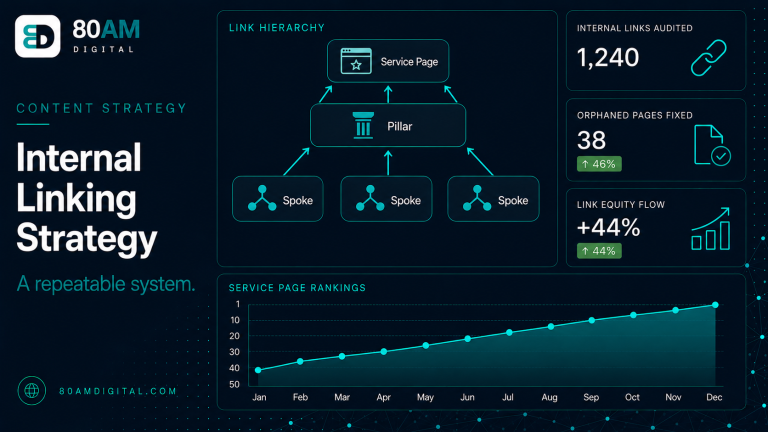
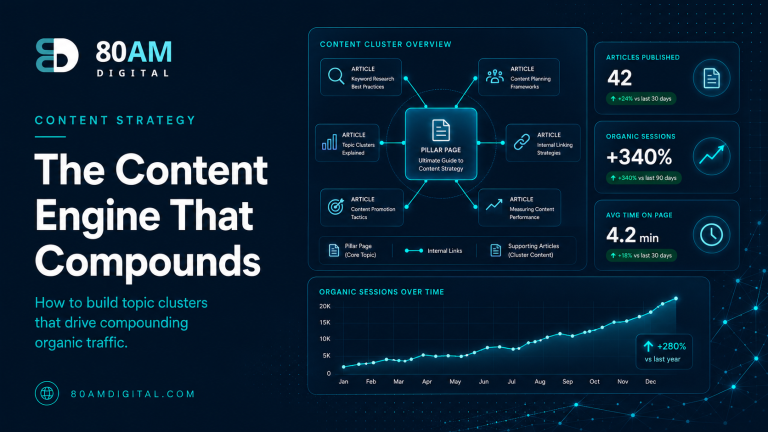
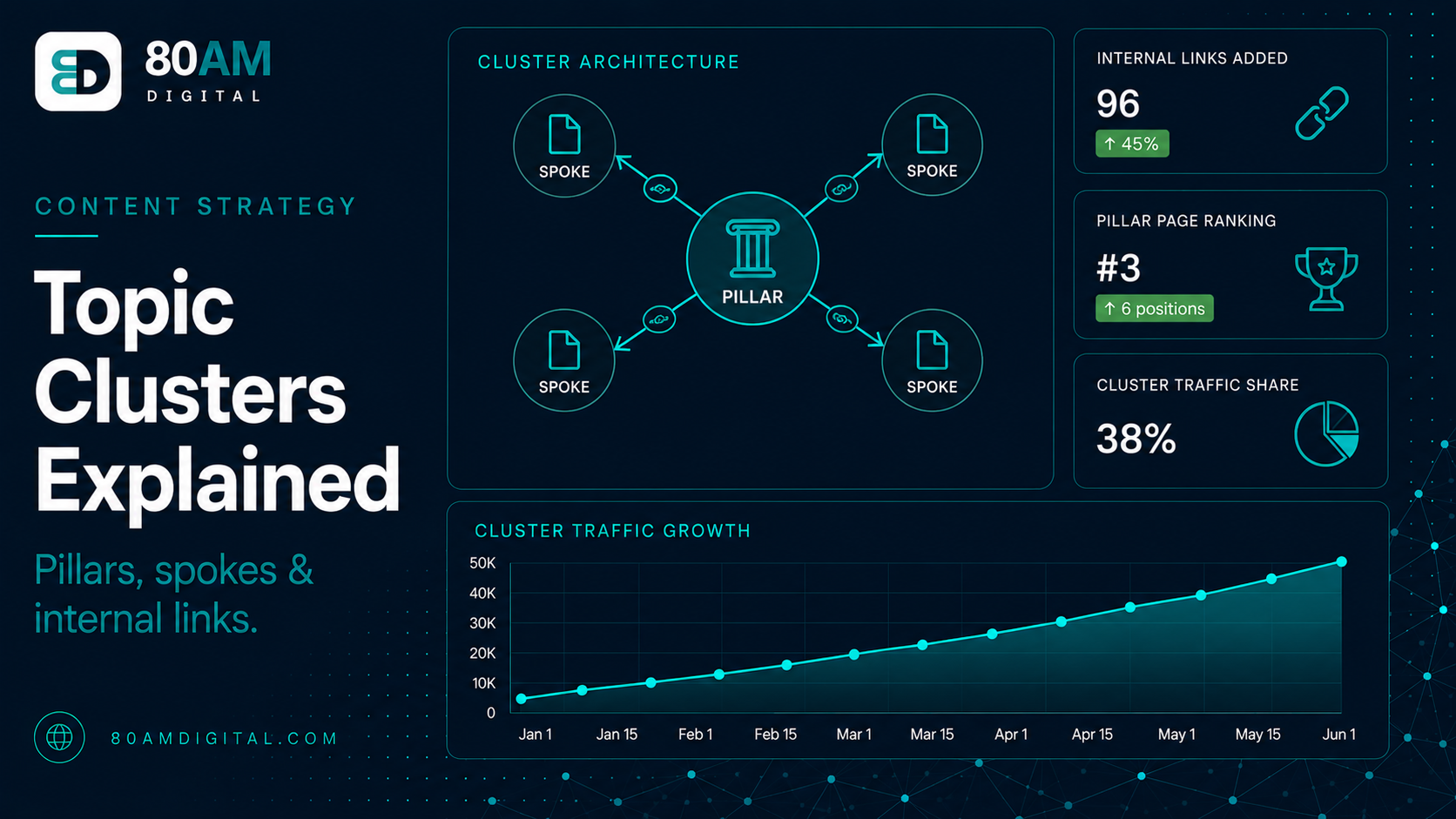
The cluster model organises your content into a hub-and-spoke structure: one comprehensive pillar page covers a broad topic, and a set of supporting articles — spokes — go deep on the subtopics beneath it. Internal links connect them, routing both readers and crawlers through related content in a way that signals depth, not just volume.
This article explains how clusters work, why they outperform scattered publishing, and what a well-built cluster actually looks like in practice.
The Short Version
- A pillar covers a broad topic; spokes go deep on its subtopics; internal links connect them both ways — that’s the whole model.
- You probably already have the ingredients of a cluster in your existing content — the work is mapping and linking, not always writing from scratch.
- Four to six well-covered spokes beat twelve thin posts that restate the same ideas — depth on real audience questions, not exhaustive keyword coverage.
- AI systems favor sites with demonstrated, consistent topical coverage — a connected cluster reads as a more authoritative source than an isolated post.
Why scattered publishing stops working
Most content libraries grow the same way: someone identifies a keyword worth targeting, commissions or writes a post, publishes it, and moves on to the next keyword. After a few years, there are dozens or hundreds of posts — each targeting a different term, none connected to each other in any meaningful way.
This approach has a ceiling. Each page competes as a standalone document, without the authority signal that comes from related content linking together. When a visitor lands on one post, there’s no structured path to other relevant content — so they leave. And when Google evaluates the site, it sees breadth without depth.
Topic clusters solve both problems. The pillar page earns authority from its spokes. The spokes earn relevance from the pillar. Visitors move through the cluster rather than bouncing out of it. And Google’s assessment of the site’s topical authority improves with every piece added to a cluster — not just in isolation.
The structure: pillar, spoke, link
| Element | Role | Typical keyword target |
|---|---|---|
| Pillar page | Comprehensive overview, introduces every subtopic, links out to each spoke | Head terms — shorter, higher-volume, broad intent |
| Spoke pages | Deep coverage of one specific subtopic, links back to the pillar and related spokes | Long-tail, narrower, more specific intent |
| Internal links | Route authority, signal topical structure to crawlers, keep visitors inside the cluster | N/A — connective tissue, not a ranking target itself |
The pillar page
The pillar is a comprehensive resource on a broad subject — broad enough to support multiple supporting articles, but specific enough to target a real audience. It covers the topic at a high level, introduces the main subtopics, and links out to the spokes for anyone who wants to go deeper on any of them.
Good pillar pages tend to rank for head terms — shorter, higher-volume keywords with broad intent. They don’t try to answer every possible question; they answer the foundational questions and create the map for the rest of the cluster.
The spoke pages
Spokes are the supporting articles. Each one covers a specific subtopic in depth — answering a narrower question that the pillar introduces but doesn’t fully address. Spokes target longer, more specific keywords, and they link back to the pillar and to other related spokes in the cluster.
A well-built cluster has enough spokes to cover the topic comprehensively — not exhaustively. The goal is depth on the questions that matter to your audience, not a post for every conceivable keyword variation.
The internal links
Internal links are the connective tissue. Each spoke links back to the pillar, and the pillar links to each spoke. Spokes may also link to each other where the content is directly related. These links do three things:
- Route authority — links from published, ranking pages pass equity to newer or weaker pages in the cluster
- Signal structure — crawlers use link patterns to understand topical relationships between pages
- Keep visitors in the cluster — contextual links to related content reduce bounce rate and increase pages-per-session on topically aligned content
A practical example
Take a site focused on organic growth for e-commerce brands. A well-built cluster might look like this:
Pillar: “The Full-Funnel Organic Growth Playbook” — covers SEO, content, and conversion as an interconnected system
Spokes:
- “How to Build a Content Engine That Compounds” (deep-dive on content systems)
- “The SEO Audit Checklist” (technical foundation spoke)
- “Traffic but No Conversions” (conversion path spoke)
- “The Organic-Growth Scoreboard” (measurement spoke)
Each spoke covers its subtopic in depth. Each links back to the pillar. The pillar introduces each spoke topic and links forward. A visitor who arrives at any spoke can follow links to the pillar and from there to other spokes — or begin at the pillar and explore the subtopics that are most relevant to them.
Topic clusters and AI search
The cluster model also helps with AI search — a growing source of traffic for sites with strong topical coverage. When an AI system evaluates sources for an answer, it favours sites that have demonstrated deep, consistent coverage of a subject. A cluster isn’t just a structure for Google; it’s evidence of authority that AI systems use to decide whose content to cite.
Individual posts that aren’t part of a cluster are harder for AI to verify as authoritative. A post connected to a pillar, which is itself linked to and from several related articles, presents a coherent signal of expertise — which is exactly what AI systems are designed to surface.
For more on how to structure the content system around clusters, see how to build a content engine that compounds.
How to build a cluster (without starting from scratch)
If you already have content, you may already have the ingredients of a cluster — they just aren’t connected yet. The process:
- Identify your pillar candidates — what are the 4–6 broad topics your site covers that a significant audience searches for?
- Audit existing content — which existing posts cover subtopics under each pillar? Map them to their closest pillar.
- Add the missing links — go into each spoke and add a contextual link back to the pillar (and to closely related spokes). Then go into the pillar and add links out to the spokes.
- Identify the gaps — which subtopics does your audience search for that your cluster doesn’t yet cover? Those become your next content priorities.
- Publish in order — if building from scratch, publish the pillar first, then the spokes. This gives spokes a page to link back to from day one.
What a healthy cluster looks like in numbers
Rough benchmarks for a working cluster
A worked example: retrofitting a cluster from scattered posts
A B2B software company had published 90 blog posts over four years with essentially no internal linking strategy — each post targeted a keyword in isolation, with maybe one or two incidental links to other content. An audit grouped the 90 posts by subject and found roughly 60 of them clustered naturally around five broad themes the business actually sold into, with the remaining 30 being one-off, low-relevance posts with little search traffic.
Rather than writing new pillar content from scratch, the team selected the strongest existing post in each of the five themes, expanded it into a proper pillar (broadening scope, adding sections that introduced each subtopic), and then went through the remaining posts in that theme adding contextual links both directions — spoke to pillar, pillar to spoke. No new spoke content was written in the first pass; the entire first round of work was linking and pillar-expansion. Within two months, the five new pillar pages were ranking for head terms the individual posts had never competed for, and several previously stagnant spoke posts saw position improvements as the pillar’s authority began routing through to them.
Frequently asked questions
Build the structure, then fill the gaps
Topic clusters work because they align how you publish content with how search engines — and AI systems — evaluate authority. Publishing without a cluster structure is like building a library with no catalogue: the books exist, but no one can find what they’re looking for, and the collection as a whole communicates nothing about what it covers.
If you’d like help mapping your existing content into clusters and identifying where the gaps are, see how we approach content and SEO strategy.