How to Do Keyword Research Around Intent, Not Just Volume
High volume means nothing if the intent is wrong. Learn how to research keywords by search intent so you target terms that actually convert, not just rank.
Table of Contents
Volume is easy to measure. Intent is what matters. A keyword with ten thousand monthly searches is worthless if the people searching it are looking for something fundamentally different from what your page offers. A keyword with three hundred monthly searches that matches exactly what your best customers are trying to do is worth every minute of work it takes to rank for it.
This guide walks through how to research keywords with intent as the primary filter — and why that shift produces content that earns rankings, keeps visitors on the page, and actually converts.
The Short Version
- Filter keywords by intent and relevance first, volume second — a low-volume keyword with the right intent beats a high-volume one with the wrong intent.
- Check what’s already ranking for a keyword to read Google’s own intent classification before you write anything.
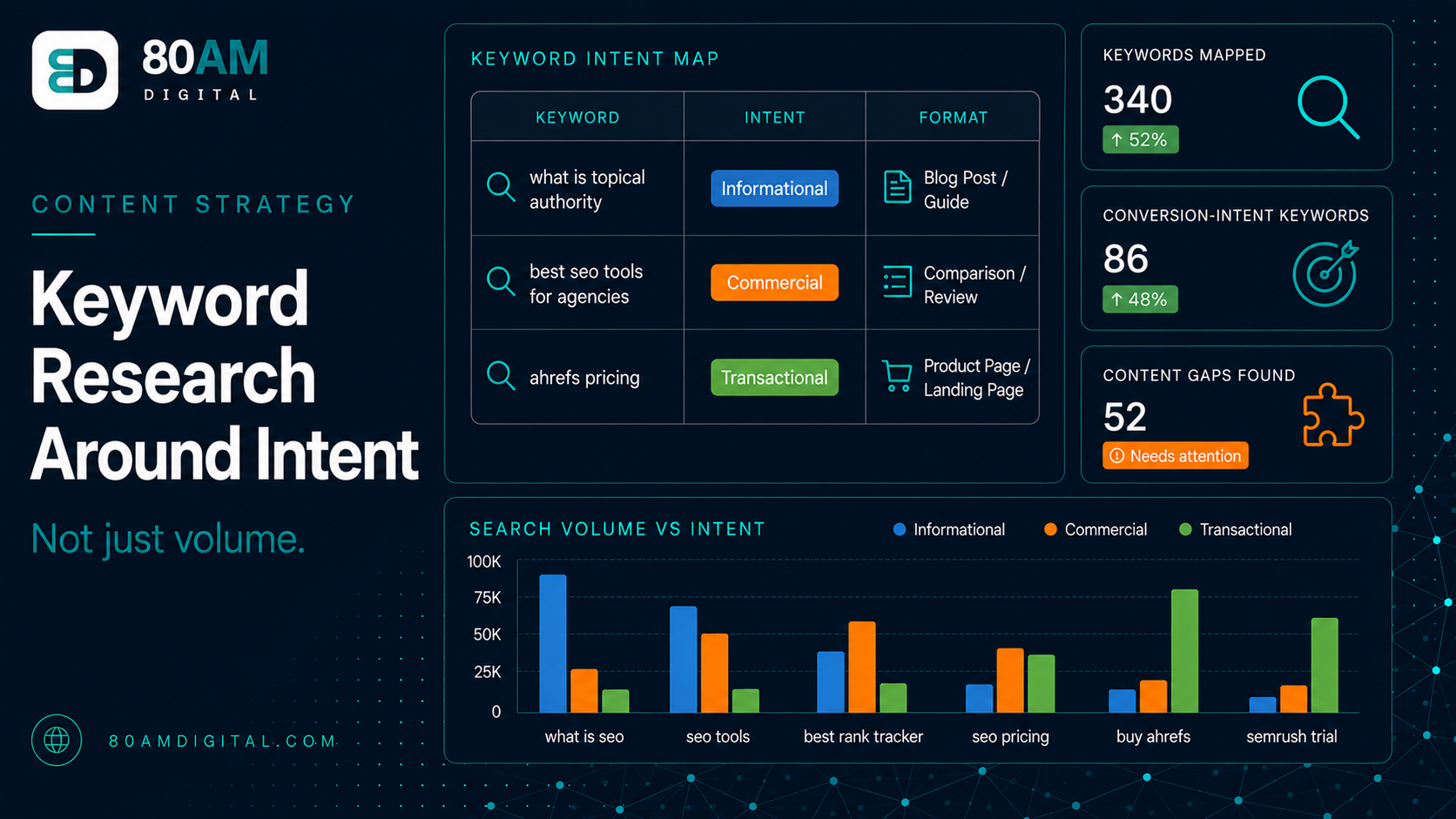
- Match content format to intent: guides for informational, comparisons for commercial investigation, landing pages with CTAs for transactional.
- Most content strategies overweight broad informational content and underweight commercial investigation — that’s usually where the gap is.
What search intent actually means
Search intent is the underlying goal behind a query. Google classifies intent in four broad categories — but understanding why the distinction matters is more useful than memorising the labels.
| Intent | What the searcher wants | Right content format |
|---|---|---|
| Informational | To learn something — researching, comparing, understanding a concept, not ready to buy | Educational guides, explainers, how-tos, checklists |
| Navigational | A specific page, brand, or resource they already know exists | Rarely an acquisition opportunity for anyone but the searched brand |
| Commercial investigation | Comparing options before a decision — reviews, comparisons, “best of” lists | Comparison articles, case studies, use-case guides |
| Transactional | Ready to act — buy, book, sign up, download | Service pages, landing pages, product pages with clear CTAs |
Most content strategies underweight commercial investigation and overweight informational content that’s too broad to convert. The intent framework helps you see where the gaps actually are.
How to identify intent for any keyword
The fastest way to understand what Google thinks the intent is for a keyword: look at what’s already ranking. Open an incognito window, search the keyword, and study the top five results.
- If the results are mostly blog posts or guides, the intent is informational
- If the results are mostly product pages, category pages, or pricing pages, the intent is transactional
- If the results are mostly comparison articles, review round-ups, or “best X” lists, the intent is commercial investigation
This matters because Google has already done the work of inferring intent from user behaviour. If you write a transactional page for a keyword that’s showing informational results, you won’t rank — not because the page is bad, but because it doesn’t match what users want at that query.
Building a keyword list around intent
Start with the funnel, not the keyword tool
Before opening any keyword tool, map the stages your customer moves through before buying. What are they trying to understand at each stage? What would they type into search at each point in that journey?
This gives you a list of topic areas before it gives you keywords. Keyword tools fill in the specific terms — they don’t create the strategy.
Seed terms and expansion
Take the topic areas from your funnel map and run them through a keyword research tool. Look for:
- Questions: “how to”, “why does”, “what is”, “can I” — almost always informational, good for cluster spokes
- Comparison modifiers: “vs”, “vs.”, “alternative to”, “reviews”, “best” — commercial investigation, good for MOFU content
- Action modifiers: “hire”, “pricing”, “cost”, “get started”, “services” — transactional or commercial, good for service and landing pages
Filter by relevance, not volume
Volume is a tiebreaker, not the primary filter. Filter first for: is the intent right? Is the audience right? Is this a topic we can say something genuinely useful about?
After relevance and intent, then look at volume — not to chase the highest numbers, but to avoid spending effort on keywords with zero actual audience. A keyword with 50 searches a month from exactly the right audience is worth more than a keyword with 5,000 searches from people who will never convert.
The intent-content match
Once you’ve identified your target keywords and their intent, the content format should follow logically:
- Informational keywords → educational guides, explainers, how-tos, checklists
- Commercial investigation keywords → comparison articles, “best of” lists, case studies, use-case guides
- Transactional keywords → service pages, landing pages, product pages with clear CTAs
Mismatching format to intent is one of the most common reasons technically well-written content fails to rank. Google’s quality signals (dwell time, pogo-sticking, click-through rate) all reflect whether the content matches what the searcher was looking for — and a well-written educational article for a transactional query will be ignored regardless of its quality.
Where most content strategies skew
Secondary keywords and topical coverage
Modern search doesn’t reward pages that target one keyword. It rewards pages that cover a topic comprehensively — addressing the related questions a searcher might have alongside the primary one.
For any target keyword, identify the related questions Google surfaces (People Also Ask, related searches, forum threads in your niche) and make sure your content addresses the most relevant ones naturally. This isn’t keyword stuffing — it’s topic completeness. A page on “keyword research” that doesn’t address search intent, keyword difficulty, or how to prioritise which terms to target is an incomplete resource, and Google evaluates it accordingly.
For the broader content system that makes keyword research actionable, see how to build a content engine that compounds.
A worked example: the same volume, two different intents
A project management software company found two keywords with nearly identical search volume — “project management methodologies” and “best project management software for agencies.” The team’s instinct, looking only at volume, was to treat them as equally valuable. A SERP check told a different story: “project management methodologies” returned almost entirely educational content from established publishers like PMI and academic sources, an intent the company’s own commercial blog had no real chance of competing for and no real product fit even if it did. “Best project management software for agencies,” by contrast, returned a mix of comparison articles and review round-ups — commercial investigation intent the company was directly positioned to serve, with a product specifically built for agencies.
The team deprioritized the methodologies keyword entirely and built a genuinely useful, specific comparison page for the agency software query — including honest tradeoffs against competitors rather than a thinly disguised sales pitch. That page ranked within three months and became one of the site’s top converting pages, while a methodologies article would likely have taken longer to rank (against much stronger competition) and converted at a fraction of the rate even if it had succeeded.
Frequently asked questions
Start with intent, build from there
Keyword research that begins with volume produces content calendars full of posts your audience isn’t ready to act on. Keyword research that begins with intent produces a map of what your audience is actually looking for — and that map tells you what to write, in what format, and in what order.
If you’d like help auditing your current content against intent and identifying where the gaps are in your cluster structure, see how we approach content strategy.