An Editorial Calendar That Survives a Busy Quarter
Most content calendars collapse the first busy month. Learn how to plan a realistic publishing cadence you can sustain—and why consistency beats volume.
Table of Contents
Most editorial calendars are made in January and abandoned by March. They’re built for ideal conditions — a full team, no competing priorities, consistent briefs, and content that somehow writes itself. Real quarters don’t work that way. The calendar that survives is the one designed for reality: fewer slots, clear ownership, and enough flexibility to absorb the weeks when everything else takes priority.
This guide covers the structure that makes an editorial calendar practical rather than aspirational — and why consistent, planned publishing compounds better than intermittent bursts.
The Short Version
- Plan for the cadence you can sustain, not the maximum you can produce in a good month — consistency compounds, bursts don’t.
- Build the calendar around cluster structure: pillar first, then spokes, then refreshes — not a random list of keyword ideas.
- Two articles per month — one new spoke, one refresh — is a credible floor that keeps a content program alive under real constraints.
- When the calendar slips, slide it and substitute a refresh rather than doubling output the following week to “catch up.”
Why consistency beats volume
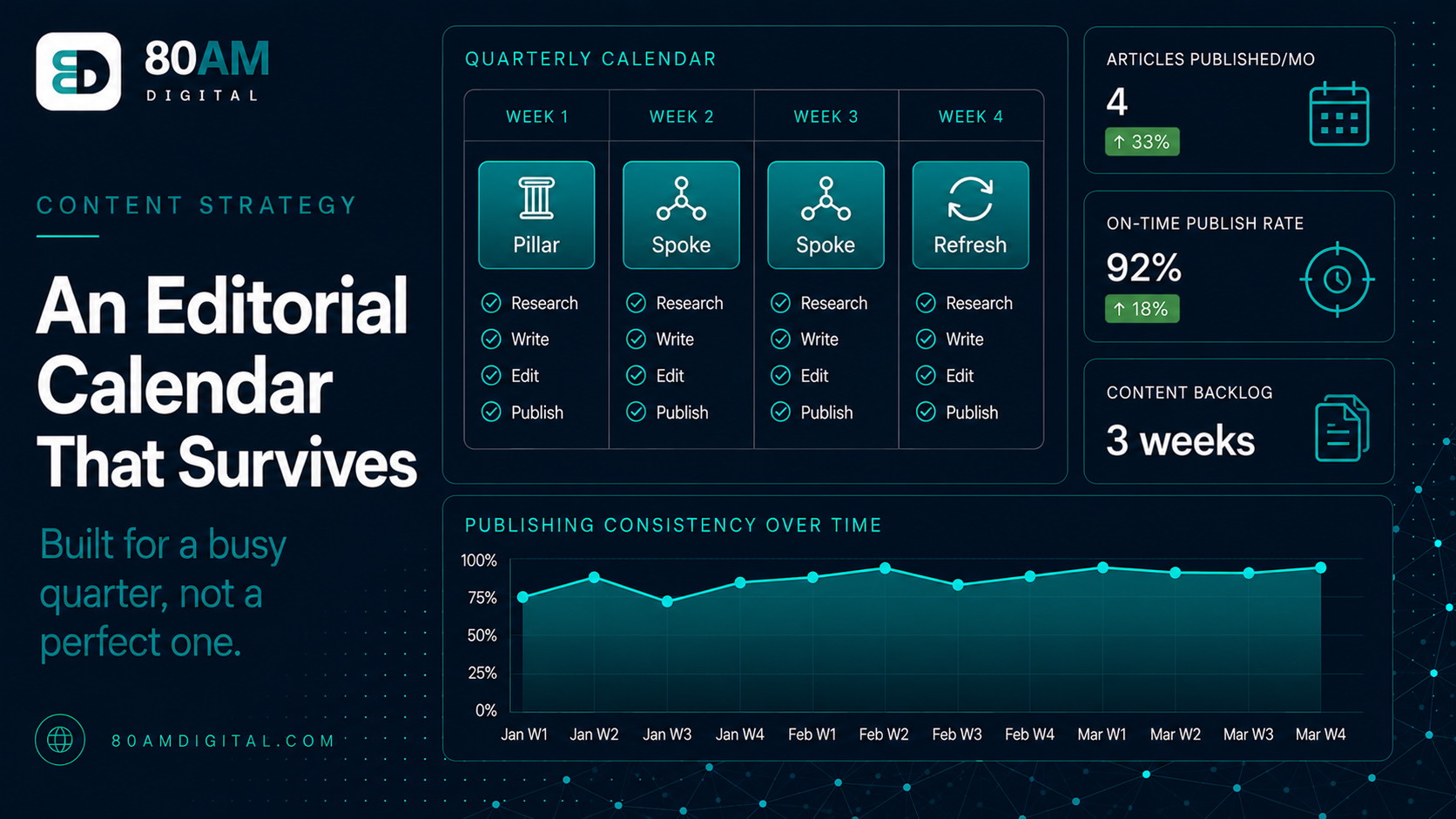
Publishing 4 posts per month for 12 months outperforms publishing 12 posts in January and then nothing for three months — even though the total output might be similar. Consistency matters for several reasons: Google crawls and indexes sites more frequently when content appears on a predictable schedule; internal links accumulate across a growing content library month by month; and audience trust builds through regular presence rather than sporadic bursts followed by silence.
The right publishing cadence isn’t the maximum you can produce — it’s the maximum you can sustain without cutting quality. A single well-researched 1,500-word article per month, consistently published, compounds more effectively over 12 months than 6 posts in one month followed by 2 months of nothing.
Building the calendar around the cluster structure
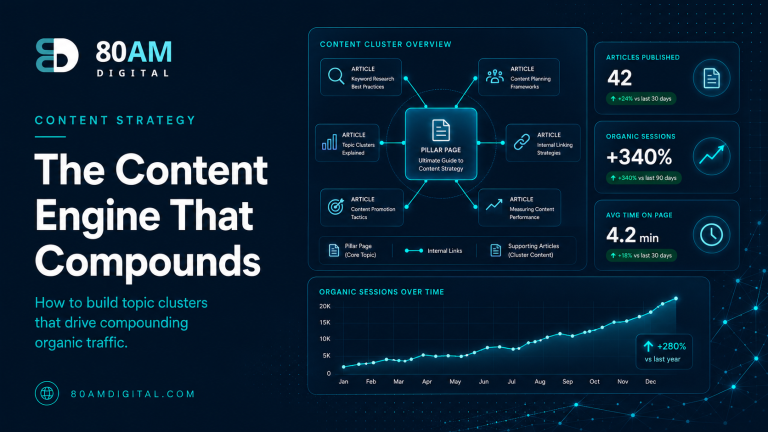
An editorial calendar without a content strategy is just a schedule. The calendar should reflect the cluster structure: pillar pages, spoke articles, and refreshes planned in a sequence that builds topical authority deliberately.
A practical quarterly structure for a site producing 4 posts per month:
| Month | What gets published | Why this sequence |
|---|---|---|
| Month 1 | 1 pillar + 3 spokes for a new cluster | Pillar launches with immediate links to spokes; spokes link back from day one |
| Month 2 | 3 more spokes for the same cluster + 1 spoke for an existing cluster | New cluster reaches 7 pieces — enough to establish topical authority |
| Month 3 | 2 new spokes + 1 refresh + 1 BOFU piece tied to a services page | Balances new coverage, library maintenance, and the conversion layer |
The minimum viable calendar
If capacity is genuinely limited, a minimum viable calendar is better than no calendar. Two articles per month — one new spoke article and one content refresh — is enough to maintain publishing consistency, keep the library current, and give Google regular signals of an active, maintained site. This is the floor that keeps the content programme alive without requiring significant weekly time investment.
What goes in each calendar slot
Each slot in the calendar should have, before the writing begins:
- Slug and target keyword: The URL and the primary search query the piece is targeting
- Intended cluster position: Pillar, spoke, or BOFU — clarifies the piece’s role in the authority structure
- Owner: Who is writing or briefing the piece
- Draft deadline: Not the publish date — the draft deadline gives buffer for review and editing
- Internal links planned: Which existing pieces this will link to and which will link back to it
Without a brief attached to each slot, the calendar is just dates — and dates without briefs are the first thing to slip when capacity tightens.
For how to write a content brief that produces the right article, see the content brief template. For the full content engine structure, see how to build a content engine that compounds.
Cadence benchmarks by library size
New content vs. refresh split, by maturity
A worked example: surviving a quarter that fell apart
A small marketing team planned an ambitious Q1 calendar: 5 posts a month including 2 brand-new pillars. By week 3, a product launch consumed the entire team’s bandwidth, and the calendar had already slipped a full two weeks behind. The instinct was to push through — keep the 5-post target and just write faster, with less research and lighter editing.
Instead, the team cut the calendar down to its minimum viable version for the remainder of the quarter: one new spoke and one refresh per month, with the second pillar pushed to Q2 entirely rather than rushed. They updated the calendar publicly (in the shared tracker) to reflect the new realistic cadence rather than leaving the original targets looking missed. The quarter ended with less total output than planned, but every piece that did publish was researched and edited to the same standard as before — and the one pillar that did launch on schedule performed well precisely because it hadn’t been rushed to hit an unrealistic deadline. The following quarter’s planning incorporated the lesson directly: target cadence was set at the proven minimum viable level, with anything beyond that treated as a bonus rather than a baseline.
Frequently asked questions
A calendar you can keep is better than one you can’t
The editorial calendar isn’t a commitment to perfection — it’s a system for making consistent decisions in advance so they don’t have to be made under pressure. Built around a realistic cadence, attached to briefs, and reviewed quarterly rather than weekly, it’s the mechanism that converts a content strategy from an idea into a compounding asset.
If you’d like help mapping out a quarter of content that aligns with your cluster structure and business priorities, get in touch.