AI-Assisted Content Workflows That Don’t Tank Quality
Used well, AI speeds research and drafting; used lazily, it gets you penalized. Learn an AI-assisted workflow that keeps originality and expertise intact.
Table of Contents
The question isn’t whether to use AI in content creation. Most content teams already are, whether officially or not. The question is where in the workflow AI adds genuine leverage and where it removes the things that make content worth reading. The distinction matters: AI used in the right places accelerates content production without diluting quality; AI used to replace the wrong things produces content that’s faster to publish and worse to read.
Here’s the framework that makes AI-assisted content workflows work.
The Short Version
- AI is genuinely useful for research aggregation, commodity explanations, structural formatting, and mechanical editing passes.
- AI can’t generate the original perspective, replace a strategic brief, or supply the authenticity layer — those have to come from a human, before drafting starts.
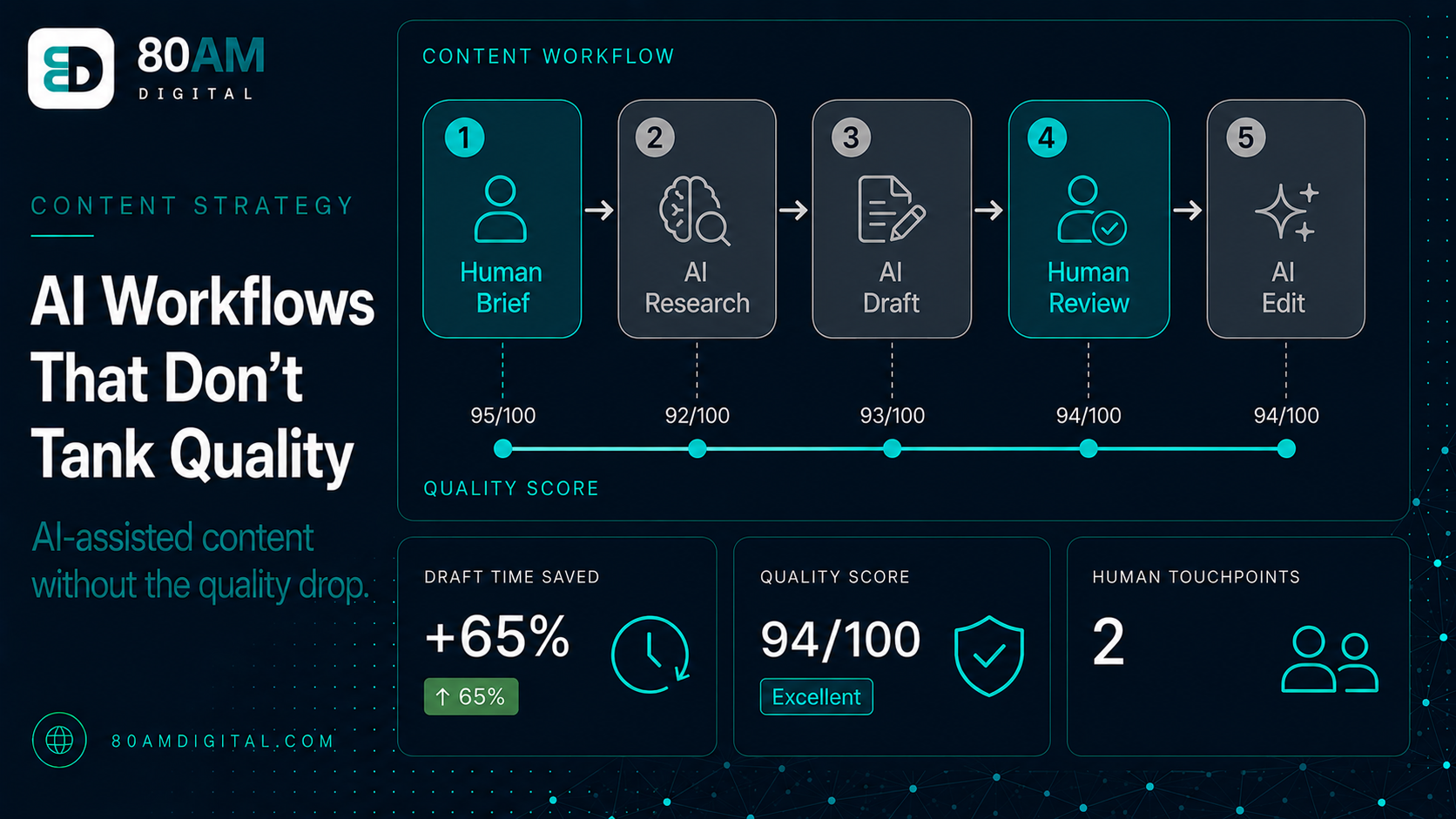
- The five-step workflow that works: human brief → AI research → AI draft from the brief → human differentiation review → AI editing pass.
- Set the quality gate at the brief, not the output — “could any other AI have produced this without the brief?” is the test that catches weak content before it’s published.
Where AI adds genuine leverage
Research aggregation: Gathering what exists on a topic — summarising top-ranking articles, identifying common questions, compiling relevant statistics — is time-consuming and produces no original value. AI handles this efficiently, freeing the writer to focus on what the research doesn’t contain: the original perspective, the specific example, the counter-argument.
First draft of standard explanations: If an article needs to explain what a canonical tag is before discussing when to use one, that explanation is commodity — the same definition is available everywhere. AI writes the commodity explanation quickly; the writer can focus on the strategic content around it.
Structural formatting: Converting an outline and a set of notes into a structured first draft — with headings, paragraph breaks, and basic transitions — is mechanical work that AI does well. The structure is right; the original content needs to be added.
Editing passes: AI is useful for clarity edits (is this sentence readable?), consistency checks (is the terminology consistent throughout?), and format validation (does every FAQ have a complete answer?). These are mechanical review tasks that are tedious for humans but fast for AI.
Where AI removes value
Generating the original perspective: AI can’t supply what your team actually thinks, what you’ve observed from client work, or what position you want to take on a contested question. When AI generates the “take,” it synthesises the median of existing published opinion — which is precisely what’s already ranking and what your content needs to be different from.
Replacing the brief: An AI-generated brief for an AI-generated article produces output that’s optimised for nothing — it has no specific angle, no original inputs, and no point of differentiation. The brief is where human judgment about what the article should say happens. It must come before the AI draft, not from it.
The authenticity layer: Voice, specific examples drawn from real experience, the confident assertion of a counter-intuitive position — these signal that a person with actual expertise wrote this. When AI writes without these inputs, the result is plausible and forgettable. The authenticity layer has to be added by a human, either in the brief or in a post-draft review.
A practical AI-assisted workflow
| Step | Who/what does it |
|---|---|
| 1. Brief creation | Human — defines angle, examples, position, original data |
| 2. Research aggregation | AI — summarises existing coverage and audience questions |
| 3. First draft from brief | AI — structure and standard explanations, anchored by the brief’s original inputs |
| 4. Differentiation review | Human — checks the original angle and examples survived |
| 5. Editing pass | AI — readability, consistency, formatting |
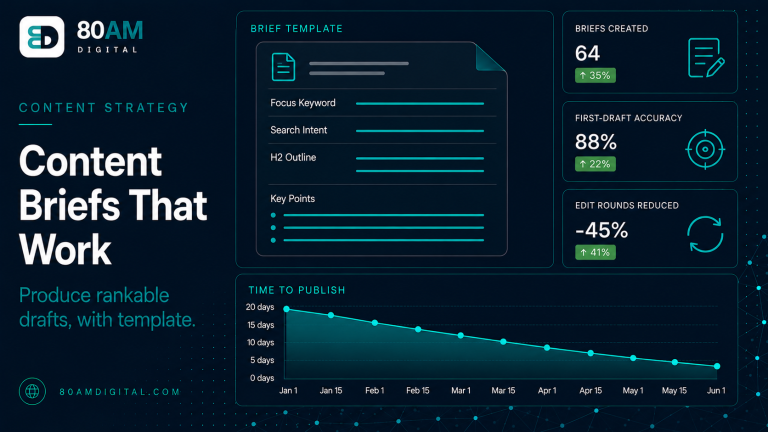
- Human brief creation: Define the angle, the specific examples, the position, and any original data. This takes 20–30 minutes and is entirely human. The brief specifies what makes this article different from every other article on the topic.
- AI research aggregation: Use AI to summarise what the top-ranking articles cover, what questions the target audience asks (from search data, Reddit, forums), and what’s missing from the existing coverage. This informs the brief but doesn’t replace it.
- AI first draft from brief: Feed the brief (with its original inputs) to an AI drafting tool. The draft picks up structure and standard explanations efficiently. The original elements from the brief survive as anchor points in the draft.
- Human differentiation review: A human reviews the draft specifically for: (a) whether the original angle is clearly expressed; (b) whether the specific examples survived; (c) whether the draft says anything that couldn’t have been written by any other AI in the same situation. Fix what doesn’t pass this test.
- AI editing pass: Once the content is right, use AI for the mechanical editing: readability, tone consistency, length, formatting.
For how content quality connects to rankings, see people-first content. For the scaling question, see how to scale content without sameness.
The leverage vs. risk split
Where the workflow actually saves or costs time
A worked example: the same draft, two briefs
A content team tested the workflow on a single topic, “how to write meta descriptions that improve CTR,” using the same AI drafting tool for both versions. The first draft used a bare brief — topic and keyword only. The output was accurate and well-structured, but its three recommendations (include the keyword, stay under 160 characters, add a call to action) were identical to the top five ranking articles already in the SERP.
The second draft used a brief that included one original input: data from the team’s own CTR testing showing that meta descriptions phrased as a direct question outperformed statement-style descriptions by 18% in their account, plus an instruction to argue against the common advice to always include the focus keyword verbatim. The resulting article led with the question-format finding, supported it with the team’s own numbers, and took a clear position that diverged from competing advice — content no other team running the same prompt could have produced, because the differentiating input didn’t exist anywhere else. Both drafts took the AI tool roughly the same four minutes to generate; the only difference was twelve minutes spent on the brief.
Frequently asked questions
AI is the tool. The brief is the strategy.
The content programmes that use AI well are the ones where human judgment happens at the brief stage — before the AI touches anything. The brief defines the angle, the examples, and the original perspective. AI executes the draft efficiently. A human confirms the original elements survived the drafting process. That’s a workflow that’s faster than before AI and better than generic AI output alone.
If you’d like to see how this workflow applies to your content programme specifically, get in touch.