How to Scale Content Without Becoming ‘Scaled Sameness’
You can publish more without publishing junk. Learn how to scale content volume while keeping the originality and depth Google’s 2026 updates reward.
Table of Contents
“Scaled sameness” is the term that emerged in the wake of Google’s 2024 and 2025 helpful content updates to describe what most AI-assisted content factories produce: high-volume, grammatically correct, factually plausible, and utterly indistinguishable from every other piece covering the same topic. Every article hitting the same structural beats, every insight available in any top-ranking piece, every opinion safely hedged to avoid controversy. Content that technically covers the topic but adds nothing to the conversation.
Scaling content volume without scaling sameness is the discipline that separates programmes that compound from ones that produce noise. Here’s what that looks like in practice.
The Short Version
- Differentiation has to be decided at the brief stage — original data, real experience, or a genuine point of view — not added during editing.
- AI is fine for structure, formatting, and first drafts of standard explanations — it can’t supply the original inputs that prevent sameness.
- Google doesn’t penalise AI content per se — it penalises unhelpful, generic content created primarily to rank, regardless of how it was produced.
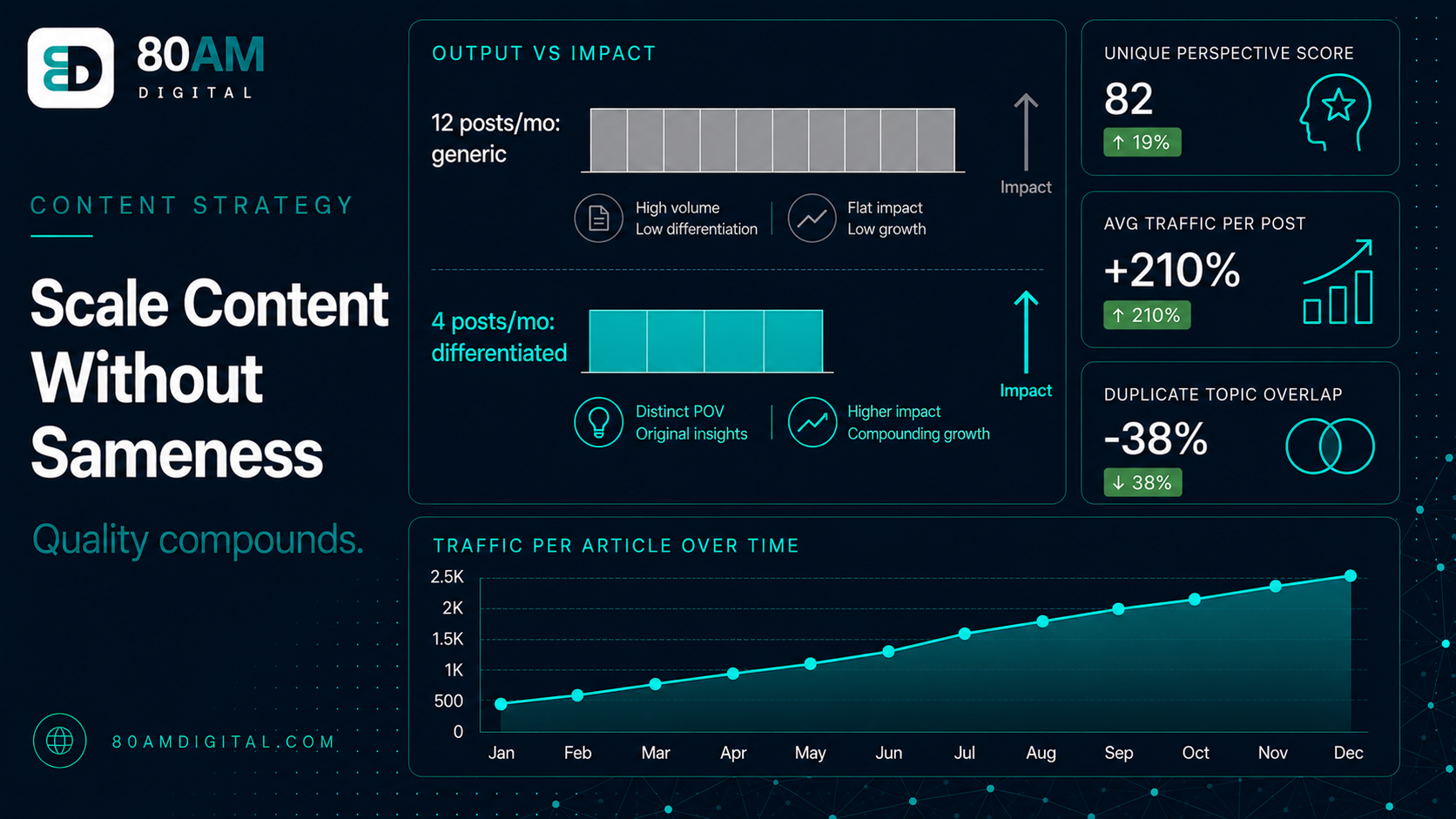
- 4 genuinely differentiated articles beat 12 pieces of scaled sameness — volume without the three original-perspective inputs is just noise.
The three sources of original perspective
Content that avoids sameness has at least one of three things that can’t be templated:
| Source | What it looks like |
|---|---|
| Original data or observation | Numbers or patterns your team has that don’t exist publicly — “in our last 20 audits, 80% had this issue” |
| Specific, demonstrable experience | Content drawing on someone who’s actually done the thing — visible in the specificity of examples and precision of warnings |
| A point of view | A position on a contested question, or a recommendation against the consensus — inherently differentiated, since competitors don’t share it |
Original data or observation: Numbers, patterns, or findings your team has that don’t exist in public sources. Client engagement patterns. Results from a specific methodology. Analysis of your own audience data. Even small datasets — “in the last 20 audits we’ve run, 80% had this specific issue” — are more valuable than generic statistics from industry reports because they’re yours and can’t be replicated by a competitor using the same AI tool.
Specific, demonstrable experience: Content written by or drawing on someone who has actually done the thing the article describes. A playbook written by someone who has run 50 site migrations reads differently from a playbook assembled from research. The difference isn’t always obvious in the text, but it shows up in the specificity of the examples, the precision of the warnings, and the confidence of the recommendations.
A point of view: A position on a contested question. An opinion about what most advice gets wrong. A recommendation against the consensus. Content with a point of view is inherently differentiated because the same point of view isn’t available from the competing top-10 results. It also tends to earn engagement and links from people who agree — or disagree — strongly enough to share it.
Where AI helps and where it hurts
AI accelerates the parts of content creation that have always been commodity: structure, formatting, research aggregation, and first drafts of standard explanations. These are fine to speed up. What AI can’t do is supply the original data, the specific experience, or the genuine point of view — those have to come from the people creating the content.
The quality problem with AI-first content workflows isn’t the AI — it’s the absence of the inputs that make content distinctive. If the brief says “write about content pruning,” AI can produce a competent article on content pruning. But if the brief says “write about content pruning and include data from our last 12 audits, reference the specific mistake most clients make in the triage phase, and take the position that most content teams prune too conservatively,” the resulting article has original inputs that AI can use to write something genuinely different.
A scaling workflow that keeps quality
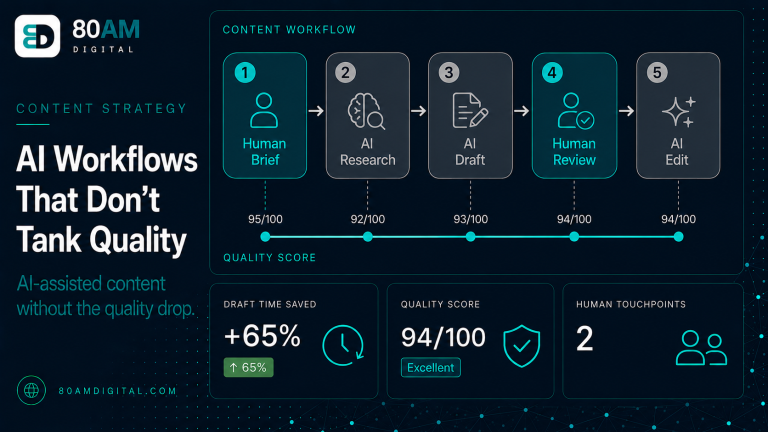
The workflow that scales without sameness has three phases:
- Brief creation with original inputs: Before AI touches anything, a human (or a subject-matter contributor) defines the angle, the position, the specific examples, and any original data that will appear in the piece. This is where the differentiation is decided — not at the writing stage.
- AI-assisted drafting: The brief with its original inputs feeds the AI draft. The structure, explanations, and standard content are generated quickly. The original elements are preserved as anchor points that the AI can elaborate around but not dilute.
- Human review and differentiation pass: A human reviewer checks whether the distinctive elements survived the drafting process, whether the point of view is clear, and whether the article makes claims that couldn’t have been made by any competitor using the same tool. This is the quality gate — not fact-checking, but sameness-checking.
For how to write the kind of content AI cites and recommends, see answer-first writing. For the content engine that systematises this at scale, see how to build a content engine that compounds.
What sustainable scaling actually looks like
Process over output targets
A worked example: the same brief, with and without inputs
A content agency ran a controlled comparison for an internal training exercise: two writers received the same assignment, “write about why ecommerce category pages underperform,” using the same AI drafting tool. The first received a bare brief — just the topic and target keyword. The resulting draft was competent and accurate, covering thin content, poor filtering, and weak internal linking — the same three points found in nearly every top-ranking article on the topic, in the same order, with no claim that wasn’t already publicly available.
The second writer received a brief that included three specific inputs: data from the agency’s own audits showing the most common category-page issue was actually missing structured FAQ content (not the more commonly cited “thin content”), a real example from a recent client engagement, and an explicit instruction to argue against the common advice to add more on-page copy. The resulting article led with a counterintuitive claim, supported it with the agency’s own audit data, and used the real client example as illustration — something no competing article using a generic prompt could replicate, because the differentiating material didn’t exist anywhere else. The exercise made the lesson concrete for the team: the AI tool was identical in both cases; the brief was the entire difference.
Frequently asked questions
Volume is not the strategy
The content programmes that compound are the ones where every piece has something the next publisher can’t copy by running the same prompt. That’s not a constraint on volume — it’s a constraint on process. Build the brief, include the original inputs, run the differentiation review. At that point, scaling is just running the process more times.
If you’d like to see how this looks in practice for your content programme, get in touch.