Answer-First Writing: Structure Content AI Will Quote
AI quotes self-contained answers, not buildup. Learn the answer-first structure—lead with the answer, then expand—that makes content easy for AI to cite.
Table of Contents
AI search systems — ChatGPT, Perplexity, Google AI Overviews — don’t read your article and summarise it. They look for passages that directly and completely answer the query being asked, then quote or paraphrase those passages in the response.
That’s a fundamentally different reading pattern than a human’s. A human might read through context and buildup before reaching the answer. An AI system is looking for a self-contained statement it can lift and use. Content that buries the answer after three paragraphs of introduction doesn’t get cited — not because the answer is wrong, but because it isn’t structured to be extractable.
Answer-first writing is a structural approach that fixes this: lead with the answer, then expand. It makes content easy for AI to cite without making it worse for humans to read.
The Short Version
- Every section that answers a question should open with the answer in 1-3 sentences, then expand with context and nuance.
- AI systems extract direct statements, defined lists, and clear processes — not narrative buildup, rhetorical preambles, or unclear passive voice.
- Answer-first writing isn’t a trade-off against traditional SEO — the same structural signals improve feature snippet extraction too.
- Test it yourself: read only the first sentence of each section. If those sentences alone answer the question, the structure is working.
What “answer-first” means in practice
Every section that addresses a specific question should open with the answer — stated clearly in one to three sentences — before adding context, examples, or nuance. This applies at the article level (the intro should answer the main question the article targets) and at the section level (each H2 and H3 should open with its most important point, not build toward it).
A useful test: read only the first sentence of each section. Can someone who reads only those sentences understand the core answer to each question? If yes, the structure is answer-first. If the first sentence of each section is setup, context, or transition, the answers are buried.
The pattern AI systems look for
AI systems are optimised to extract passages that match a specific pattern. Research on AI Overview citations and feature snippet extraction (which uses similar extraction logic) consistently identifies the same structural signals:
| Extractable | Not extractable |
|---|---|
| Direct statement: “X is Y” | Long narrative paragraphs with the answer buried mid-paragraph |
| Numbered/bulleted lists, independent items | Opinion pieces with no clear factual anchor |
| Definition followed by elaboration | Content requiring surrounding context to make sense |
| Clear, numbered process steps | Rhetorical preambles before the actual answer |
- Direct statement of fact or definition: “X is Y” or “The difference between X and Y is Z”
- Numbered or bulleted lists with clear, independent items — AI can extract the list as a unit
- A definition followed by elaboration: Define the concept in the opening clause, then expand
- Steps in a process: “To do X: 1. [step], 2. [step]…” — AI can cite the process as a complete, structured answer
Conversely, the structures AI rarely cites: long narrative paragraphs where the answer is embedded mid-paragraph, opinion pieces without clear factual anchors, content that requires the surrounding context to make sense of the specific passage.
Applying the structure to different content types
Definition and explainer articles
Open the article with a one-paragraph definition of the primary concept — complete enough to stand alone as an AI-quotable answer. Then expand with context, examples, and nuance. The opening paragraph is the citable unit; everything else supports it for the reader who wants to go deeper.
How-to and playbook articles
Open with a brief summary of the process (e.g., “There are five steps to X: [step], [step], [step], [step], [step].”) before walking through each one in detail. This gives AI a complete answer to “how to X” in the first paragraph, and gives readers a mental map of what’s coming. The detailed sections that follow serve the reader; the opening summary serves the AI.
Comparison and opinion pieces
State the conclusion upfront: “X is better than Y when [condition]” or “The key difference between X and Y is [specific point].” Opinion pieces that withhold the opinion until the end are structurally incompatible with AI citation — AI systems are looking for a clear, extractable position statement, not a conclusion that requires reading the full argument to understand.
What to avoid
The patterns that reliably prevent AI citation:
- “In this article, we’ll explore…” — never citable; announces what’s coming without saying anything
- Long rhetorical preambles before the answer: “Many businesses struggle with X. And in today’s landscape, Y is more important than ever. So what exactly is Z?” This is three sentences before the answer appears. AI skips to where the answer is.
- Passive voice where the subject is unclear: AI systems weight passages where the subject, verb, and object are all clear and directly stated
- First-person opinion without factual grounding: “We think X is the best approach” is less citable than “X outperforms Y because [specific reason]”
For the broader AI search strategy that answer-first writing supports, see how to get your brand cited by AI search and AEO vs GEO vs SEO: what’s actually different.
A worked example: rewriting one paragraph
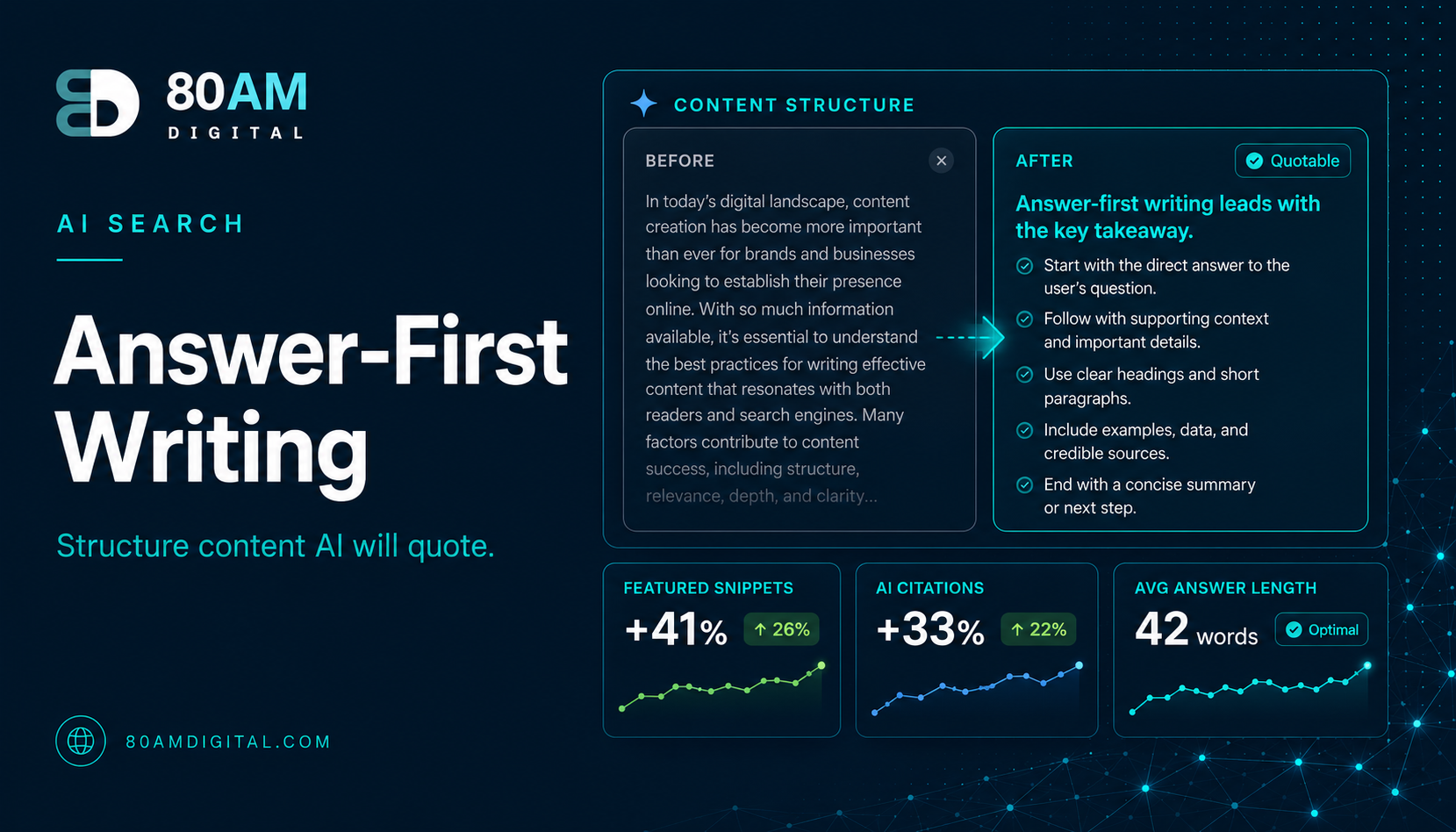
Before and after, side by side
An FAQ page’s section on “what is a canonical tag” originally opened: “Many site owners run into duplicate content without realising it. Search engines need a way to know which version of a page is the one to index. This is where canonical tags come in.” Three sentences of buildup before any definition appeared — and the section never showed up in AI Overviews or ChatGPT answers for the query, despite the page ranking on page one of Google.
The team rewrote the opening to: “A canonical tag is an HTML element that tells search engines which version of a duplicate or near-duplicate page should be treated as the original for indexing and ranking purposes.” The buildup sentences moved after the definition instead of before it. Within three weeks of the change being indexed, manual checks showed the page being cited in Perplexity’s answer to “what is a canonical tag” — the same content, reordered to lead with the extractable statement.
Frequently asked questions
Write for extraction
AI search rewards content that is structured to be used, not just consumed. Answer-first writing is the most direct way to make your content AI-citable without compromising its value for human readers — because a well-structured answer that leads with the conclusion is also a better reading experience than one that buries it.
If you’d like help auditing your existing content for AI citability and restructuring pages for better AI and traditional search performance, see how we approach content strategy.