Brand Mentions vs Backlinks: What Matters for AI Search
Backlinks built SEO for 20 years. Brand mentions are becoming at least as important in the age of AI search. Here’s how they differ and why both now matter.
For most of Google’s history, backlinks — hyperlinks from other websites to yours — were the dominant signal of authority. PageRank, Google’s foundational algorithm, treated each link as a vote of confidence, and the number and quality of those votes determined where a page ranked. This remains true and important. But the rise of AI search has introduced a parallel signal that’s becoming increasingly significant: brand mentions without links.
AI search systems don’t just crawl hyperlinks. They process the full text of the web — articles, forums, reviews, social discussions — and form associations between brand names and topics based on how and where those names appear, whether or not a hyperlink accompanies the mention. A brand that’s discussed positively across many authoritative sources has a very different entity authority profile than a brand that’s barely mentioned outside its own website, even if both have the same number of backlinks.
The Short Version
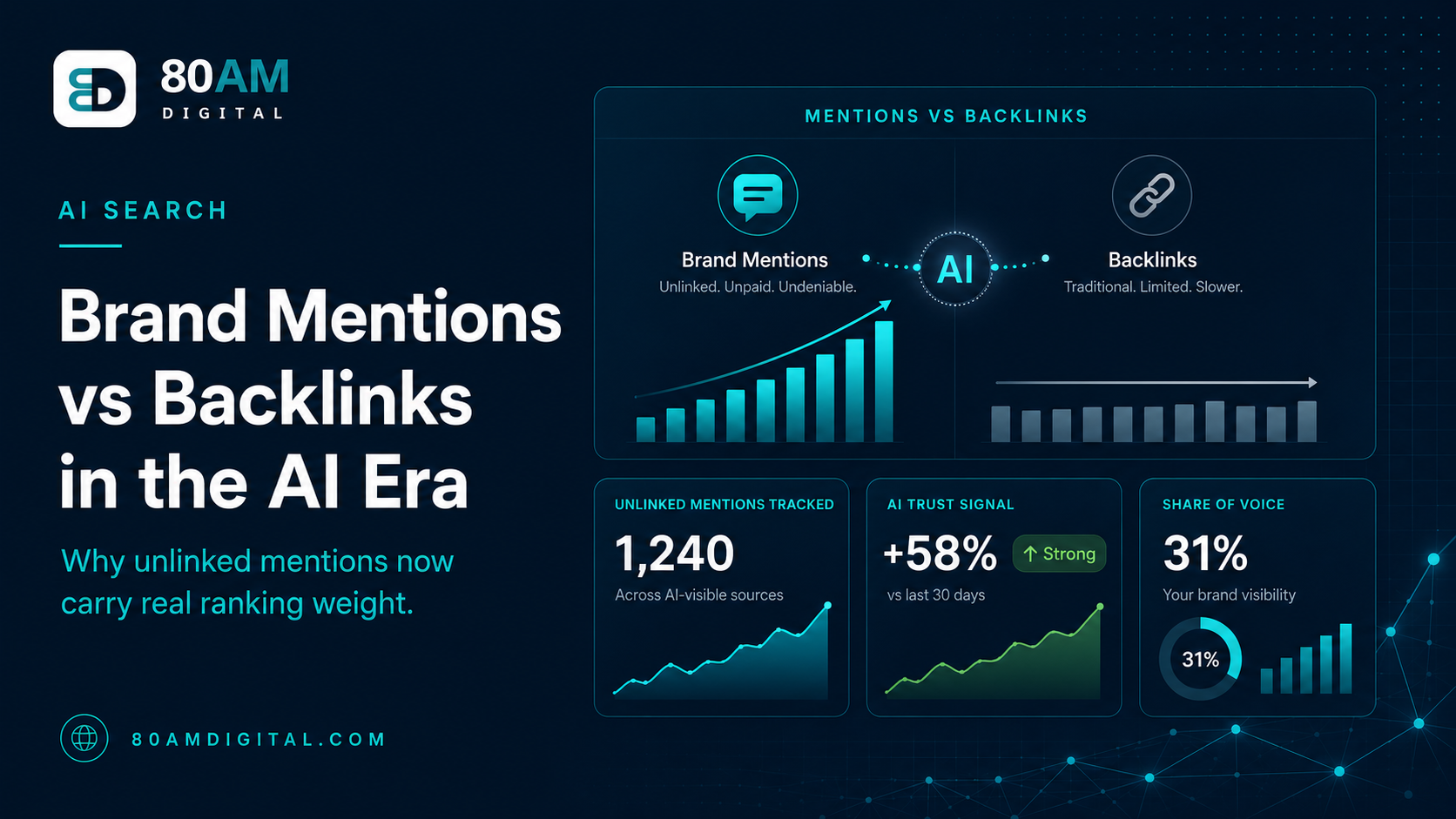
Backlinks transfer PageRank and remain the primary signal for traditional organic rankings. Brand mentions — even unlinked — build entity authority that AI systems use to associate your brand with a topic when answering recommendation-style queries. AI systems have no PageRank equivalent, so they lean heavily on co-occurrence: how often, and how positively, your brand appears alongside a topic across the web. The strategy is to earn both wherever possible (digital PR), and not dismiss unlinked mentions as worthless.
Table of Contents
Why Brand Mentions Matter for AI Search Citation
When an AI system is trained on or queries the web to answer “which are the best SEO agencies in the UK,” it doesn’t count backlinks. It looks at which brands are discussed in the context of “SEO agency,” “SEO results,” “recommended for SEO,” “hired for SEO” across a large corpus of text. A brand that appears across industry publications, client testimonials, review sites, and professional forums in consistently positive association with a relevant topic category accumulates entity authority that influences AI citation decisions.
This is not entirely new — Google has long talked about using “implied links” (mentions without hyperlinks) as a signal — but AI search makes it more prominent and more measurable. Perplexity and ChatGPT, when recommending service providers, draw on this association signal extensively because they have no equivalent of PageRank to rely on.
Backlinks vs Mentions: What Each Does
Backlinks: Transfer PageRank authority from the linking domain to the destination page. Directly influence traditional organic rankings. Require active link-building or editorial coverage that results in a hyperlink. Can be acquired through digital PR, guest content, partnerships, and resource page placements. Quality and relevance of the linking domain matter more than quantity. Still the primary authority signal for traditional organic search rankings.
Brand mentions (without links): Contribute to entity authority and topical association signals. Influence AI search citations by building associations between the brand name and the relevant topic domain. Accumulate from any published mention — review sites, forums, social media, press coverage, podcast transcripts, newsletter archives. Don’t directly transfer PageRank but build the entity trust that AI systems draw on for recommendation queries. Increasingly important as the primary discovery mechanism shifts from “search for a keyword and find a website” to “ask an AI for recommendations.”
| Dimension | Backlinks | Brand mentions |
|---|---|---|
| Primary mechanism | PageRank transfer | Co-occurrence / entity association |
| Where it influences | Traditional organic rankings | AI Overviews, chatbot recommendations |
| How it’s acquired | Digital PR, guest content, partnerships | Any published discussion, linked or not |
| Measurability today | Mature tooling (Ahrefs, Semrush) | Earlier-stage tooling (Mention, Brand24) |
| Decay rate | Slow, link can be removed | Cumulative, hard to “remove” |
Strategies That Earn Both
The highest-leverage activity is digital PR that earns both a backlink and a brand mention in the same piece of coverage — a journalist article that links to your original research, a trade publication that includes your expert quote with a link, a case study co-published with a client who links back from their own site. These count in both the traditional link graph and the entity mention corpus.
For mentions-only: ensure your brand appears in industry discussions, review platforms (Google Business, Clutch, G2), podcast conversations, and conference speaker lists. These are unlinked in most cases, but they build the entity signal that makes your brand a recognisable, associated name in your topic area.
For the broader AI citation strategy, see how AI Overviews choose sources. For how brand mentions connect to entity SEO, see entity SEO fundamentals.
A Worked Example
A mid-sized accounting software company had strong backlinks from years of content marketing but found it was rarely recommended when prospects asked AI chatbots for software recommendations in its category. An audit showed the brand had almost no presence in the unlinked discussion spaces where buyers research software — Reddit threads, G2/Capterra reviews, podcast mentions, “best of” listicles from independent reviewers.
Over six months, the team ran a structured mention-building programme: encouraging satisfied customers to leave detailed G2 and Capterra reviews, pitching the founder for category podcast appearances, and participating substantively (not promotionally) in relevant subreddit and community discussions. Backlink count barely moved — most of this activity generated no links at all.
By the end of the period, the brand began appearing in AI chatbot responses to “best accounting software for small business” queries where it had previously been absent, despite no material change in organic rank. The mention volume and positive sentiment across review platforms and community discussion was the variable that moved — confirming that for AI-driven recommendation queries, entity presence beyond the link graph was the missing input.
Frequently Asked Questions
Build Presence Across the Topic, Not Just on Your Own Site
The authority signal that AI search systems respond to isn’t contained within your website — it’s distributed across every place your brand is discussed, mentioned, cited, or recommended on the web. Building that distributed presence — through earned media, industry participation, review platforms, expert contributions, and original research — is the activity that produces AI citation authority. Backlinks remain essential for traditional rankings. Brand mentions are increasingly the currency of AI search. Building both is the strategy.
If you’d like help developing a brand mention and link building strategy for AI search, get in touch.