FAQs for Answer Engines: How to Write Q&A Content AI Will Cite
FAQ sections aren’t just for user experience. Written correctly, they’re the format AI search systems are most likely to extract and cite. Here’s how to write them.
Question-and-answer content is the format most naturally aligned with how AI search systems work. An AI Overview, a Perplexity answer, or a ChatGPT response with web search is essentially answering a question by synthesising content from multiple sources — and content that’s already structured as a question and a direct answer is far easier to extract, attribute, and cite than long-form prose that buries the answer in the middle of a section.
FAQ sections done well aren’t a box-ticking exercise at the bottom of a page. They’re one of the highest-leverage formats for appearing in AI-generated answers across a range of queries that don’t perfectly match any single article on your site. This article covers what makes a FAQ citable, where to place FAQ content, how to write questions and answers that extraction systems can use, and how to implement FAQ schema correctly.
The Short Version
FAQ content is the closest match to how AI search systems work: a question in, a direct answer out. Citable FAQs use real search queries as questions, answer in the first sentence, stay self-contained at 60–150 words, and carry FAQPage schema. Place FAQs at the end of every article and, where natural, inline within how-to content. The most common failure isn’t missing schema — it’s questions nobody searches for and answers that require reading the rest of the page to make sense.
Table of Contents
What Makes a FAQ Citable by AI Systems
The question must match real search intent. FAQ questions that nobody actually asks (“What makes your company unique?”) are invisible to AI search systems because they don’t match any query. Questions should be drawn from actual search data: Search Console queries, “People also ask” suggestions in the SERP, keyword research, and the questions your customers actually ask before they buy. Every FAQ question should be something a real person might type or speak into a search interface.
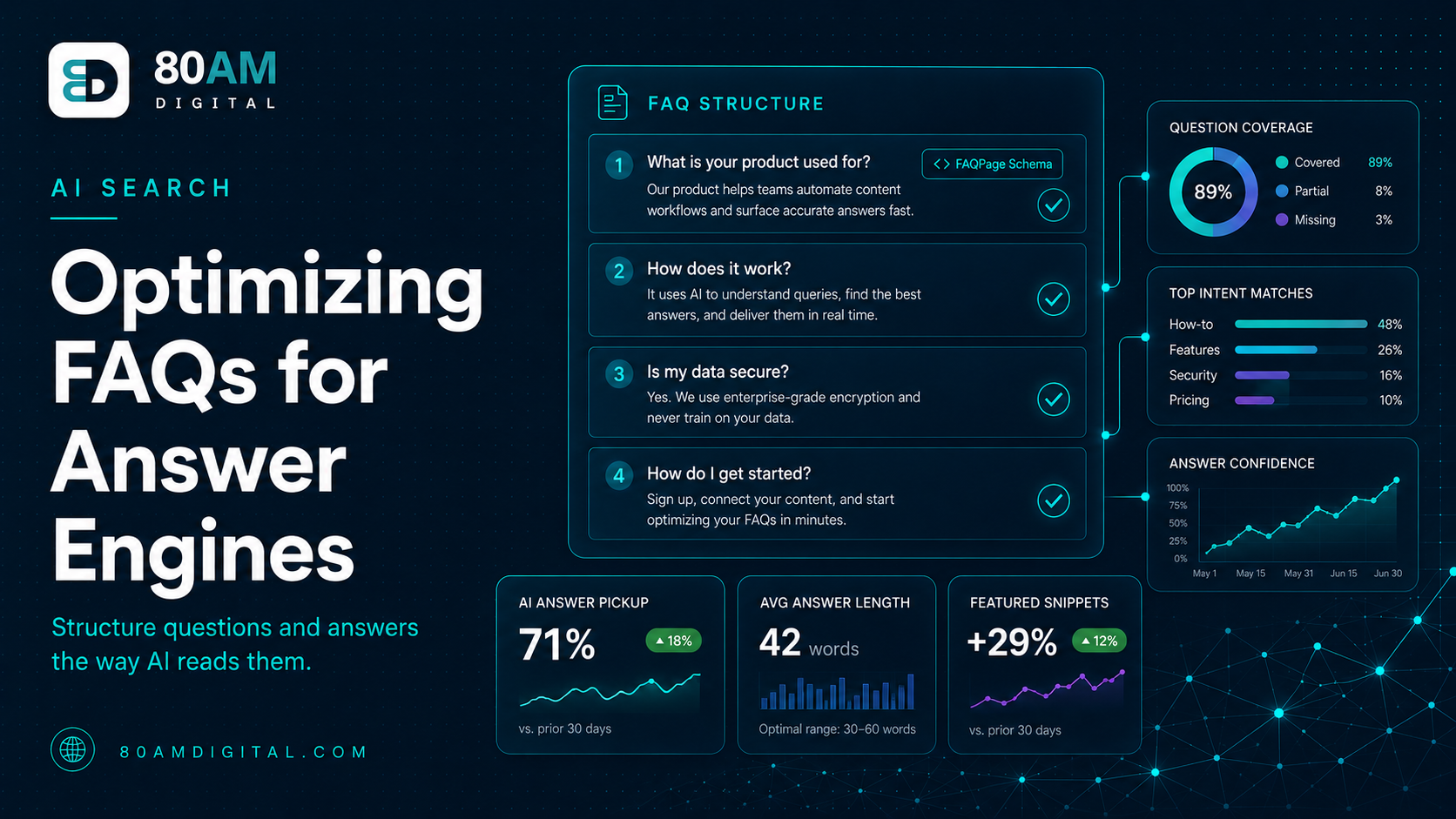
The answer must be complete in itself. An AI Overview extracts and displays the answer without the surrounding context. An answer that says “As we mentioned above, the key factor is…” makes no sense when displayed in isolation. FAQ answers should be self-contained: they answer the question completely without referencing other parts of the page. Aim for 60–150 words per answer — enough to be complete, short enough to display cleanly in a search feature.
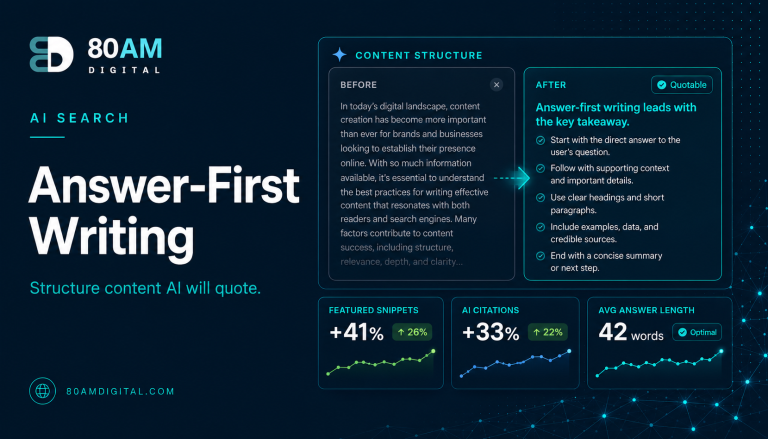
The answer must lead with the answer. Don’t start FAQ answers with a preamble (“That’s a great question. There are many factors to consider…”). Start with the direct answer to the question. “Yes,” “No,” “Three steps,” or the key fact — whatever the answer actually is — should appear in the first sentence. AI extraction systems optimise for direct answers; preamble gets left out or deprioritised.
FAQ schema (JSON-LD) must be implemented. Without FAQ schema, search systems may still extract your Q&A content, but with FAQ schema they have an explicit, machine-readable signal that this content is structured Q&A, which makes it more likely to appear in rich results and more reliably extracted by AI systems. Implement FAQPage schema with Question and acceptedAnswer properties for every FAQ section.
Writing Questions That Match Real Search Intent
The single biggest difference between a FAQ section that drives AI visibility and one that doesn’t is where the questions came from. A FAQ written from internal assumptions about what customers “probably” want to know rarely matches actual query patterns. A FAQ written from search data does.
- Search Console query report: filter to the page you’re adding FAQs to, sort by impressions, and look for question-format queries the page doesn’t directly answer in its body copy.
- “People also ask” boxes: search your primary keyword and note the PAA questions Google already considers related — these are pre-validated as real query patterns.
- Sales and support transcripts: the questions prospects ask on calls or in support tickets before converting are often more specific and commercially relevant than anything keyword research surfaces.
- Competitor FAQ sections: not for copying answers, but for confirming which questions are common enough that multiple sites have chosen to address them.
A useful filter once you have a candidate list: would a real person type or say this exact phrase into a search bar? “What is the average cost of X” passes. “Why is our solution the best choice for X” does not — that’s a sales question dressed up as a search question, and it won’t match any real query pattern AI systems are synthesising answers from.
Structuring Answers AI Can Extract
Two FAQ answers can cover the same fact and have wildly different extraction odds depending on how they’re structured. The table below shows the pattern.
| Element | Low-extraction pattern | High-extraction pattern |
|---|---|---|
| Opening sentence | “That’s a common question, and there are a few factors to think about…” | “Most FAQ pages should have between four and eight questions.” |
| Context dependency | References “the table above” or “as discussed earlier” | Fully self-contained — makes sense with zero surrounding context |
| Length | One line (“It depends”) or 400+ words | 60–150 words: complete but compact |
| Structure | Buried qualifier before the actual answer | Answer first, qualifiers and nuance after |
| Specificity | Vague generalities (“it varies by business”) | Concrete numbers, thresholds, or named steps |
Implementing FAQ Schema Correctly
FAQPage schema marks each question as a Question entity with a name property and a nested acceptedAnswer entity carrying the answer text. A few implementation details matter more than they might appear:
- The schema text must match the visible text. Google and AI crawlers cross-check structured data against rendered content; schema that doesn’t match what’s on the page can be ignored or treated as a quality signal failure.
- Mark up every FAQ section, not just one per page. If you have an inline FAQ and an end-of-article FAQ, both should carry schema — there’s no per-page limit on FAQPage instances.
- Don’t mark up content that isn’t really a FAQ. Wrapping a bullet list of features in FAQ schema because “what does X include” sounds like a question is a manipulative pattern search engines have explicitly targeted with policy changes.
- Validate with Google’s Rich Results Test after implementation, and recheck after any theme or page-builder update — schema output is one of the most common things that silently breaks during a redesign.
Where to Place FAQs on a Page
A dedicated FAQ section at the end of an article (as this page demonstrates) is the most common and effective placement. The FAQ section expands the page’s keyword coverage to long-tail, question-format queries that the article body doesn’t directly address, giving the page additional entry points for AI-sourced traffic.
FAQ sections can also be embedded within the body of an article at points where questions naturally arise. This works well for how-to content where anticipated questions interrupt the instructional flow (“But what if your hosting plan doesn’t support…?”). These inline FAQs carry FAQ schema benefits if marked up correctly, even when not in a dedicated section at the end.
For the broader content format principles, see answer-first writing for AI search. For the structured data implementation, see schema markup for AI visibility.
A Worked Example
A B2B payments company had a FAQ section on its main pricing page with eleven questions, most written from a sales perspective: “Why choose us over a competitor,” “What makes our security different.” None of these matched real search queries, and Search Console showed the page earning impressions for zero question-format queries despite ranking well overall.
The team pulled the actual query list from Search Console and cross-referenced it against PAA boxes for their core terms, rebuilding the FAQ around six real questions: “How long does payment processing setup take,” “What are the fees for international transfers,” “Is there a minimum monthly volume requirement,” and three others phrased exactly as customers searched them. Each answer was rewritten to lead with the direct answer in the first sentence and stay under 130 words.
Within ten weeks, the page began appearing in AI Overviews for three of the six questions, and Search Console showed impressions on question-format queries the page had never previously ranked for. The fact pattern wasn’t unusual — the original questions simply hadn’t been written to match anything anyone searches for.
Frequently Asked Questions
Q&A Format Is the Native Language of AI Search
AI search systems answer questions. Content that’s structured as questions and direct answers gives those systems exactly what they need to extract, attribute, and cite. FAQ sections with real questions, direct answers, and FAQ schema are one of the most efficient investments for AI search visibility — they extend a page’s reach to question-format queries, improve structured data coverage, and provide the citation-ready format that AI systems prefer. Every article on a topic-authority site should end with one.
If you’d like help structuring your content for AI search visibility, get in touch.