Will AI Kill SEO? The Honest Answer
AI search is changing SEO — but it’s not killing it. Here’s what’s actually changing, what remains constant, and what the businesses winning at SEO in 2026 are doing differently.
The question gets asked every few years with a different noun in place of “AI.” Will social media kill SEO? Will voice search kill SEO? Will Google’s algorithm updates kill SEO? SEO has survived each of them, not by staying the same but by shifting with the underlying change in how people find content and what earns the right to be found. AI search is a more significant shift than any of those predecessors. But “more significant” is not the same as “terminal.”
The honest answer is: AI is killing some forms of SEO, fundamentally changing others, and leaving a substantial portion intact. This article breaks down each category specifically, with data on the actual traffic impact so far, and a worked example of how one business repositioned rather than retreated.
The Short Version
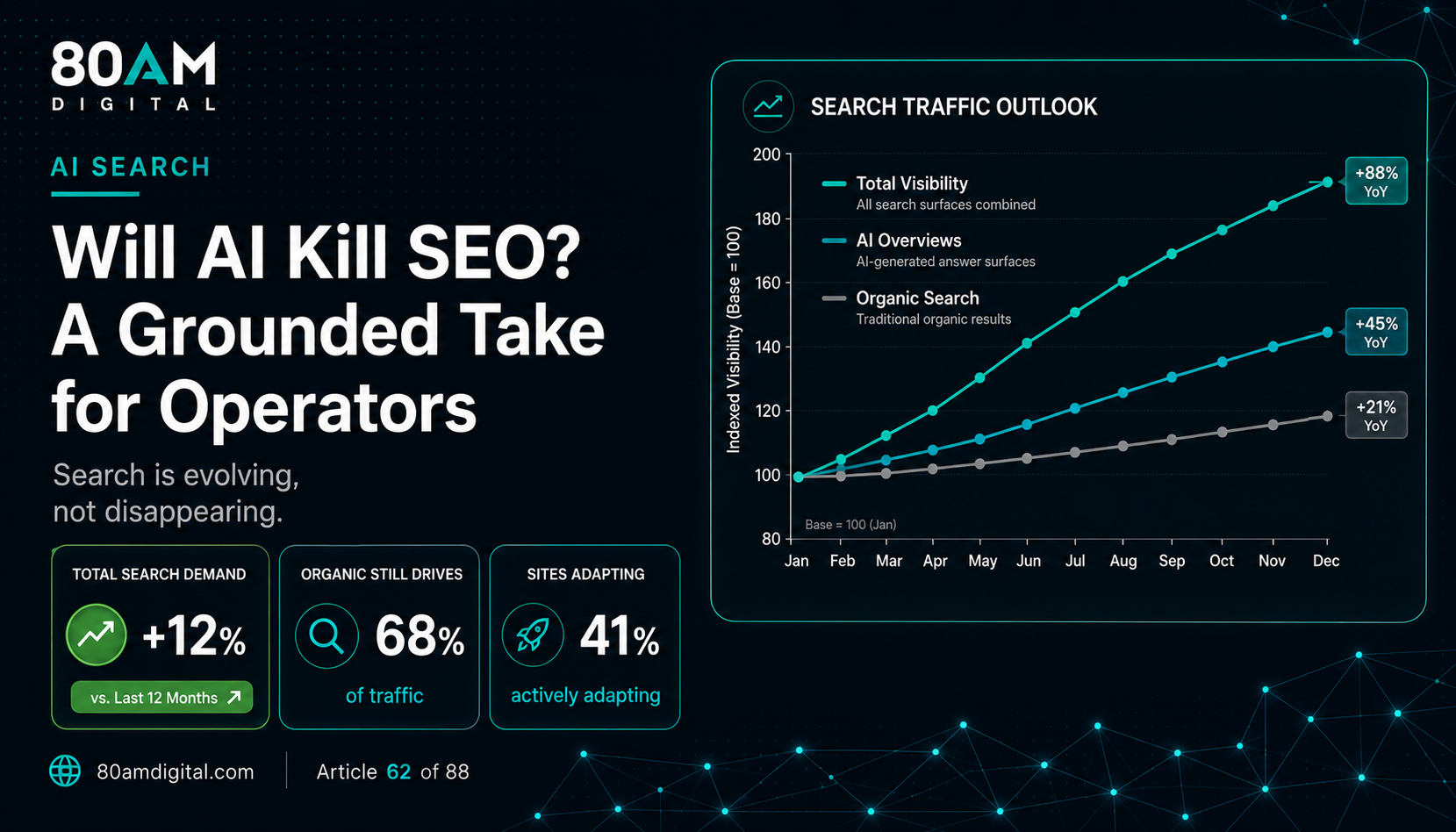
AI search is killing thin informational content farms and keyword-stuffed pages without real expertise behind them. It’s changing what “success” looks like — citation share alongside rank, answer-first structure alongside keyword targeting, brand mentions alongside backlinks. It’s not changing the need for commercial and local search, the value of genuine brand authority, or the competitive advantage of topical depth. Overall click declines to websites are estimated at 10–20% through mid-2025, concentrated heavily in informational content — commercial-intent sites are seeing far smaller, sometimes positive, impact.
Table of Contents
| Category | Examples | Verdict |
|---|---|---|
| Killing | Thin content farms, keyword stuffing, “publish more” volume plays | Largely over as a viable strategy |
| Changing | Rankings → citation share, keyword density → extractability, links → entity authority | Adapt the approach, keep the goal |
| Not changing | Commercial/local search, brand authority value, topical depth advantage | Keep doing what’s already working |
What AI Search Is Killing
Thin, informational content farms: The category of SEO that produced thousands of articles designed primarily to rank for informational keywords with thin, commodity content — “what is X,” “how does Y work,” “10 tips for Z” — is genuinely under threat. AI Overviews can synthesise a better version of this content in real time, without the visitor needing to click through to the page that contains it. The traffic model that depended on aggregating dozens of these thin informational queries into meaningful traffic numbers is broken.
Keyword-stuffed optimisation without substance: Pages that ranked historically through aggressive keyword matching and on-page manipulation — keyword in title, keyword in headings, keyword in every paragraph, without substantive expertise behind them — were already in decline from Google’s helpful content systems. AI search accelerates this decline by preferring sources with demonstrated authority and genuine expertise over pages that merely contain the right phrases.
The “publish more” content strategy: The approach of building organic traffic by publishing a high volume of keyword-targeted articles, without a clear differentiated point of view or expertise, is losing its effectiveness faster than before. Volume alone no longer overcomes quality deficits when AI systems are selecting sources based on authority, specificity, and genuineness.
What AI Search Is Changing (But Not Killing)
The role of rankings: Ranking #1 remains valuable, but appearing in AI Overviews at position 1 of the AI-summarised answer is increasingly the more valuable position for high-volume informational queries. The metric shifts from “ranking” to “citation share” — what percentage of the relevant queries in your topic space result in your content being cited. This requires a different optimisation approach than traditional rank tracking.
The content success criteria: Content that previously succeeded by ranking well for a target keyword now needs to also be directly extractable for the AI answer to that query. Answer-first structure, FAQ sections with schema markup, and topical depth become more important than exact keyword frequency.
Link building vs brand authority: Backlinks remain important for traditional rankings, but brand mentions, entity associations, and distributed presence across authoritative platforms become equally important for AI citation authority. The link-centric model of SEO expands to a broader authority-building model.
What AI Search Is Not Changing
- The need for commercial, transactional, and local search: “Hire SEO agency,” “ecommerce SEO pricing,” “best restaurant in Brighton” — these queries require visiting a specific business. AI Overviews don’t replace the click for a buyer who needs to choose a provider, make a purchase, or visit a location. The commercial search use case — where organic traffic leads to revenue — is largely intact.
- The value of brand authority in search: Brands that are recognised, trusted, and frequently mentioned across the web get preferred treatment from AI systems as well as from traditional Google rankings. Building a genuine brand with real expertise and real results remains the most durable SEO foundation, independent of how the search interface changes.
- The competitive advantage of topical depth: Comprehensive, authoritative coverage of a topic — the topic cluster model — performs better in AI search for the same reasons it performs better in traditional search: it signals expertise and trustworthiness to the systems deciding what to surface.
For the practical implications for your content strategy, see topic clusters for AI search. For how to adapt your specific measurement approach, see how to track AI and zero-click visibility.
A Worked Example
A home services franchise network built most of its organic traffic on a library of 400+ thin “how to fix X” articles, each targeting a narrow DIY query. Traffic to that library fell 38% over twelve months as AI Overviews began answering the same questions directly in the search results, with no need to click through.
Rather than abandoning content investment, the team reallocated it. They pruned roughly 150 of the lowest-performing, most easily-synthesised DIY articles, and redirected the budget into two areas the audit showed AI search hadn’t displaced: location pages with genuine local detail (service area, technician credentials, real customer reviews) and a small library of “when to call a professional vs DIY” comparison content — exactly the kind of decision-support content that still drives a click because the reader needs a recommendation, not just a fact.
Twelve months later, total organic traffic was down slightly versus the prior peak, but lead volume and revenue from organic were up 14%, because the remaining and new content was concentrated on queries that still required a business decision rather than a fact lookup. The DIY content loss was real; the business impact wasn’t, because the content mix shifted toward what AI search hadn’t taken away.
Frequently Asked Questions
AI Is Raising the Bar, Not Lowering the Ceiling
SEO isn’t dying — it’s being subjected to a more rigorous quality test. The shortcuts and volume plays that worked for the last decade are losing their effectiveness faster than they were before. The foundations — genuine expertise, technical excellence, real brand authority, comprehensive topic coverage — are becoming more valuable, not less. Businesses that have been building these foundations will find that AI search rewards them more explicitly than traditional search did. Businesses that relied on thin-content volume will need to rebuild on stronger ground. That’s not the death of SEO. That’s the maturation of it.
If you’d like to assess your site’s position relative to these changes and plan your strategy, get in touch.