Zero-Click Search: What It Means and How to Adapt Your Strategy
More searches than ever end without a click. Understand what drives zero-click, which queries are worth targeting anyway, and how to adapt your SEO strategy.
Table of Contents
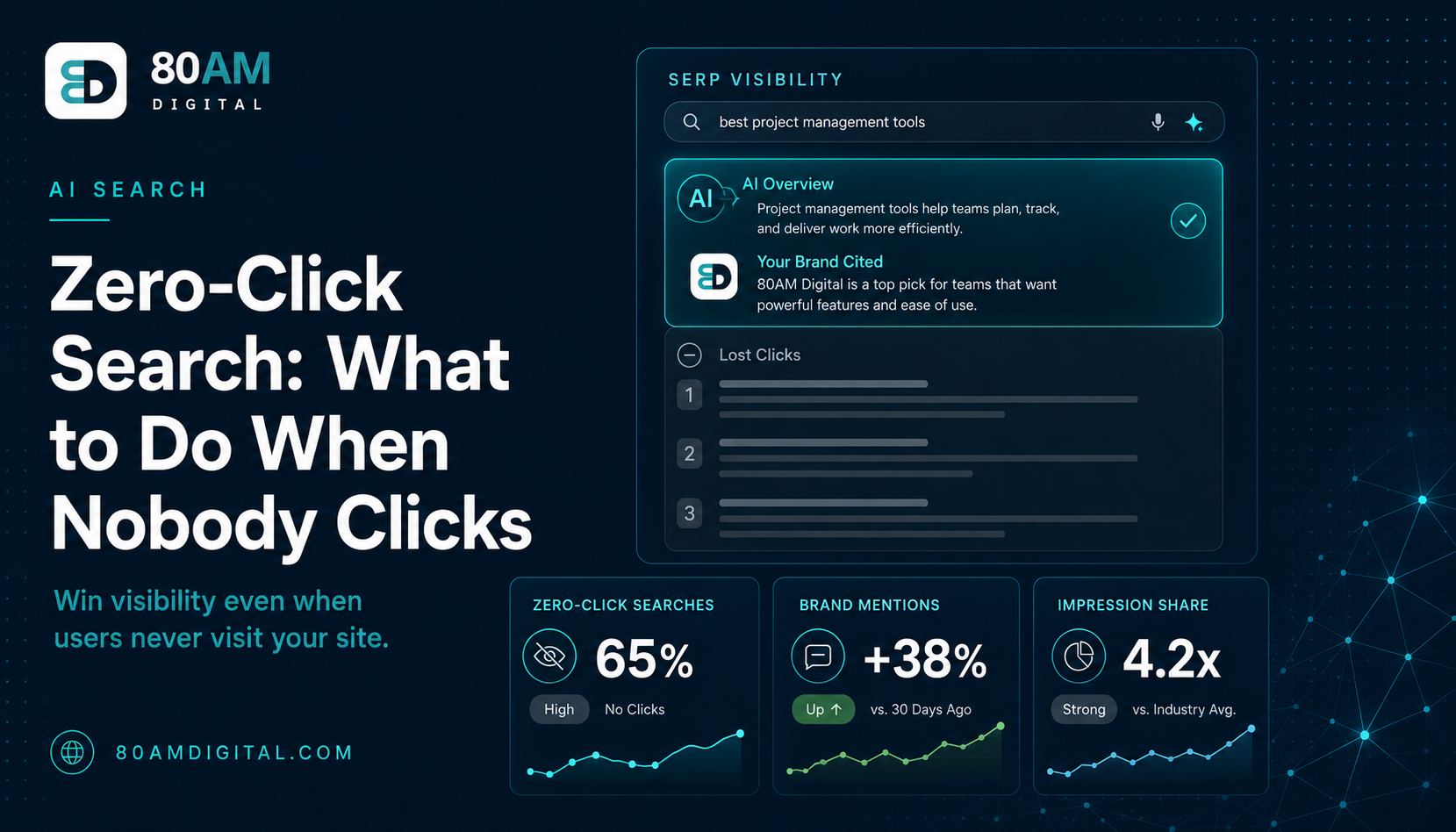
A zero-click search is one where the user gets the answer they need directly in the search results page — from a featured snippet, a Knowledge Panel, an AI Overview, a calculator, a weather widget — without clicking through to any website. Estimates from SparkToro and Rand Fishkin suggest roughly 60% of searches end without a click. That figure has grown as Google has added more direct-answer features to the SERP, and AI Overviews accelerate the trend further.
The first reaction to this data is often alarm. If 60% of searches produce no click, is SEO investment still worth making? The answer is more nuanced than the headline number suggests — but the implications for strategy are real.
The Short Version
- Zero-click rates aren’t uniform — simple factual queries are fully absorbed by SERP features; commercial and transactional queries still drive clicks.
- Definition articles and simple how-tos are the most exposed content types; detailed tutorials, comparisons, and transactional content still require a site visit.
- Winning a featured snippet is still usually worth it — it outperforms the #2 organic position even when it depresses overall clicks on that specific query.
- Zero-click doesn’t mean SEO is dying — it means informational publisher content is most exposed, while service and product businesses targeting commercial queries are largely unaffected.
Not all queries have the same zero-click rate
Zero-click rates are not uniform across query types. Queries that Google can answer completely within the SERP have extremely high zero-click rates: “what is the capital of France,” “time in New York,” “10 euros in dollars,” “weather tomorrow London.” Nobody needs to click through to a website to answer these questions — and they never did, even before Google added answer features.
Queries where the user needs to read a full explanation, compare options, evaluate a service, make a purchase, or learn a skill have much lower zero-click rates. “How to fix Core Web Vitals,” “best SEO agency for ecommerce,” “how to write a content brief,” “technical SEO consultant Brighton” — these queries can’t be fully answered in a SERP feature. The user still needs to visit a website to get what they came for. These are the queries that still drive clicks, and they’re the queries worth building SEO strategy around.
Which types of content are most at risk
| Content type | Zero-click risk |
|---|---|
| “What is X” definitions | High — fully extractable into a one-paragraph snippet |
| Simple procedural how-tos | High — short instructions display directly in the SERP |
| Detailed multi-step tutorials | Low — too long/nuanced to compress into a feature |
| Comparison and transactional content | Low — requires evaluating options or completing an action |
- Definition and factual content: “What is [X]” articles are highly vulnerable. If a one-paragraph definition fully answers the query, AI Overviews and featured snippets extract it and display it without a click. Traffic to definition-focused content has declined materially for many publishers.
- Simple how-to content: Quick procedural instructions (“how to clear browser cache,” “how to add alt text in WordPress”) are displayable in a SERP feature. More complex how-to content with multiple steps, nuance, or context requirements still drives clicks.
- Pure informational queries with clear single answers: Any query where the correct answer is a single sentence or a short list is at elevated zero-click risk.
Adapting strategy: what still drives clicks
Content that can’t be compressed into a SERP feature continues to drive clicks. Specifically:
- Detailed tutorials and step-by-step guides that require reading the full page to understand and apply
- Comparison content where the user needs to evaluate multiple options in depth before deciding
- Original research and data that can be referenced in a snippet but requires visiting the source to use
- Commercial and transactional queries where the user needs to purchase, contact, or sign up
- Local and navigational queries where the user needs to visit a specific business or page
The strategic response to zero-click search isn’t to avoid appearing in featured snippets or AI Overviews — appearing in these features still builds brand recognition and drives branded searches even when it doesn’t generate a direct click. The strategic response is to prioritise content types and query targets where the full answer requires visiting your site.
For how AI search features decide what to surface, see how AI Overviews choose their sources. For measuring visibility in AI search when clicks don’t follow, see how to track AI and zero-click visibility.
Zero-click exposure by query type
Where the risk concentrates
A worked example: reallocating a content calendar
A marketing software company’s content calendar was roughly 60% definition-style articles (“what is X,” “Y vs Z meaning”) and 40% deeper guides and comparisons. A Search Console review showed the definition articles had high impressions but average CTR under 1.5%, while the deeper guides averaged 4-6% CTR on similar impression volumes — a clear sign the definition content was being absorbed into zero-click features at a much higher rate.
The team rebalanced the calendar to roughly 25% definition content (kept for entity and topical-coverage reasons, not traffic) and 75% detailed guides, comparisons, and template/tool-style content that required a site visit to use. Over the following two quarters, total organic sessions rose even though the number of published articles per month stayed the same — the shift toward click-resistant content types produced more traffic per piece published, even as several of the new definition-style pages still picked up featured snippets and contributed to branded search growth.
Frequently asked questions
Target clicks, not just impressions
Zero-click search is a real structural shift — not a crisis, but a reason to be more deliberate about which queries you build content around. Queries that generate impressions but no clicks have branding value; queries that generate clicks and conversions have revenue value. The strategy is to maximise both, while accepting that the proportion of impressions that convert to clicks will continue to decline for purely informational queries as AI Overviews expand their coverage.
If you’d like help auditing your organic search strategy in the context of zero-click trends, get in touch.