Topic Clusters in the Age of AI Search
Topic clusters were built for Google. They’re even more important for AI search, where depth and entity authority determine which sites get cited. Here’s how to build them.
Table of Contents
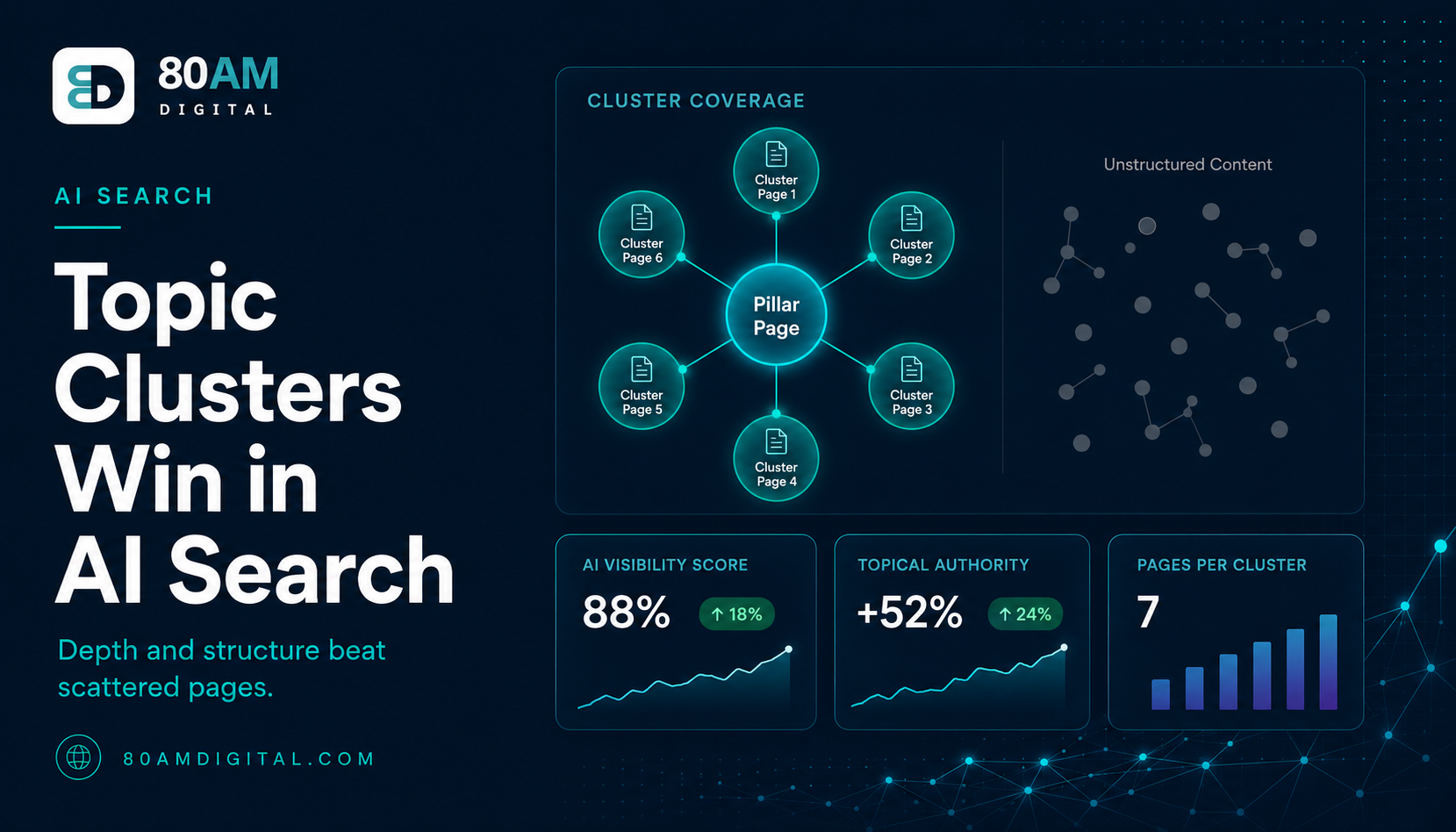
The topic cluster model — a pillar page covering a broad topic, supported by cluster pages covering subtopics, all interlinked — was designed for traditional search. It works because it signals topical authority to Google: a site with deep, interlinked coverage of a topic ranks better for that topic than a site with a single excellent page about it.
In AI search, the same principle applies with even more force. AI systems synthesising answers from the web need to find comprehensive, trustworthy coverage of a topic in one place. A well-built topic cluster is a more reliable source for AI citation than a single page, however excellent, because it demonstrates breadth of knowledge, consistent expertise, and a site that knows the topic thoroughly — not just the specific angle the user asked about.
The Short Version
- The structure stays the same (pillar + cluster pages + interlinking) — what changes is the weight on entity disambiguation, answer-first structure, and per-page schema.
- One page with original data or a proprietary framework gives the whole cluster “citation gravity” — AI systems prefer sources with information not available elsewhere.
- Audit existing clusters for: a complete pillar overview, answers in the first 100 words of each cluster page, coverage gaps vs. “People also ask,” and consistent internal linking.
- AI search makes the cluster model more valuable, not less — single-page content can’t demonstrate the topical authority AI systems prefer to cite.
How topic clusters differ for AI search
The core structure is the same: pillar page + cluster pages + internal links. What changes for AI search optimisation:
| What changes | Why it matters for AI |
|---|---|
| Entity disambiguation | AI needs to understand the topic as an entity, not just a keyword |
| Answer-first structure | AI extracts direct answers; buried answers don’t get cited |
| Schema on every cluster page | Helps AI identify content type and extract the right passage |
| Original data/research anchor | Gives the cluster citation gravity competitors can’t replicate |
- Entity disambiguation becomes more important: AI systems need to understand what your cluster is about as a topic (entity), not just as a keyword. Named concepts should be defined clearly, relationships between concepts should be stated explicitly, and schema markup should map the content to the relevant entities. See entity SEO for the underlying framework.
- Answer-first structure is more valuable: AI systems extract direct answers from content. Cluster pages that bury the answer to their stated question in a long preamble are less likely to be cited than pages that answer immediately in the first paragraph. The answer-first writing approach becomes the standard for all cluster pages, not just FAQ-style content.
- Schema markup on cluster pages matters more: FAQ schema, HowTo schema, and Article schema on individual cluster pages help AI systems identify what type of information each page provides and extract the relevant passage for a given query. A cluster where every page has appropriate structured data is more machine-readable and more likely to be cited correctly.
- Unique research or data in the cluster gives it citation gravity: AI systems prefer to cite sources that contain information not available elsewhere. If one page in your cluster contains original data, a proprietary framework, or a specific example that can’t be found on competitor sites, that page becomes a citation anchor — it pulls references to the broader cluster. See original data for citations for how to create this anchor content.
Auditing your existing topic clusters for AI readiness
For each existing cluster, check:
- Does the pillar page give a complete overview of the topic? AI systems often use the pillar page as the “this site knows this topic” signal, then drill into cluster pages for specific answers. A pillar page that’s too thin or too narrow limits the cluster’s AI citation potential.
- Do cluster pages answer their stated topic question in the first 100 words? If not, restructure to lead with the answer.
- Are there subtopics the cluster doesn’t cover? AI search surfaces the gaps — if users ask a question that your cluster doesn’t address, a competitor’s page fills the citation gap. Identify missing subtopics by checking “People also ask” for your pillar topic and the questions your cluster doesn’t currently answer.
- Is the internal linking from cluster pages back to the pillar page consistent? Internal links are how search systems understand cluster structure. Missing or inconsistent internal links fragment the entity signal.
For the content cluster fundamentals, see topic clusters explained. For how to build the supporting content efficiently, see content brief template.
What changes vs. what stays the same
The cluster model, sharpened for AI citation
A worked example: one cluster, audited and fixed
An ecommerce SEO agency’s “Core Web Vitals” cluster had a pillar page and nine cluster pages, but a four-question AI-readiness audit found problems: the pillar gave a solid overview but had no schema; six of nine cluster pages buried their answer after 200+ words of context; “People also ask” surfaced three subtopics (INP optimisation, third-party script impact, and mobile-specific CWV issues) the cluster didn’t cover at all; and three cluster pages had no internal link back to the pillar.
Over six weeks, the team added Article and FAQPage schema to all ten pages, rewrote the six buried-answer pages to lead with the answer in the first 60-80 words, published three new cluster pages covering the missing subtopics (one including original data from the agency’s own client audits on third-party script impact), and fixed the broken internal links. Manual citation checks across 12 related queries went from 1 citation before the fixes to 5 after, with the new original-data page on third-party scripts becoming the most frequently cited page in the cluster.
Frequently asked questions
Build the cluster, earn the authority
Topic clusters require more upfront investment than single-page SEO plays. The payoff is authority that’s harder to replicate and more durable: a site that comprehensively covers a topic earns citations across all the questions within that topic, in both traditional and AI search. That authority compounds as the cluster grows, the content is refreshed, and external sources reference the cluster as the definitive resource on the topic.
If you’d like help planning and building topic clusters for your niche, get in touch.