Entity SEO: How Google Understands Topics, Not Just Keywords
Google increasingly ranks by understanding entities — people, places, brands, concepts — not just matching keywords. Learn how to make your site an authoritative entity.
Table of Contents
A keyword is a string of text. An entity is a thing — a person, a place, a brand, a concept, an event — that exists and can be described and related to other things. Google’s move from keyword matching to entity understanding is one of the most significant shifts in how search works, and it has practical implications for how websites should be structured, what content should cover, and how sites establish authority on a topic.
When Google understands your site as an authoritative entity on a topic — not just a collection of pages containing keywords — you earn rankings more broadly, appear more consistently in AI-generated answers, and benefit from authority that compounds over time.
The Short Version
- An entity is a thing Google can describe and relate to other things — your brand, your authors, your products, the concepts you write about.
- Four levers build entity authority: schema markup, consistent name usage, sameAs links to authoritative platforms, and topic depth rather than just keyword breadth.
- Entity authority lets you rank for queries you never explicitly targeted and appear in AI answers even when the exact phrasing differs from your page.
- E-E-A-T is essentially entity attributes — expertise, authority, and trust mapped onto your author and domain entities.
What is an entity in Google’s understanding?
In Google’s Knowledge Graph, an entity is anything that has a distinct, unique existence that can be described: “80AM Digital” (a business entity), “Core Web Vitals” (a concept entity), “Shopify” (a product entity), “Brighton” (a place entity). Entities have attributes (properties) and relationships to other entities. “80AM Digital” has the attribute “industry: SEO” and the relationship “serves: ecommerce brands.”
When Google understands these relationships, it can answer queries about topics even when the exact query keywords don’t appear on a page — because it knows your page is authoritative on a topic, not just a keyword match for specific phrases.
How to build entity authority for your site
| Lever | What it signals |
|---|---|
| Schema markup | Explicit declaration of entity type, identity, and properties |
| Consistent entity mentions | One name, used identically everywhere, so signals consolidate |
| sameAs links | This site’s entity matches the same entity on trusted platforms |
| Topic depth | Comprehensive coverage, not just keyword-matched pages |
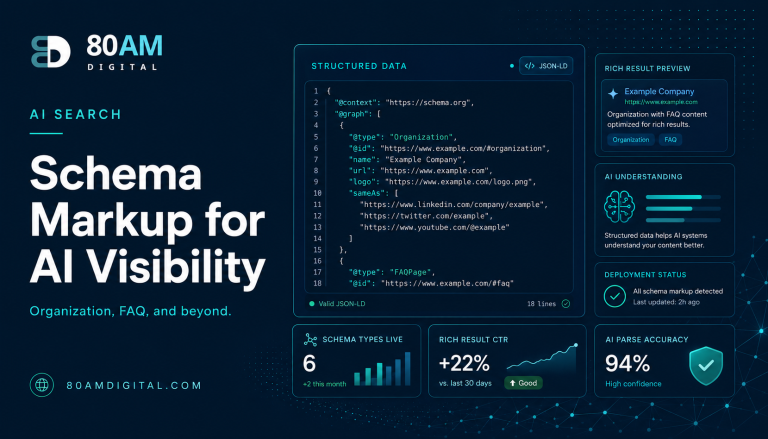
Schema markup: Structured data (JSON-LD) tells Google explicitly what type of thing your content describes. An Organization schema on your homepage declares your business name, logo, address, contact info, sameAs links (LinkedIn, Crunchbase, Wikipedia if applicable). A Person schema on an author page declares the expert’s name, credentials, and affiliation. This explicit declaration helps Google map your site to entities in its Knowledge Graph rather than having to infer the connection from text alone.
Consistent entity mentions: Your brand name, product names, and the names of key people associated with your site should be used consistently across all your content and all external references — social profiles, press mentions, directories, partner sites. Inconsistency (“80AM” vs “80AM Digital” vs “80am digital”) fragments the entity signal and slows Google’s ability to consolidate authority under a single entity.
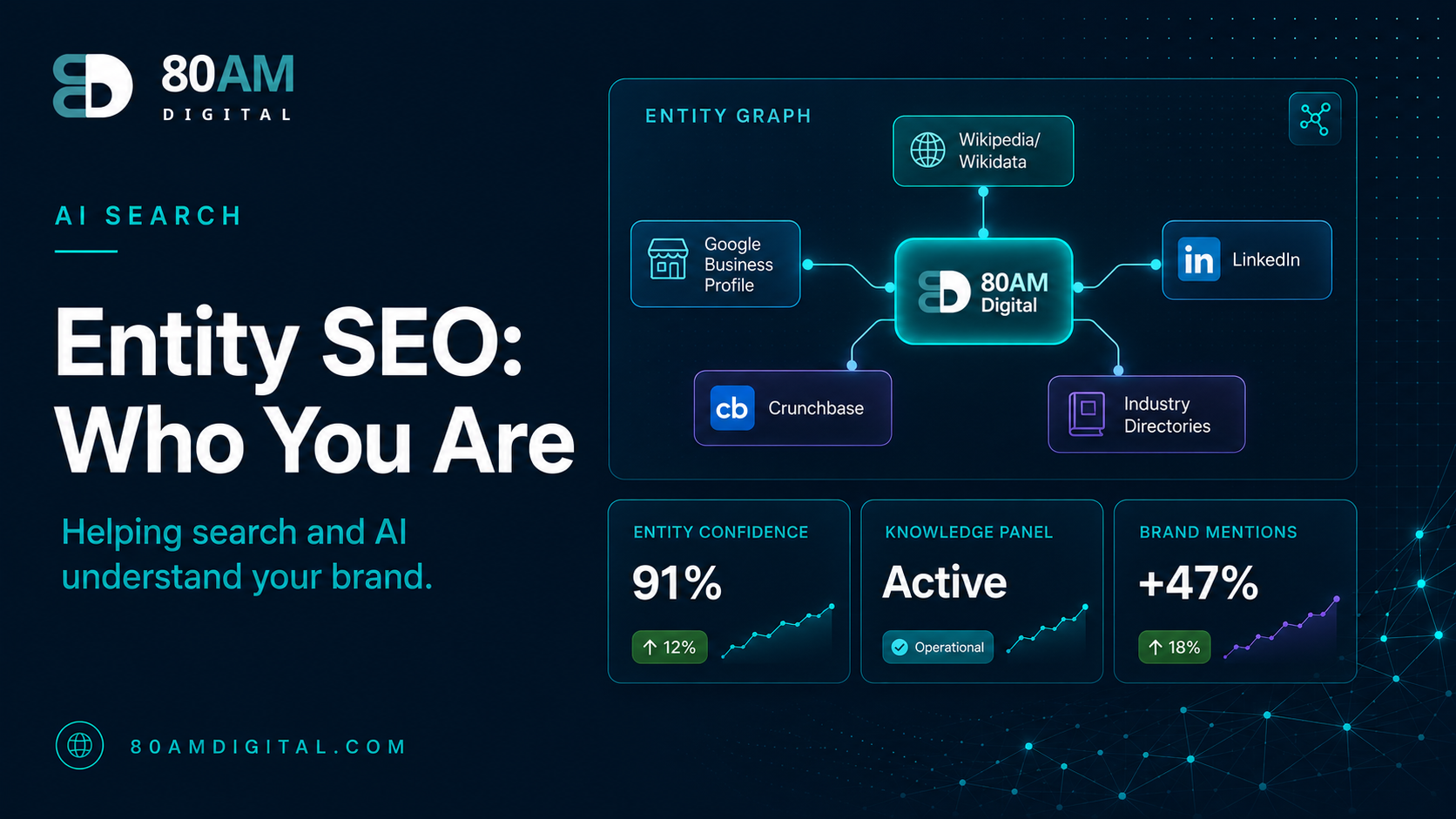
sameAs links: In your Organization or Person schema, the sameAs property lists external URLs that represent the same entity: your LinkedIn company page, Crunchbase profile, Google Business Profile, Wikipedia article (if one exists), Wikidata entry. Each sameAs link is a signal that the entity defined on your site is the same entity referenced on those authoritative platforms.
Topic depth, not just keyword breadth: A site that covers every aspect of a topic — from foundational explanations to edge cases to practical how-tos — signals to Google that it’s an authoritative entity on that topic, not just a site that contains content about it. This is the entity equivalent of building a content cluster, but the goal is topical authority (a signal that the entity “this site” = expertise in “this topic”), not just keyword coverage.
Entity SEO and AI search
AI search systems (Google’s AI Overviews, Perplexity, ChatGPT with search) draw on entity relationships to generate answers. A site that’s well-established as an entity on a topic is more likely to be cited as a source when that topic is queried, regardless of whether the exact keywords in the response appear on the site. Entity authority is one of the core mechanisms by which established brands consistently appear in AI-generated answers while newer or less well-defined sites with equivalent content do not.
For the structured data implementation that signals entity relationships, see structured data for rich results. For how entity authority connects to AI citations specifically, see how to get cited by AI search.
The four entity signals at a glance
What strong entity signals compound into
A worked example: consolidating a fragmented entity
An agency had grown organically over eight years, and its name appeared inconsistently across the web: “Northgate Digital” on its website, “Northgate” on Twitter, “Northgate Digital Marketing Ltd” on Google Business Profile, and “Northgate Digital Agency” in several older press mentions. The brand had no Knowledge Panel despite reasonable brand search volume, and AI tools frequently confused it with an unrelated company of a similar name.
The team standardised on “Northgate Digital” everywhere it had control — the website, Organization schema, Google Business Profile, and social bios — and added sameAs links connecting all of them in the schema. They also created a Wikidata entry, since Wikipedia notability wasn’t met. Over the following four months, a Knowledge Panel appeared for branded searches for the first time, and manual checks showed ChatGPT and Perplexity correctly distinguishing the agency from the similarly-named company in two of three test queries where confusion had previously occurred.
Frequently asked questions
Entities are the foundation beneath the keywords
Keyword targeting is the tactical layer of SEO. Entity authority is the strategic foundation beneath it. A site that establishes strong entity signals — clear structured data, consistent brand mentions, topical depth, sameAs links to authoritative platforms — earns the right to rank for queries it hasn’t explicitly targeted, appear in AI-generated answers, and compound its authority over time as its entity becomes more established in Google’s Knowledge Graph.
If you’d like help auditing your site’s entity signals and structured data, get in touch.