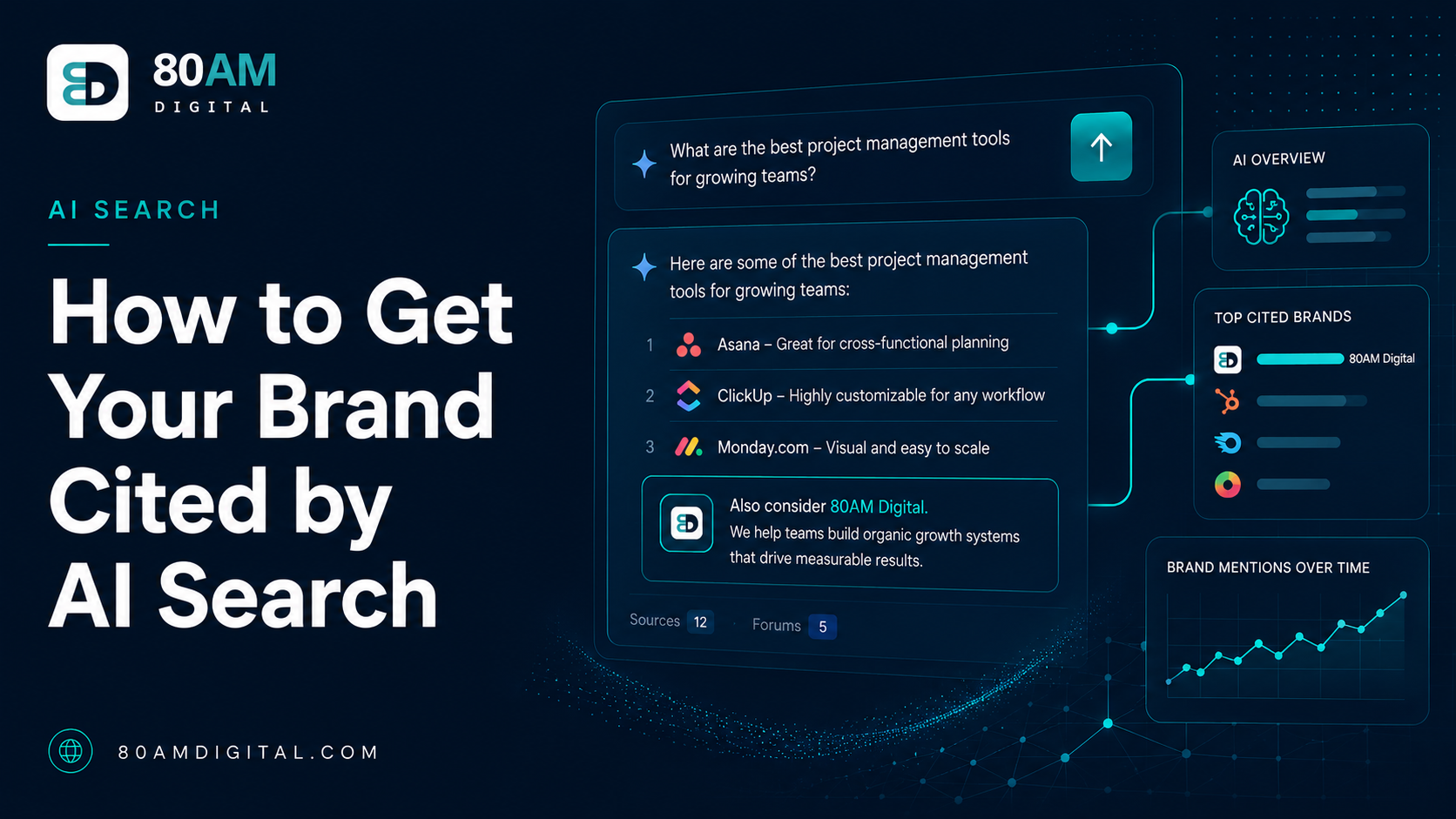
How to Get Your Brand Cited by AI Search
AI Overviews, ChatGPT and Perplexity answer questions without a click. Learn how to structure, source and mark up content so AI cites your brand in the answer.
Table of Contents
AI search engines—Google’s AI Overviews, ChatGPT, Perplexity, Gemini—increasingly answer a question directly and cite a handful of sources, instead of returning a list of links. You can’t “rank” in an AI answer; you get cited in one. To become a cited source, make your content easy to extract and easy to trust: answer the question directly and early, structure it in clean chunks, back it with original data and clear sourcing, mark it up with schema, and make your brand an unmistakable entity.
This matters more every quarter. By current estimates, AI Overviews now appear on roughly 30–40% of searches, and click-through on informational queries is falling as people get their answer on the results page. That makes AI visibility a real channel—and it’s the discovery edge of full-funnel organic growth. This is the map for that channel; each lever below links to a deeper guide.
The Short Version
- You can’t “rank” in an AI answer — you get cited. Citations go to content that answers directly, structures cleanly, and is backed by verifiable data.
- The seven levers: answer first, clean structure, original data, matching schema, a clear brand entity, topic clusters, and third-party mentions.
- AI Overviews appear on ~30–40% of searches today. Informational CTR is declining — AI citation is where the discovery happens instead.
- Getting cited by ChatGPT or Perplexity is still heavily driven by traditional SEO fundamentals — authority, structure, and topical depth.
How AI search actually works
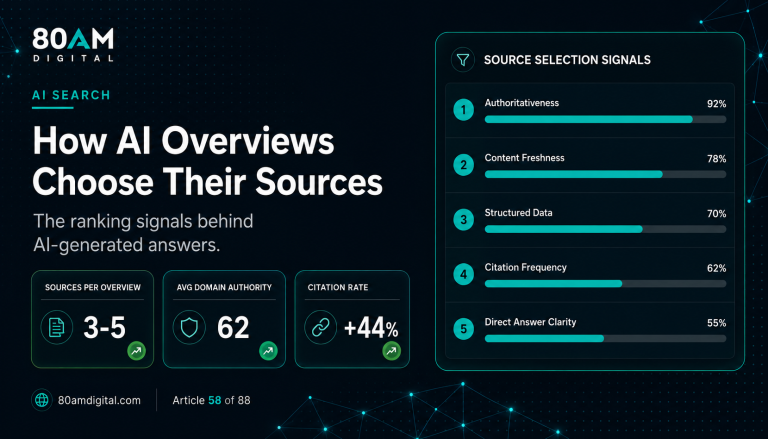
At a high level, AI answers are built in two steps: the system retrieves relevant sources, then generates a synthesized answer and attributes it to a few of them. Which sources it pulls from depends on what it already trusts—often pages that already rank well and read as authoritative—plus whatever it can cleanly parse in the moment.
The surfaces differ in the details: Google’s AI Overviews lean on what already ranks, ChatGPT and Perplexity run their own live retrieval, and each weights sources a little differently. But they reward the same fundamentals—content that’s relevant, clearly structured, verifiably sourced, and tied to a recognizable, trustworthy entity. Optimize for those and you’re in the running everywhere, rather than chasing one product’s quirks.
Ranking vs being cited
The mental shift is from “earn the click” to “be the source.” A citation in an AI answer may not always send a click, but it puts your brand in front of the buyer at the exact moment of the question—and it compounds your authority. Increasingly, winning looks like being the named source in the answer and seeing a lift in branded search afterward, even on queries that never produce a click. Here’s how the two models differ:
| Dimension | Traditional search | AI search |
|---|---|---|
| Goal | Rank a page | Get cited in the answer |
| Unit of visibility | A blue link | A sentence and a source mention |
| What wins | Relevance, authority, links | Clarity, structure, sourcing, entity trust |
| Typical outcome | A click to your site | Often a zero-click answer that names your brand |
The seven levers of AI visibility
None of these is a trick. They’re the same habits that make content genuinely useful—which is exactly why AI rewards them. Here they are at a glance, then one by one.
| Lever | Why it earns citations | Go deeper |
|---|---|---|
| Answer first | AI weights the opening; a direct answer is easy to lift verbatim | Answer-first writing |
| Clean structure | Short sections, lists, and tables give self-contained passages to quote | FAQs for answer engines |
| Original data & sourcing | Verifiable facts and stats get cited far more than unsupported opinion | Citation-worthy data |
| Matching schema | Structured data helps AI parse and trust what a page is about | Schema for AI visibility |
| A clear brand entity | Consistent authorship and Organization data make the source trustworthy | Entity SEO |
| Topic clusters | Depth across linked pages signals genuine expertise, not a one-off | Clusters in AI search |
| Third-party mentions | AI trusts what others say about you, not only your own claims | Mentions vs backlinks |
Answer first
Lead each section with a complete, direct answer in the first sentence or two, then expand. AI weights the opening of a section and lifts self-contained statements; throat-clearing and slow build-ups get skipped. In practice: turn headings into the questions people actually ask, and make the very next line the answer. More in answer-first writing.
Clean structure
Short paragraphs, descriptive headings, lists, and tables give models clean, quotable passages. A wall of text forces the AI to guess where the answer is; a tight list hands it over. FAQs are especially citable because each question-and-answer pair is a ready-made chunk—see FAQs for answer engines.
Original data and sourcing
Verifiable facts, original statistics, and named sources get cited far more than unsupported opinion, because the engine can stand behind them. Even small original research—a survey, a benchmark, a teardown—gives AI something only you have, which makes you the natural source to attribute. See citation-worthy data.
Matching schema
Structured data helps machines parse what a page is, who wrote it, and what each section means. It won’t manufacture authority, and it must match the visible content—but it removes ambiguity, which makes a page easier to interpret and reuse confidently. See schema for AI visibility.
A clear brand entity
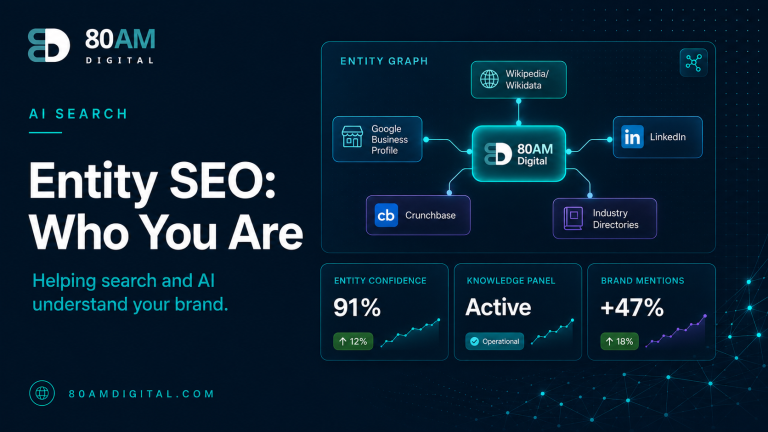
AI has to know who you are to cite you with confidence. Consistent naming, a defined Organization entity, real authorship and bios, and corroborating mentions elsewhere all make your brand an unambiguous, trustworthy source rather than an anonymous page. See entity SEO.
Topic clusters
Depth across linked pages signals genuine expertise; a lone post on a topic reads as a one-off. Covering a subject thoroughly—a pillar plus supporting pages—makes you a likelier source across the many sub-questions in a category, not just the one headline term. See clusters in AI search.
Third-party mentions
AI weighs what others say about you, not just your own claims. Being referenced on the trusted sites your category already cites feeds the same signals that make you a credible source—linked or not. See mentions vs backlinks.
A worked example: making a page citable
Take a definitional or how-to page that ranks but never gets cited. Diagnose it: the actual answer is buried in the fourth paragraph, the page is one long block of text, there’s no schema, no named author, and no sources. None of that gives an answer engine a clean passage to lift or a reason to trust it.
Now restructure. Move a one-sentence answer to the very top, under a heading phrased as the question. Break the rest into short chunks and a list. Add Article and FAQ schema and a real byline with a bio. Cite a primary source for the key statistic. You haven’t changed what the page knows—you’ve made it extractable and attributable, which is exactly what gets quoted. And the same edits make it clearer for human readers, which is the point.
Where to start
You don’t rebuild the whole site. Start where you already have visibility and work outward:
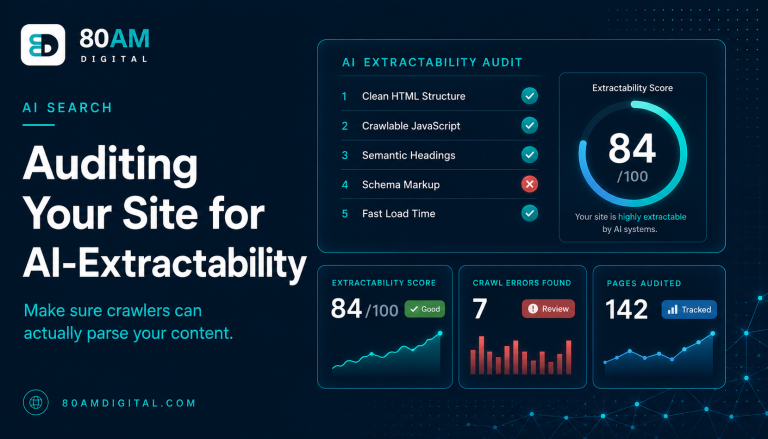
- Audit your top pages for extractability. Is the answer up top? Is it chunked? Is there schema and clear authorship? See auditing your site for AI-extractability.
- Rewrite answer-first on the informational pages that already earn impressions—that’s where a small change pays back fastest.
- Add matching schema and authorship so each page declares what it is and who stands behind it.
- Build cluster depth around the topics your buyers care about, so you’re a candidate across a whole subject, not one term.
What you can’t control (and shouldn’t chase)
Honesty matters here, because the space is full of overclaiming. A few things to keep in perspective:
- You can’t guarantee a citation. You can stack the signals in your favor; you can’t force an AI to quote you. Anyone promising guaranteed AI placements is selling something.
- Surfaces shift. AI features, layouts, and citation behavior change fast. Build on durable fundamentals—useful, well-structured, trustworthy content—rather than this month’s hack.
- It’s not a separate site. You don’t need a parallel “AI version” of your content. The same pages that serve readers well are the ones AI cites.
How to measure AI visibility
You can’t manage what you can’t see, and AI visibility is harder to measure than rankings—but not impossible. Track a few things together:
- AI referral traffic. Watch for visits from AI tools in your analytics; isolate them so you can see the channel grow.
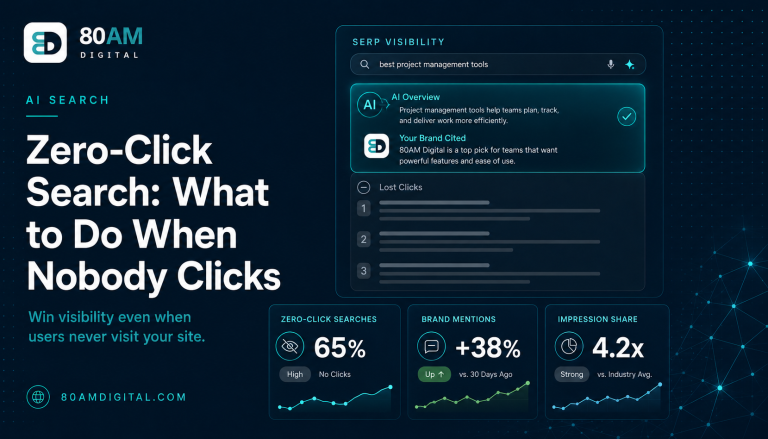
- Impressions and branded search. A rise in impressions without a matching rise in clicks often signals zero-click answers; lifts in branded search hint that people are seeing you in answers.
- Manual citation checks. Ask the AI tools your key questions on a regular cadence and log whether—and how—they cite you, so you can see movement over time.
The full setup lives in how to measure AI referral traffic, and it feeds the same organic-growth scoreboard as the rest of your metrics. AI visibility also builds on a clean technical and structured-data base—the SEO Audit Checklist covers that groundwork.