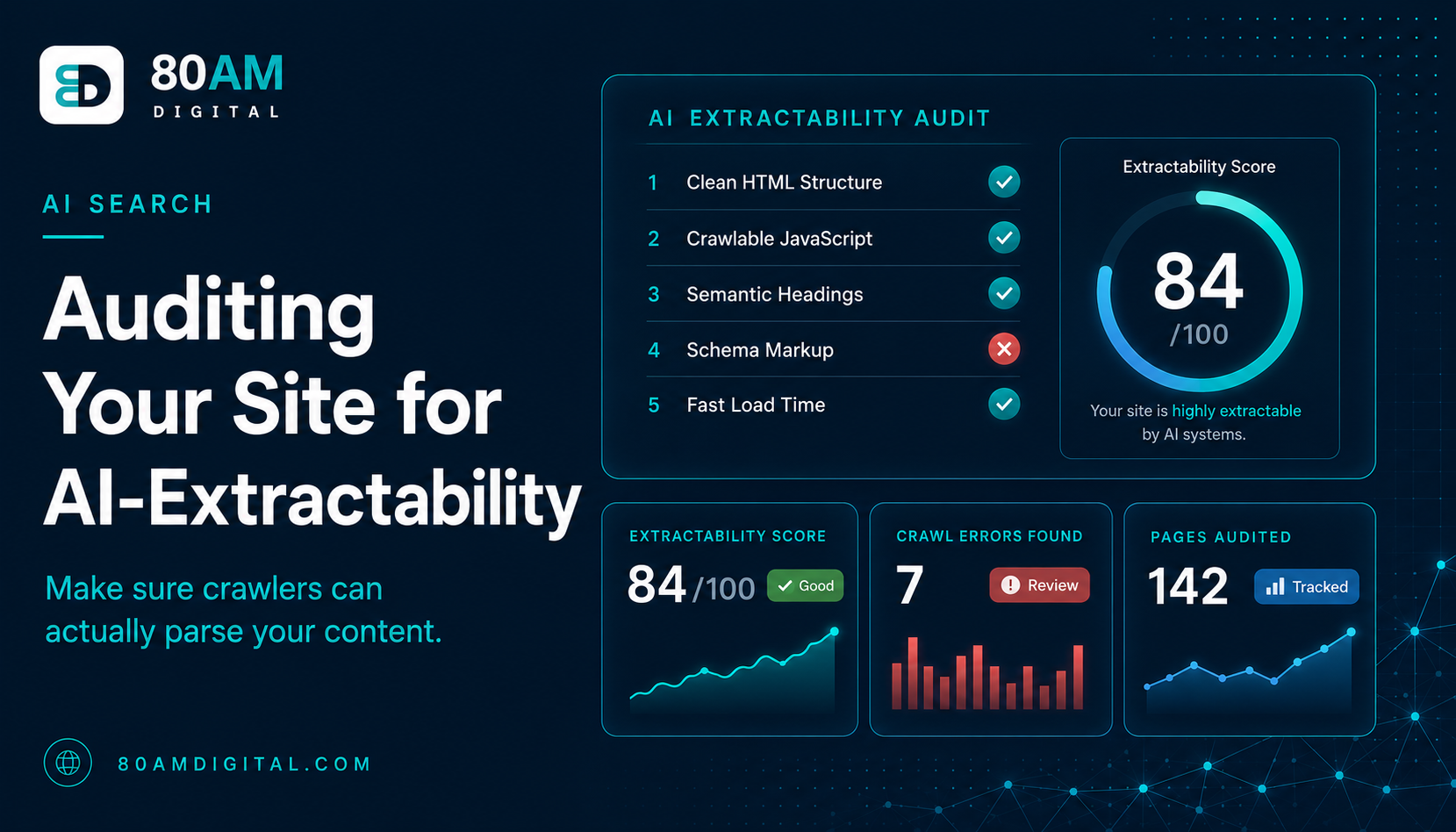
How to Audit Your Site for AI Extractability
AI search systems extract and cite content differently from traditional search crawlers. Learn how to audit your site to ensure AI can find, read, and cite your content.
Traditional SEO audits check whether search engines can crawl, index, and rank your content. An AI extractability audit checks a different — but related — set of questions: whether AI search systems can find your content, understand what it’s about, extract the specific answers it contains, and attribute those answers to your site in a generated response.
The two audits share most of their technical foundations (crawlability, indexation, structured data) but diverge on content structure, answer clarity, and entity signals. Here’s a systematic, four-step framework for auditing both dimensions in a single pass, plus a worked example of what fixing the gaps actually looks like.
The Short Version
An AI extractability audit covers four layers: crawlability and indexation (can AI systems find the page at all), structured data coverage (FAQPage, Article, Organization, Person schema), content structure (answer-first headings, self-contained sections), and entity signals (consistent brand naming and credentialed authorship). Most sites that are well-optimised for traditional SEO are 70% of the way there already — the gap is almost always in content structure and entity consistency, not crawlability.
Table of Contents
| Step | What it checks | Primary tool |
|---|---|---|
| 1. Crawlability & indexation | Can AI systems reach and index the page | Search Console Coverage report |
| 2. Structured data coverage | Is the page machine-readable as a content type | Google Rich Results Test |
| 3. Content structure | Is the answer extractable without reading the whole page | Manual review against the checklist |
| 4. Entity signals | Is the brand and author identity consistent everywhere | Manual cross-site audit |
Step 1: Crawlability and Indexation
AI Overviews and AI search tools that cite live web content (Perplexity, ChatGPT with search) draw from indexed pages. The first check is whether your key pages are indexed. In Search Console: Coverage report → Indexed pages. Any page you want to appear in AI citations must be indexed. Common issues that block indexation: noindex meta tags applied incorrectly, canonicals pointing to a different URL, pages blocked by robots.txt, pages not linked from the rest of the site (orphan pages), or thin content that Google has determined isn’t worth indexing.
Also check whether key pages are included in your sitemap and whether the sitemap is submitted to Search Console. AI systems that crawl the web use sitemaps as a starting point for discovery — a comprehensive, up-to-date sitemap ensures all your content is discoverable.
Step 2: Structured Data Coverage
Check structured data implementation using Google’s Rich Results Test (search.google.com/test/rich-results) on your key pages. For AI extractability, the most important schema types to audit:
- Organization or LocalBusiness schema on the homepage: Establishes the entity identity of the site.
- Article schema on blog posts and guides: Signals that the page is a structured piece of content with an author, a publication date, and a defined topic.
- FAQPage schema on pages with Q&A sections: Makes question-and-answer content machine-readable and more likely to be extracted by AI systems.
- Person schema on author bio pages: Establishes the author as an entity with expertise in a topic area — directly relevant to E-E-A-T and AI citation.
Step 3: Content Structure Audit
For each key page, check whether answers are clearly extractable by reviewing:
- Does the H1 clearly state the page’s topic? AI systems use heading structure to understand content organisation. A H1 that says “Thoughts on Technical SEO” is less useful than “Technical SEO for Ecommerce: Faceted Navigation, Pagination and Duplicate URLs.”
- Do H2 headings match the questions the page addresses? H2s that are phrased as questions or clear topic statements are more extractable than creative, vague, or punny headings.
- Does the first 150 words contain the key answer or summary? AI systems prioritise content that leads with the answer, not content that builds to it after a long preamble.
- Are there distinct, self-contained sections? A page structured as flowing prose is harder to extract from than a page with clearly delineated sections that can each be cited independently.
Step 4: Entity Signal Audit
Check whether your brand is consistently named across your site (consistent entity name in all schema, footers, and author bios), whether your author pages include professional credentials and external profile links, and whether your domain name appears consistently on external platforms where AI systems may encounter it (Google Business Profile, LinkedIn, Crunchbase, industry directories). Inconsistencies in brand naming or entity presentation fragment the authority signal that AI systems use to evaluate source credibility.
For structured data implementation details, see schema markup for AI visibility. For entity SEO specifically, see entity SEO fundamentals.
A Worked Example
A 200-page B2B services site ran this four-step audit across its top 30 pages by traffic. Crawlability and indexation passed cleanly — no surprises there. Structured data was the first real gap: 12 of the 30 pages had no Article schema at all, and 4 pages had FAQ sections with no FAQPage markup despite having genuine Q&A content.
The content structure step found a bigger issue: across the 30 pages, the average distance from the H1 to the first direct answer was 280 words — almost double the recommended threshold — because every page opened with a multi-paragraph scene-setting introduction before getting to the point. The entity audit found three different formal names for the company in use across the homepage schema, the footer, and the author bios (a legal entity name, a trading name, and an abbreviated version).
The team prioritised fixes in order: standardised the entity name everywhere first (a one-day fix), added missing FAQPage and Article schema over two weeks, then rewrote openings on the 30 pages to land the answer within the first 100 words. Within the following quarter, AI Overview citation tracking (checked manually against a list of 60 target queries) rose from 3 cited queries to 19 — without any change to organic rank, backlinks, or new content production.
Frequently Asked Questions
Make Your Site Easy for Machines to Read
AI extractability and traditional SEO aren’t in tension — the same foundations that make a site crawlable and rankable also make it more extractable by AI systems. The additional work is in content structure: leading with answers, using descriptive headings, marking up Q&A content with schema, and establishing consistent entity signals. These aren’t radical changes for a well-optimised site — they’re refinements that make the machine-readability properties already there more reliable and explicit.
If you’d like a full AI extractability and SEO audit of your site, get in touch.