How to Measure AI Referral Traffic and Citations
AI now sends real traffic and shapes perception before the click. Learn how to track AI referrals and citations in GA4 and tools so you can prove the channel.
Table of Contents
AI search is sending real traffic — and for a growing number of sites, it’s becoming a material channel. ChatGPT, Perplexity, and Google AI Overviews all refer users to external sources, and those referrals show up in your analytics. The challenge is that most analytics setups weren’t built to surface them clearly, and the measurement story for AI citation (where your content is cited without a click) is even less developed.
This guide covers what can currently be measured, where to look for it, and how to tell the difference between AI referral traffic (a click to your site from an AI tool) and AI citation influence (your content shaping AI responses without generating a direct click).
The Short Version
- GA4 captures AI referral clicks as regular referral sessions — chatgpt.com, perplexity.ai, claude.ai — segment them with a saved Exploration.
- Google AI Overview citations don’t get a separate GA4/Search Console label yet — high-impression, low-CTR, top-position queries are the proxy signal.
- Manual monthly checks of your 10-20 priority queries in ChatGPT, Perplexity, and AI Overviews remain the most reliable citation-tracking method.
- Zero-click AI citations (no referral, just brand exposure) are an unsolved “dark funnel” problem — branded search volume over time is the best available proxy.
AI referral traffic in GA4
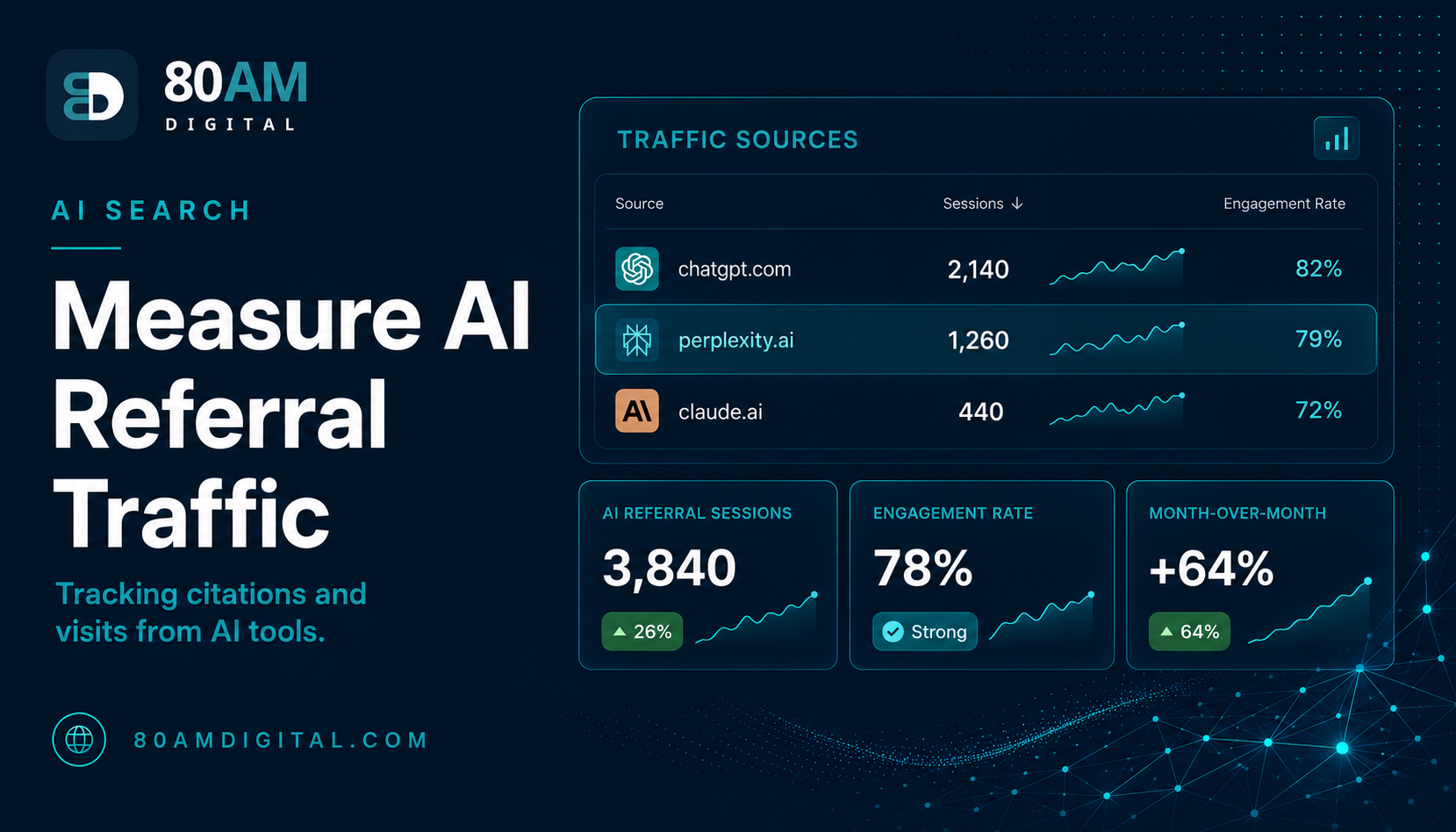
GA4 captures traffic from AI tools the same way it captures any referral: by the source domain of the referring session. If someone reads a ChatGPT response, clicks a link in it, and lands on your site, GA4 records the session with a source of “chatgpt.com” and a medium of “referral.”
To find this data:
- Go to Reports → Acquisition → Traffic Acquisition
- Set the primary dimension to “Session Source”
- Look for: chatgpt.com, perplexity.ai, claude.ai, bing.com (for Copilot traffic), gemini.google.com
For a cleaner view, create a custom segment in Explorations that filters for all known AI referral sources. Save it — this is a view you’ll want to check monthly as the channel grows.
What to look for in the data: AI referral traffic often has high engagement metrics — longer session duration, more pages per session — because users who clicked through from an AI recommendation are typically further along in their research than someone who clicked from a search result. This makes it useful to track session-level quality, not just volume.
Google AI Overview traffic in Search Console
When your page is cited in a Google AI Overview, it can appear in Search Console as an impression even if no click occurred. Google has added some visibility into this in the Performance report — look for impressions on queries where your average position is unusually high (position 1–2) but your CTR is very low. This pattern often indicates you’re being cited in an AI Overview (which appears above traditional results) but users aren’t clicking through because the AI answer satisfied the query.
There’s no definitive filter for AI Overview impressions vs. traditional impressions yet in Search Console, but you can approximate it: filter queries by Search Type = “Web” and look for high-impression, low-CTR, top-position queries where the topic lends itself to an AI answer. Cross-reference with manual checks: search those queries and confirm whether an AI Overview appears.
Manual monitoring: checking for citations
For queries where you want to know whether your content is being cited in AI responses, manual checking is currently the most reliable method — particularly for Perplexity and ChatGPT, which show source citations explicitly.
A practical monitoring routine:
- Identify the 10–20 queries most important to your business
- Search each in ChatGPT, Perplexity, and Google AI Overviews monthly
- Note: Is your domain cited? Is your specific page cited? Is a competitor’s content cited instead?
- Record in a simple tracking sheet — compare month to month to spot trends
This is time-intensive for large query sets but manageable for the 10–20 highest-priority terms. For larger-scale monitoring, tools like Profound, Otterly.ai, and Semrush’s AI toolkit are building citation-tracking capabilities — though the tooling is still maturing.
| Method | What it surfaces | Limitation |
|---|---|---|
| GA4 referral segment | Actual click-through sessions from AI tools | Only captures clicks, not zero-click citations |
| Search Console proxy signals | Likely AI Overview impressions (high position, low CTR) | No definitive AI Overview filter exists yet |
| Manual query checks | Exact citation status per query, per tool | Time-intensive; doesn’t scale past ~20 queries easily |
| Branded search volume trend | Proxy for zero-click brand influence | Imperfect — many other factors move this metric too |
Attribution challenges: the zero-click problem
The harder measurement problem is AI citations that influence behaviour without generating a click. If an AI Overviews response answers the query well enough that the user doesn’t click through to any source — but your brand was cited in the response — that citation may have shaped brand perception or even led to a later direct session you can’t attribute.
This “dark funnel” measurement challenge isn’t unique to AI search — it exists anywhere brand impressions happen without traceable conversion paths. The practical approach: track branded search volume in Search Console over time, and watch for correlations between increased AI citation activity and increases in branded queries. This is an imperfect proxy but currently the most accessible one for most sites.
For the content strategy that supports AI citation, see answer-first writing: structure content AI will quote and how to get your brand cited by AI search.
A worked example: a quarter of AI traffic tracking
What three months of tracking showed
A B2B software company set up a saved GA4 Exploration segmenting chatgpt.com, perplexity.ai, and claude.ai referrals, and began checking 15 priority queries monthly across ChatGPT, Perplexity, and Google AI Overviews. In month 1, AI referral sessions were 0.4% of organic traffic and only 2 of the 15 queries showed any citation of the company’s content.
Over the same quarter, the content team applied answer-first restructuring and added FAQPage schema to the pages targeting those 15 queries. By month 3, AI referral share had risen to 1.3% of organic sessions, 6 of the 15 queries showed citations (up from 2), and branded search volume in Search Console had risen 18% — a correlation the team couldn’t fully attribute to AI citation alone, but one that lined up closely with the citation gains and gave the team confidence the content work was paying off beyond the directly measurable referral clicks.
Frequently asked questions
Measure the channel before it becomes material
AI referral traffic is small enough today that most sites treat it as a footnote. But the sites that set up measurement now will have the historical data to understand their AI channel growth as it scales — and to prove the value of AI-optimised content investments. The cost of setting up GA4 segments and monthly citation checks is low; the cost of not having the data when the channel matters is real.
If you’d like help setting up AI referral tracking alongside your broader analytics measurement system, see how we approach analytics and measurement.