Schema Markup for AI Visibility: Organization, FAQ and Beyond
Schema doesn’t just earn rich results—it helps AI understand and trust your content. Learn which types matter most for AI visibility and how to implement them.
Table of Contents
Schema markup (structured data) tells search engines — and increasingly AI systems — what your content means, not just what it says. Without it, a page’s content is text that requires inference. With it, key facts are explicitly declared: who the organisation is, what the article is about, what the FAQ questions and answers are, what the product costs.
AI search systems use structured data as a high-confidence signal. When AI is choosing between two pages that both discuss a topic, the page with explicit, machine-readable declarations of authority, authorship, and content type has an advantage — because the AI doesn’t have to infer those signals, they’re stated directly.
This guide covers the schema types that most directly support AI visibility and how to implement them without a developer.
The Short Version
- Organization schema establishes entity identity, Article/Author schema establishes expertise, FAQPage and HowTo schema pre-format content for extraction.
- The
sameAsproperty in Organization schema links your entity to authoritative external records — exactly the corroboration AI systems use to establish trust. - FAQPage schema is one of the highest-impact types for AI citation — each answer must be self-contained, not “as mentioned above.”
- Most WordPress sites can implement Article, FAQPage, BreadcrumbList, and Organization schema via Rank Math or Yoast without writing any code.
Organization schema: establishing entity identity
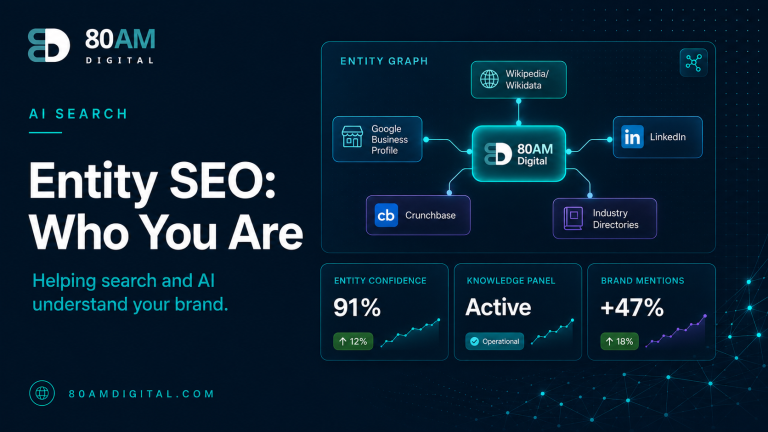
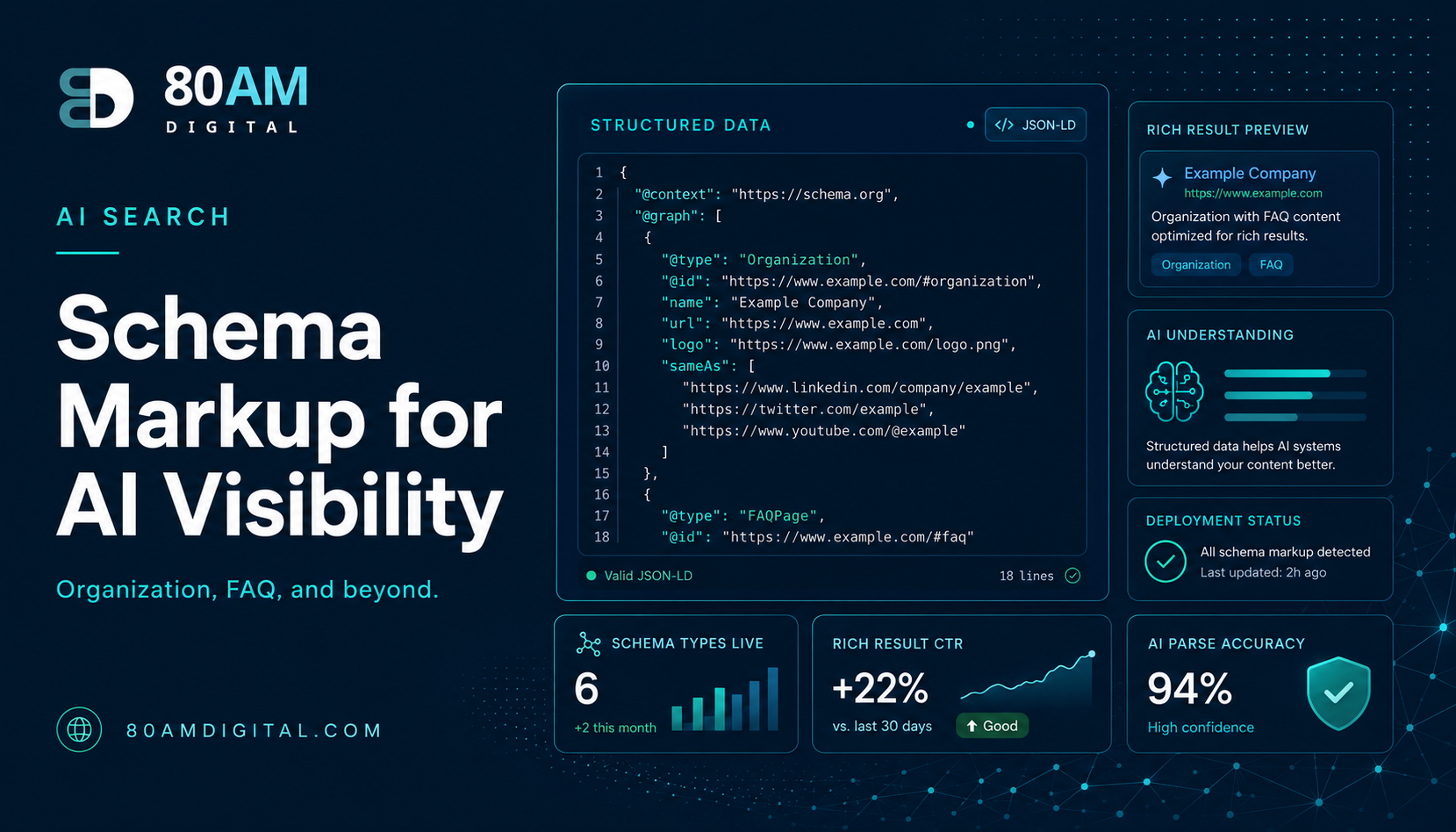
Organization schema is the most foundational schema implementation for AI visibility. It explicitly declares who you are: your business name, URL, logo, contact information, social profiles, and in some cases your area of operation or type of organisation.
AI systems use entity recognition to establish trust. When a site’s Organisation schema is properly implemented, AI systems can match your site to a known entity — cross-referencing with other data sources to confirm you are who you say you are. Sites without it require inference, which is a weaker signal.
The most important fields in Organization schema for AI visibility:
| Field | Purpose |
|---|---|
| name | Exact business name as it appears in external references |
| url | Canonical homepage URL |
| logo | URL of the logo image |
| sameAs | Array of authoritative external profiles (LinkedIn, Crunchbase, etc.) |
| description | Brief, accurate description of what the organisation does |
name— exact business name as it appears in external referencesurl— canonical homepage URLlogo— URL of the logo imagesameAs— array of authoritative external profiles (LinkedIn, Crunchbase, Wikipedia if applicable, industry directories)description— a brief, accurate description of what the organisation does
The sameAs property is particularly important: it links your site’s entity to external, authoritative records of that entity — which is exactly the kind of corroboration AI systems use to establish trust in a source.
Article and author schema: demonstrating expertise
Article schema with explicit Author markup addresses one of AI’s primary trust signals: E-E-A-T (Experience, Expertise, Authoritativeness, Trustworthiness). When Article schema declares an author with their credentials, associated organisation, and external profile links, it gives AI systems direct access to the authorship evidence rather than requiring it to be inferred from page content.
Implement on every substantive article:
@type: "Article"headline— the article titledatePublishedanddateModifiedauthor— nested Person schema with name, url (their profile page or LinkedIn), and jobTitlepublisher— nested Organization schema
FAQPage schema: direct answer extraction
FAQPage schema explicitly marks up questions and answers on a page in a machine-readable format. AI systems can extract these directly — the Q&A pairs become citable units without requiring the AI to identify and extract them from surrounding prose.
This is one of the highest-impact schema types for AI citation because it aligns with how AI search answers questions: find a question that matches the query, extract the answer. A page with FAQPage schema is a catalogue of pre-formatted, pre-matched answers.
Implementation requirements: each Question must include the full question text; each Answer must be a complete, self-contained response. Answers that reference “as mentioned above” or “see the section on X” are not self-contained and lose their extractability.
HowTo schema: process extraction
For how-to and process articles, HowTo schema declares the steps explicitly — each step with a name, description, and optional image. AI systems can cite the process as a structured unit rather than reconstructing it from prose. This is particularly valuable for technical SEO how-tos, content guides, and step-by-step setup articles.
How to implement without a developer
For WordPress sites, Rank Math and Yoast SEO generate schema automatically for the most common types — Article, FAQPage, BreadcrumbList, WebSite, and Organisation. Check that these are configured correctly (Rank Math → Schema in the post editor; Rank Math → Titles & Metas → Local SEO for Organization schema).
For custom types not covered by your SEO plugin, use Google’s Structured Data Markup Helper to generate the JSON-LD, then add it to the page using a code block or your site’s header/footer script manager. Validate all implementations with Google’s Rich Results Test before publishing.
For the broader AI search strategy, see how to get your brand cited by AI search and answer-first writing: structure content AI will quote.
A worked example: four schema types, one site
What a full schema rollout typically shows
A B2B SaaS company audited its blog and found Organization schema present but missing the sameAs array, Article schema present but with a generic “Admin” author on every post, and no FAQPage schema despite most articles ending with an FAQ section written in plain HTML. Manual checks in ChatGPT and Perplexity showed zero citations of the company’s content across a list of 20 target queries the content directly answered.
The team added sameAs links to LinkedIn and Crunchbase, attributed every article to one of three named writers with linked author bio pages, and converted the plain-HTML FAQ sections to proper FAQPage schema across the 15 highest-traffic posts. Re-running the same 20 queries six weeks later showed citations in 4 of the 20 — up from zero — with the cited pages all among the ones that received the FAQPage schema update.
Frequently asked questions
Tell AI who you are and what you know
Schema markup is the most direct way to provide AI systems with the machine-readable signals they use to establish authority and select sources. Organisation schema establishes entity identity; Article and Author schema establish expertise; FAQPage and HowTo schema pre-format your content for extraction. Together, they remove the inference burden from AI and replace it with explicit, verifiable declaration.
If you’d like help auditing your site’s schema implementation and identifying gaps in structured data coverage, see how we approach technical SEO and AI visibility.