Structured Data That Actually Earns Rich Results
Schema markup can earn rich results and help AI understand your pages—but only if it matches visible content. Learn which types to use and how to validate them.
Table of Contents
Structured data is code added to a page’s HTML that tells search engines and AI systems what specific pieces of content mean — not just what they say. A page might mention a price, but without structured data, Google doesn’t know whether that’s a product price, a service price, or a number in a paragraph. Structured data (using Schema.org vocabulary in JSON-LD format) declares it explicitly: “this is a Product, this is its price, this is its availability.”
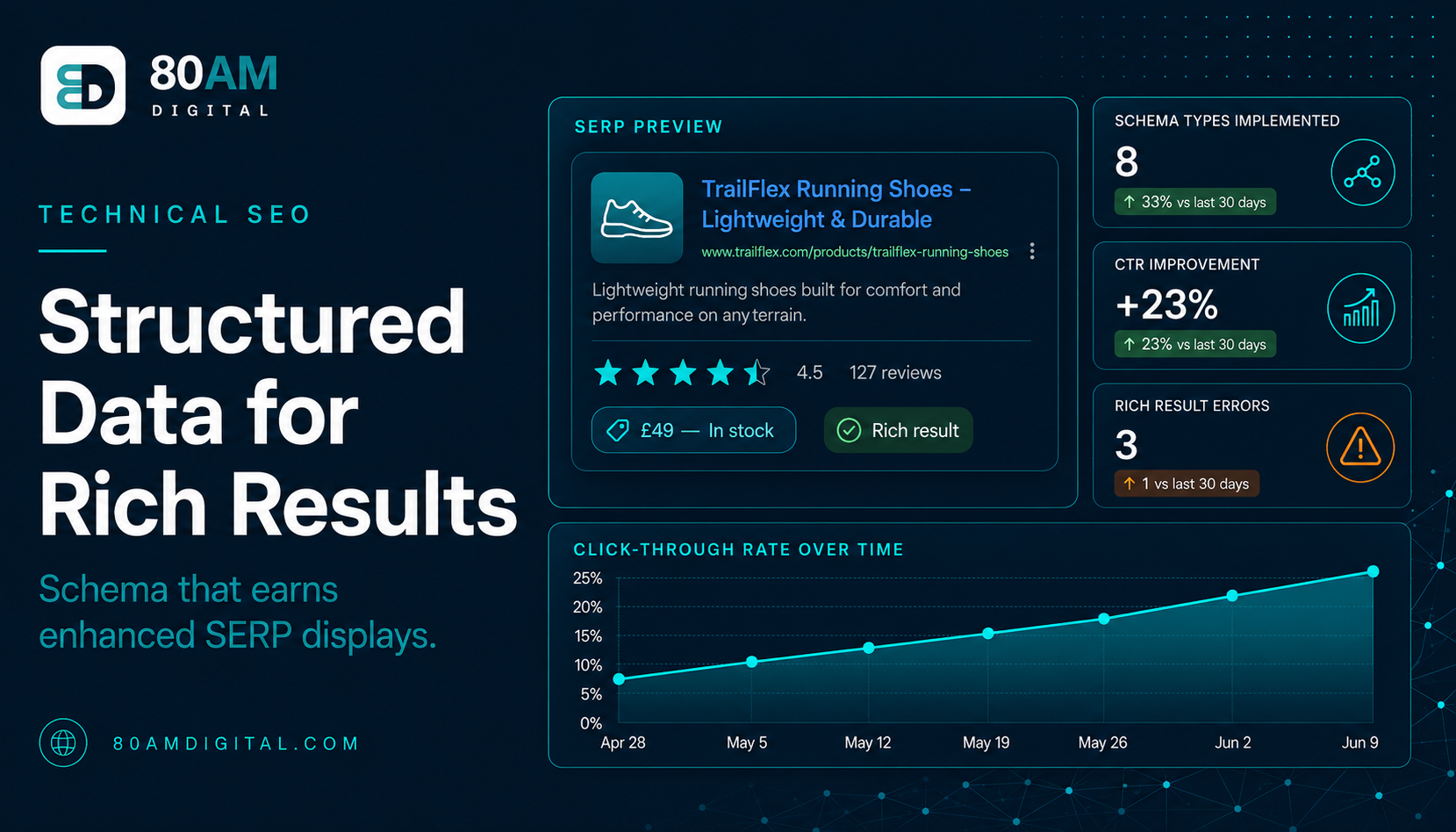
When structured data is implemented correctly and matches the page’s visible content, it can unlock rich results — enhanced SERP displays showing star ratings, prices, FAQs, event dates, and more. These features increase click-through rate by making your listing more informative than a plain blue link. They also help AI systems extract and cite your content more accurately.
The Short Version
- Structured data doesn’t directly improve rankings — it unlocks rich results, which improve CTR at the same ranking position.
- Markup must match visible content exactly; mismatched or fabricated markup risks being ignored or flagged as a manual action.
- JSON-LD in the page head is the recommended format — easiest to implement, validate, and maintain compared to Microdata or RDFa.
- Valid markup doesn’t guarantee a rich result appears — Google still decides based on content quality, authority, and query type.
The schema types that earn rich results
| Schema type | What it marks up | Best for |
|---|---|---|
| FAQPage | Questions and answers visible on the page | Service pages and explainer articles with real on-page FAQs |
| Product | Name, image, description, price, currency, availability | Ecommerce pages — enables price/rating snippets on transactional queries |
| Article | Headline, author, publication date, image | Editorial content — supports E-E-A-T and AI metadata extraction |
| HowTo | Step-by-step instructional content | Pages with genuine visible numbered steps |
| Event | Date, location, organiser | Pages announcing specific events |
| LocalBusiness | Name, address, phone, opening hours, URL | Service-area businesses and local SEO, reinforces Knowledge Panel data |
Each schema type requires its specific fields to qualify for the corresponding rich result — Product needs offers with price and availability to earn the merchant snippet, and review markup (aggregateRating) adds the star display on top of that.
The rule: markup must match visible content
Google’s structured data guidelines are explicit: markup must represent content visible to users on the page. Adding FAQPage markup with questions that don’t appear on the page, or Product markup with a price that differs from what’s shown, is a violation of the guidelines and can result in the structured data being ignored or a manual action for misleading markup.
This rule also defines what structured data can’t do: it can’t add context to pages without relevant content. A page with no visible star ratings can’t benefit from aggregateRating markup. A page with no step-by-step content can’t use HowTo markup. The structured data describes what’s there, not what you wish were there.
How to implement and validate
Implementation: JSON-LD in the page’s <head> is the recommended format — it’s separate from the page’s HTML and doesn’t require marking up individual elements. SEO plugins (Rank Math, Yoast) add common schema types automatically for posts, pages, and products. For more granular control, use a plugin like Schema Pro or write custom JSON-LD.
Validation: Use Google’s Rich Results Test (search.google.com/test/rich-results) to verify that your markup is valid and qualifies for rich results. Also check Search Console → Enhancements, which shows rich result coverage for each schema type and flags any errors or warnings. Common errors: missing required fields (Product markup without offers), mismatched prices, and FAQPage markup where the Q&As aren’t visible on the page.
For how structured data connects to AI visibility, see schema markup for AI visibility. For the full technical audit, see the SEO audit checklist.
What rich results actually do for CTR
Why rich results are worth the implementation effort
A worked example: Product schema on a small catalog
A small outdoor gear retailer had Product schema technically present on all 180 product pages via a plugin default, but the Rich Results Test showed errors on roughly a third of them — the offers field was missing availability status on out-of-stock items, and a handful of recently discounted products had a schema price that no longer matched the visible sale price after a pricing update that hadn’t propagated to the structured data.
Fixing the plugin configuration to pull availability and price dynamically from the live product data — rather than a cached value set once at page creation — resolved both issues going forward. Search Console’s Enhancements report showed valid Product items rise from 120 to 180 over the following two weeks as Google re-crawled the catalog, and the rating-and-price snippet began appearing for the majority of product pages on branded and long-tail product queries, which the team tracked via a noticeable CTR increase in the Performance report for that page group.
Frequently asked questions
Markup that reflects what’s actually on the page
Structured data works when it accurately describes real, visible content. The effort is worth making for the pages where rich results will make a measurable difference to CTR — product pages, FAQ-rich service pages, and step-by-step guides. And beyond the SERP, correct entity markup increasingly determines how accurately AI systems represent and cite your business.
If you’d like your structured data reviewed and implementation checked as part of a technical audit, get in touch.