How Google’s AI Overviews Choose Their Sources
AI Overviews don’t cite the top-ranking page for a query — they cite the most extractable, authoritative answer. Here’s what signals determine which sources get chosen.
AI Overviews (formerly Search Generative Experience or SGE) don’t simply cite the top organic ranking result for a query. They synthesise an answer from multiple sources and then attribute specific claims to the sources they drew on. Which sources get cited is determined by a different set of signals than traditional keyword rankings — and understanding those signals is key to appearing in AI Overviews rather than just in the organic results below them.
This article breaks down what we know about source selection, the signals that actually move citation odds, what doesn’t guarantee a citation despite common assumptions, and a worked example of a site that improved its citation rate by changing how it structured existing content.
The Short Version
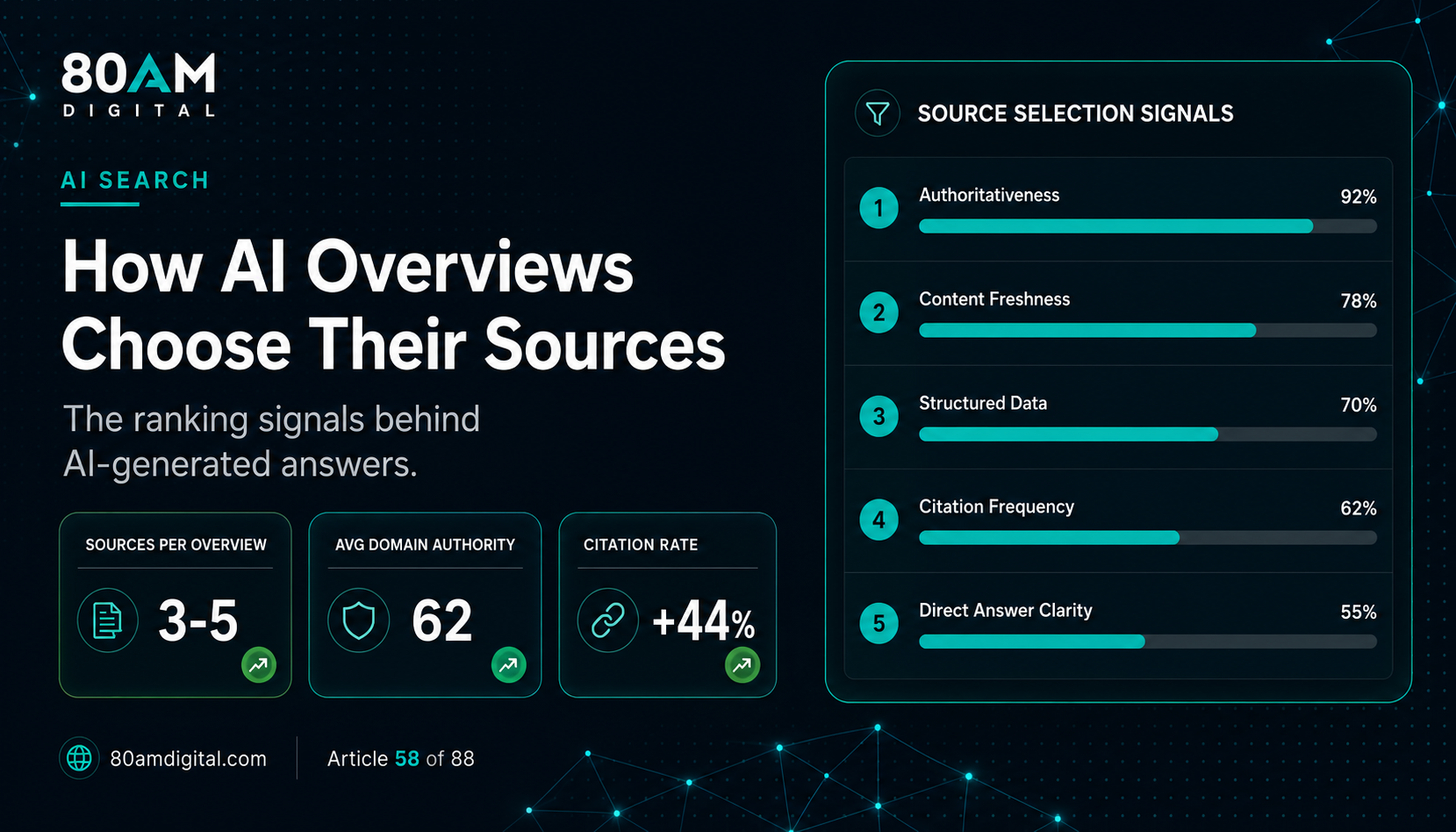
Organic rank #1 correlates with AI Overview citation but doesn’t guarantee it — 30–50% of citations come from pages outside the top 10. The strongest predictors are direct answer extractability, domain authority, structured data (FAQ/HowTo/Article schema), and topical depth. Word count, keyword density, and organic position alone don’t move citation odds. Optimise for “can this passage be lifted and cited in isolation,” not “does this page rank.”
Table of Contents
What We Know About AI Overview Source Selection
Ranking correlation, not ranking equivalence: Studies by SearchEngineLand, BrightEdge, and Authoritas consistently show a correlation between ranking in the top 10 organic results for a query and being cited in the AI Overview for that query — but the correlation is around 50–70%, not 100%. Roughly 30–50% of AI Overview citations come from pages that don’t rank in the top 10 organic results for the same query. This means that optimising for the AI Overview requires different signals than optimising for the organic rank, though both benefit from common foundations like authority and relevance.
Direct answer extractability: AI Overviews prefer sources where the answer to the implied query is clearly stated in a short, extractable passage — ideally in the first 100–150 words of the page, or in a well-structured section that directly addresses the question. Long-form content that wraps the relevant answer in extensive preamble is less likely to be cited than content that leads with the answer.
Domain authority and trust signals: Established, authoritative domains are cited more frequently than newer or lower-authority domains, controlling for content quality. This reflects Google’s broader trust model: established entities with strong E-E-A-T signals are preferred sources for AI-generated answers that are surfaced to millions of users. A brand new site with excellent content will be cited less frequently than an established site with comparable content, at least until the new site has accumulated sufficient authority signals.
Structured data: Pages with FAQ schema, HowTo schema, and Article schema are more machine-readable. Google’s AI systems can more reliably identify what type of content a page contains and what specific questions it answers when structured data explicitly declares this. A page with FAQ schema that asks “How do AI Overviews choose sources?” and answers it directly is a more reliable citation candidate for that query than a page that addresses the same question in unstructured prose.
Topic authority signals: Sites with deep, comprehensive coverage of the topic being queried are more likely to be cited as authoritative sources than sites with single pages on a topic. The topic cluster model — pillar page plus detailed cluster pages plus consistent internal linking — is the content architecture most aligned with how AI Overviews assess topical authority.
The Five Signals Ranked by Impact
None of these signals work in isolation, but practitioner data and our own client audits suggest a rough order of leverage when a page already ranks reasonably well but isn’t being cited.
| Signal | Relative impact | What to fix |
|---|---|---|
| Answer extractability | Highest | Restructure so the direct answer appears in the first 1–2 sentences of the relevant section |
| Structured data | High | Add or correct FAQ, HowTo, and Article schema matching visible content |
| Topical depth | Medium-high | Build out the cluster around the page rather than treating it as a standalone asset |
| Domain authority | Medium (slow to move) | Earn legitimate links and mentions; no shortcut exists here |
| Organic rank | Supportive, not sufficient | Keep improving rank, but don’t treat it as the finish line |
What Doesn’t Guarantee AI Overview Citations
- Ranking #1 in organic search: While a correlation exists, ranking #1 for a query doesn’t guarantee AI Overview citation for that query. The AI Overview may cite sources 3, 7, and 14 in the organic results because those pages are more extractable, more specific to the query’s exact sub-question, or from more authoritative domains on the specific sub-topic.
- High word count: Longer content isn’t more likely to be cited. AI systems extract specific passages; the length of the page around the passage is irrelevant. A 300-word page with a perfectly targeted answer may be cited over a 3,000-word page where the relevant answer is buried.
- Keyword density: AI Overview citation is driven by meaning and relevance, not keyword matching. A page that uses the exact query phrase repeatedly isn’t more likely to be cited than a page that discusses the concept in different but semantically related terms.
For how to structure content for AI extractability, see answer-first writing and FAQs for answer engines.
A Worked Example
A financial services content site ranked in positions 2–6 for a cluster of around 40 commercial-intent queries but was appearing in AI Overviews for fewer than 10% of them. The pages were long (2,000+ words), well-researched, and earned solid organic traffic — but answers to the specific implied question for each query were typically two or three paragraphs into the article, after context-setting introductions.
The team restructured the top 15 pages in the cluster: a direct answer in the first 1–2 sentences after the H1, FAQ schema added to existing Q&A content that had previously been unstructured prose, and Article schema corrected where author and publish-date fields were missing or malformed. No new content was added — the existing research and depth were preserved, just resequenced.
Over the following eight weeks, AI Overview citation rate across the 15 restructured pages rose from roughly 9% to 34% of tracked queries, while organic rank for the same pages was essentially unchanged. The lesson: for pages that already rank, the highest-leverage lever is often restructuring for extraction, not chasing more rank or more content.
Frequently Asked Questions
Optimise for Extraction, Not Just Ranking
AI Overview citation requires a different optimisation lens than traditional organic ranking. The question isn’t “does my page rank for this keyword?” but “is my page’s answer to this question clear, direct, and trustworthy enough to be cited in a synthesised AI response?” Directness, structured data, topical authority, and domain trust are the primary variables. Ranking helps but doesn’t guarantee citation; excellent extractability on a well-authorised domain is the target.
If you’d like help auditing your content for AI Overview citation potential, get in touch.