AEO vs GEO vs SEO: What’s Actually Different
AEO, GEO and SEO get used interchangeably, but they optimise for different things. Here’s a clear breakdown of how they differ and where they overlap.
Table of Contents
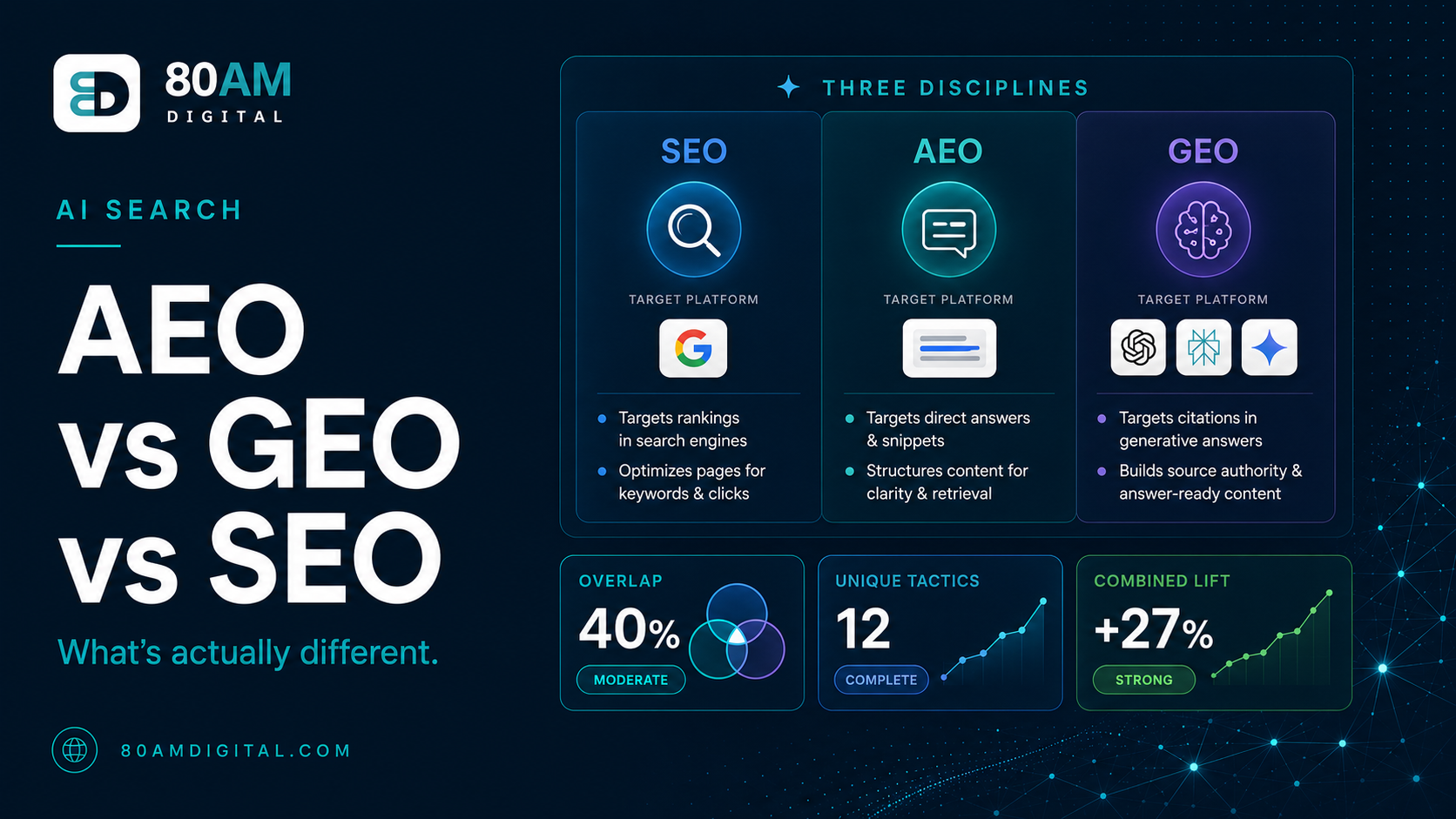
SEO, AEO, and GEO all deal with search visibility — but they optimise for different surfaces and different outcomes. SEO (search engine optimisation) targets ranked positions in traditional search results. AEO (answer engine optimisation) targets citations and extracts in answer engines like ChatGPT, Perplexity, and AI Overviews. GEO (generative engine optimisation) is the broader practice of making content easy to extract and cite across all generative AI systems. The differences are real; the overlap is larger. Getting the fundamentals right for one tends to help all three.
The Short Version
- SEO targets ranked positions in traditional search. AEO targets citations in AI-generated answers (ChatGPT, Perplexity, AI Overviews). GEO targets extractability and visibility across all generative AI systems.
- The fundamentals overlap heavily — clear structure, accurate facts, topical authority, and E-E-A-T signals help all three.
- Prioritise SEO first, layer AEO by writing direct-answer content with schema markup, then build GEO signals over time.
- Getting cited by AI tools is still heavily determined by how well your site does traditional SEO.
The short answer
SEO: optimising for search engines
SEO is the established practice of making web pages rank higher in search engine results pages (SERPs). It works through three main levers: technical factors (crawlability, site speed, structured data, mobile usability), content factors (relevance, depth, E-E-A-T signals), and authority factors (backlinks, brand signals, entity clarity).
The output of SEO success is a click — someone sees your blue link, clicks it, and lands on your page. All other metrics (impressions, rankings, CTR) are proxies for that outcome. SEO is still the largest source of discoverable organic traffic for most commercial websites in 2026, and nothing in the AI landscape has changed that for high-intent, transactional queries.
Where SEO is most powerful: bottom-of-funnel commercial queries (“buy X,” “best Y for Z,” “how to hire a [service]”), navigational queries, and any query where the user wants to click through to a source rather than have an answer synthesised for them.
AEO: optimising for answer engines
AEO is the practice of structuring content so that AI answer engines — tools that synthesise an answer from multiple sources rather than returning a list of links — are more likely to extract from and cite your content.
The key mechanisms that AEO focuses on:
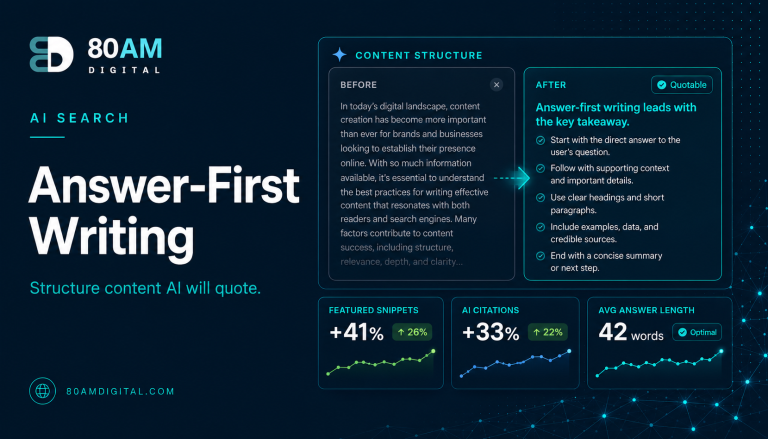
- Answer-first structure. Lead with the direct answer in paragraph one, then expand. AI engines extract self-contained statements — buildup before the answer gets skipped.
- Cite-worthy specificity. Vague claims don’t get cited. Original data, precise definitions, specific numbers and mechanisms are what AI summarisation tools pull.
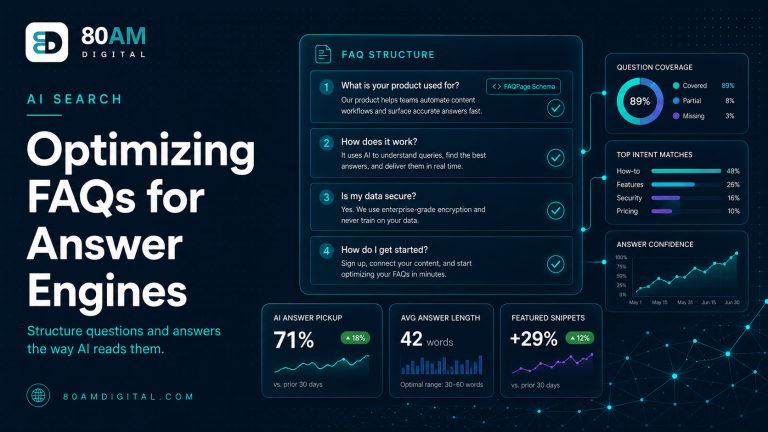
- Schema markup. FAQPage, HowTo, Organization, and Article schema help AI systems understand the type and authority of your content.
- Topical authority. AI engines favour sources that have covered a topic comprehensively — a cluster of related content is more citable than a single post.
AEO is most valuable for informational and consideration-stage queries — the type of question someone asks an AI before they start comparing options. That’s the stage where being cited builds brand awareness and shapes the decision before the buyer even clicks anything.
GEO: optimising for generative engines
GEO is a broader umbrella than AEO. Where AEO focuses on being cited in AI-generated answers to specific questions, GEO addresses the full challenge of being represented accurately and favourably across any generative AI system — including large language model (LLM) pre-training data, retrieval-augmented generation (RAG) pipelines, AI summarisation tools, and multimodal search.
GEO tactics include everything in AEO, plus:
- Entity clarity across the web. Consistent NAP (name, address, phone), consistent brand description across owned and third-party properties, Wikipedia/Wikidata presence where applicable — all signals that help AI systems build an accurate model of who you are.
- Brand mentions on authoritative sources. Unlinked brand mentions on reputable sites contribute to the AI’s model of your credibility, in much the same way that unlinked citations in academic papers build authority.
- Content in LLM training data. Older, high-authority content may already be in an LLM’s training data. Keeping that content accurate and maintaining its authority is part of GEO.
GEO is the most forward-looking of the three disciplines and the one with the least direct measurement tooling right now. It’s valuable, but if you’re prioritising where to invest effort, AEO and SEO have more measurable near-term returns.
How they compare: the key differences
Where they overlap (and why that matters more)
The three disciplines share more foundations than they differ on. The practices that make content good for SEO — expertise, depth, clear structure, original insight, authoritative sources — are exactly the same practices that make content good for AEO and GEO. There’s no version of “optimise for AI” that doesn’t start with “write excellent, well-structured content that demonstrates genuine knowledge.”
Shared foundations: what helps all three
The practical implication: you don’t need three separate strategies. You need one strategy that produces high-quality, expertly-structured content inside a clear topic architecture — and then applies the distribution and technical signals that help each surface understand and trust it. Our guide on how to get cited by AI search covers the AEO/GEO layer specifically.
Which to prioritise and in what order
If you’re starting from zero — or if resources are constrained — this is the sequence that delivers the highest return:
Frequently asked questions
The terminology will keep evolving — there will be a new acronym by next year. What won’t change is the underlying principle: visibility in search and AI engines is earned by content that’s authoritative, well-structured, and genuinely useful. Optimise for that, apply the right signals for each surface, and the acronyms take care of themselves.
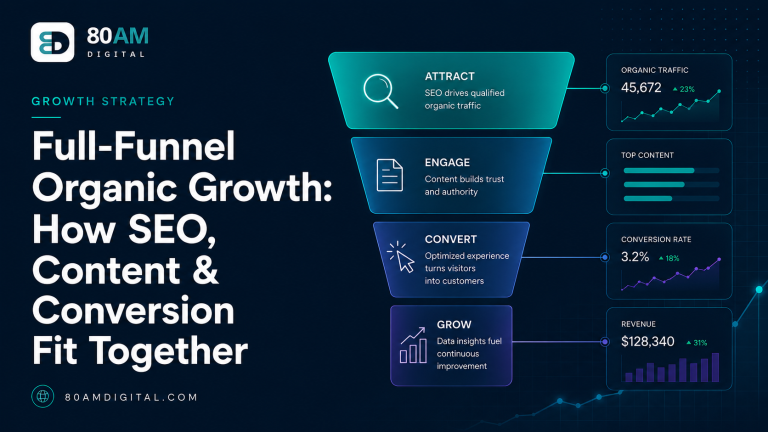
For the practical playbook on getting cited in AI search specifically, see how to get your brand cited by AI search. For the full system that connects SEO and AI visibility into a coherent growth strategy, see the full-funnel organic growth playbook.