A/B Testing With Low Traffic: What Works Instead
Most A/B testing advice assumes high-traffic sites. For everyone else, here’s a framework for improving conversion rates without the traffic volume to run valid tests.
Table of Contents
The promise of A/B testing is simple: change one thing, split traffic between version A and version B, and let data tell you which version converts better. The problem: this only works if you have enough traffic to reach statistical significance before the test becomes irrelevant. Most small to mid-sized businesses don’t.
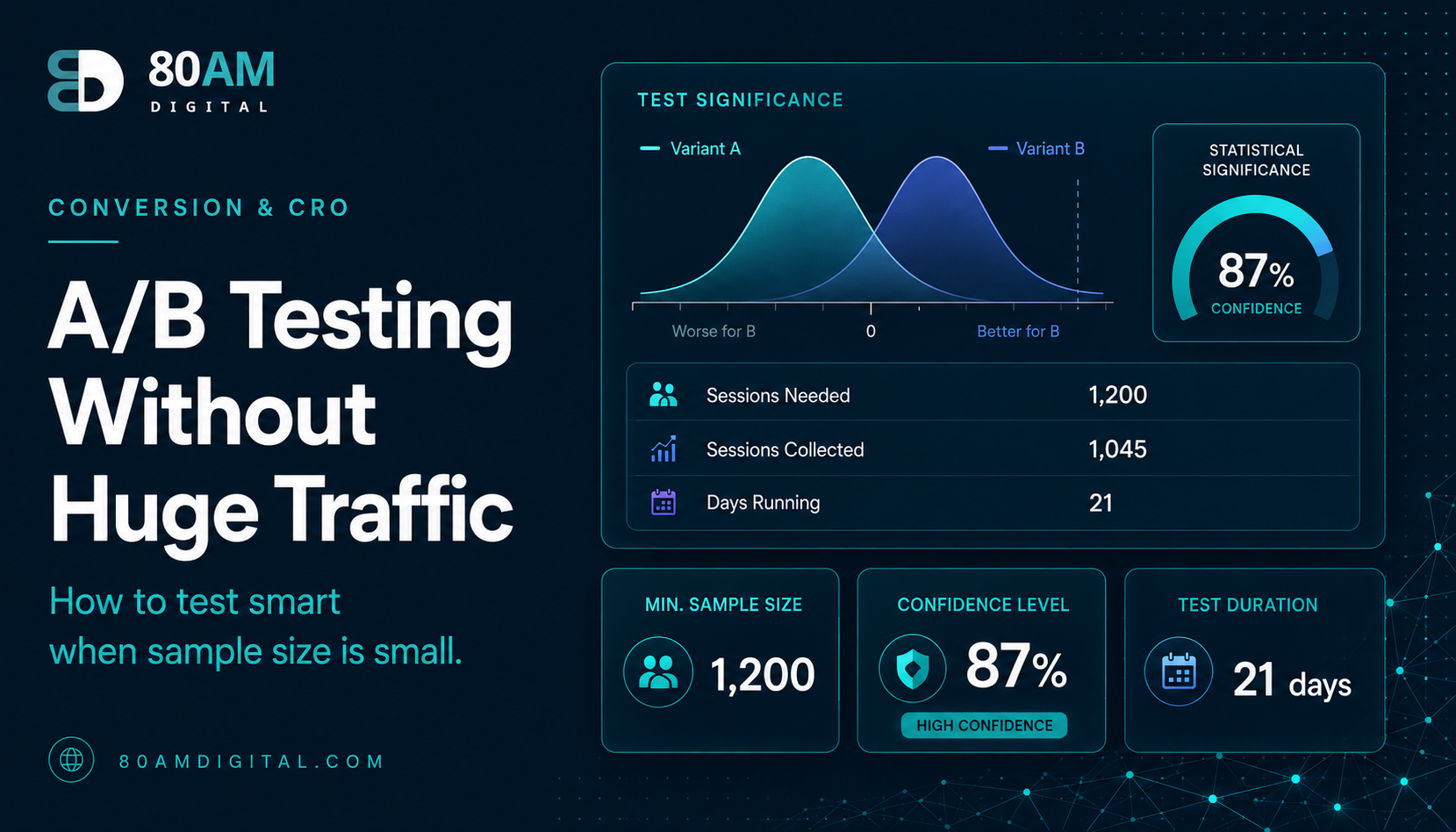
The minimum traffic volume required to run a valid A/B test depends on your current conversion rate, the size of the improvement you’re testing for, and the confidence level you need. For a site converting at 2% that wants to detect a 20% relative improvement (from 2% to 2.4%), each variant needs approximately 4,700 visitors. At 500 visitors per month per page, that’s nearly 10 months — far too long. By the time the test completes, the market has changed, the page has been edited, and the data is questionable.
The Short Version
- Below roughly 1,000 monthly visitors or 50 conversions per variant, an A/B test produces statistical noise that looks like data, not real insight.
- Sequential improvement — one change at a time, measured before/after over 4 weeks — is the valid low-traffic alternative.
- Five qualitative user-testing sessions often surface more actionable problems than six months of inconclusive A/B data.
- Never stop a test early because one variant looks like it’s winning — “peeking” produces a systematic bias toward false positives.
When not to run A/B tests
Don’t run A/B tests when:
| Condition | Why it invalidates the test |
|---|---|
| Fewer than 1,000 monthly visitors on the page | Won’t reach significance before the test is stale |
| Under 50 conversions/month per variant | Statistical noise dwarfs the measured effect |
| Testing a full redesign, not one variable | Multiple changes at once isn’t a controlled test |
- You have fewer than 1,000 visitors per month on the page you’re testing.
- Your conversion volume is under 50 conversions per month per variant (below this, statistical noise makes results unreliable).
- The change you’re testing is large enough to affect multiple variables at once (a full page redesign isn’t an A/B test — it’s a coin flip).
Running “tests” below these thresholds doesn’t give you data — it gives you randomness that looks like data. A test that shows “Version B had 23% more conversions” on a sample of 80 visitors is meaningless; the margin of error dwarfs the measured effect.
What to do instead: sequential improvement
Sequential improvement — making one change at a time, measuring for 4 weeks, and comparing before/after — is a valid alternative to A/B testing for low-traffic sites. It’s not as statistically clean as a true A/B test (seasonality and other factors can confound results), but it produces real improvement data rather than random noise.
The sequential improvement process:
- Identify the highest-impact hypothesis (the change most likely to improve conversion, based on heuristic audit, session recordings, or user feedback).
- Implement the change on the page (not a variant — the page itself).
- Record the baseline conversion rate for the 4 weeks before the change and the 4 weeks after.
- Annotate the change in GA4 (using the Notes feature) so you can attribute any uplift to the specific change.
- Repeat for the next hypothesis.
Eight sequential changes over eight months, each producing a modest 10–15% uplift in conversion rate, compounds to a conversion rate that’s 2–3x the starting rate. This outperforms the output of an A/B testing programme on a site that doesn’t have the traffic to run valid tests.
Qualitative research as a proxy for A/B testing
When sample sizes are too small for statistical testing, qualitative research produces higher-confidence insights per unit of effort. Five user testing sessions where a real person attempts to complete the conversion flow while thinking aloud will surface more actionable problems than six months of inconclusive A/B test results. Moderated user tests can be conducted via Lookback, UserTesting, or simply by calling a customer and asking them to share their screen while they try to fill in your enquiry form.
Questions to ask in a user test: Can you tell me what this page is offering? What would you want to know before you clicked the button? What would stop you from completing this form? The answers are specific, qualitative, and directly usable — no statistical analysis required.
For conversion audit methods using free tools, see how to audit your conversion rate without paid tools. For the framework that generates the right hypotheses to test, see traffic but no conversions.
The traffic thresholds at a glance
When testing is viable vs. when it isn’t
A worked example: eight months, eight changes
A professional services site with roughly 700 monthly visitors to its main contact page — well below the threshold for a valid A/B test — started a conversion rate at 1.8%. Rather than attempting a low-powered test, the team ran sequential improvement: month 1 rewrote the headline around outcome instead of service category; month 2 cut the form from 9 fields to 4; month 3 added a named testimonial above the CTA; month 4 fixed a 4.2-second mobile load time down to 1.9 seconds.
Each change was annotated in GA4 and measured for a full 4-week window before the next was introduced. By month 8, after eight sequential changes, conversion rate had risen to 4.3% — more than double the starting rate, achieved entirely through changes too small in traffic terms to ever have reached statistical significance individually, but cumulatively validated by consistent before/after measurement.
Frequently asked questions
Don’t let perfect be the enemy of better
The most important thing about A/B testing is understanding when not to do it. Sites with low traffic that run inconclusive tests get a false sense of having “done CRO” while never actually improving conversion rates. The alternative — structured heuristic audits, sequential improvements, and qualitative user research — isn’t as rigorous as valid A/B testing, but it’s vastly better than running tests that produce no valid data. Start with the methods that your traffic level can support, and add formal testing when traffic grows to the threshold where it will produce reliable results.
If you’d like help prioritising conversion improvements for your site regardless of traffic level, get in touch.