Content Briefs That Produce Rankable Drafts
A good brief is the difference between a rankable draft and a rewrite. Get our content brief template and the inputs writers need to nail intent the first time.
Table of Contents
Most content editing is actually brief editing — fixing problems that started upstream, before a word was written. The writer didn’t understand the intent. The angle was off. The structure was borrowed from the wrong competitor. The H2s don’t match what searchers want to know.
A good brief doesn’t just tell a writer what to write about — it hands them the research already done, the structure already validated, and the intent already confirmed. The result is a first draft that needs refinement, not reconstruction.
This page covers what a brief needs to include, why each section exists, and what to cut if you’re building a lighter-weight version for faster production cycles.
The Short Version
- A brief is a decision document — every research-intensive call (intent, format, structure) should be made before the writer opens it.
- The non-negotiables, even for a lightweight brief: target keyword, intent, audience, H2 outline, and key points per section.
- SERP format analysis matters most — asking for a long-form guide when the SERP is all listicles sets the writer up to fight the wrong fight.
- Time spent on the brief is almost always recovered in editing time saved — roughly two to three hours of structural editing per hour invested upfront.
What a brief is actually for
A brief is a decision document. By the time a writer opens it, every research-intensive decision should already be made:
- What is the one thing this page needs to accomplish?
- Who is the specific reader, and what do they already know?
- What format does the SERP expect?
- What questions does the page need to answer — in what order?
- What’s the page’s position in the cluster — what does it link to and from?
If any of those questions are left for the writer to figure out, the brief hasn’t done its job.
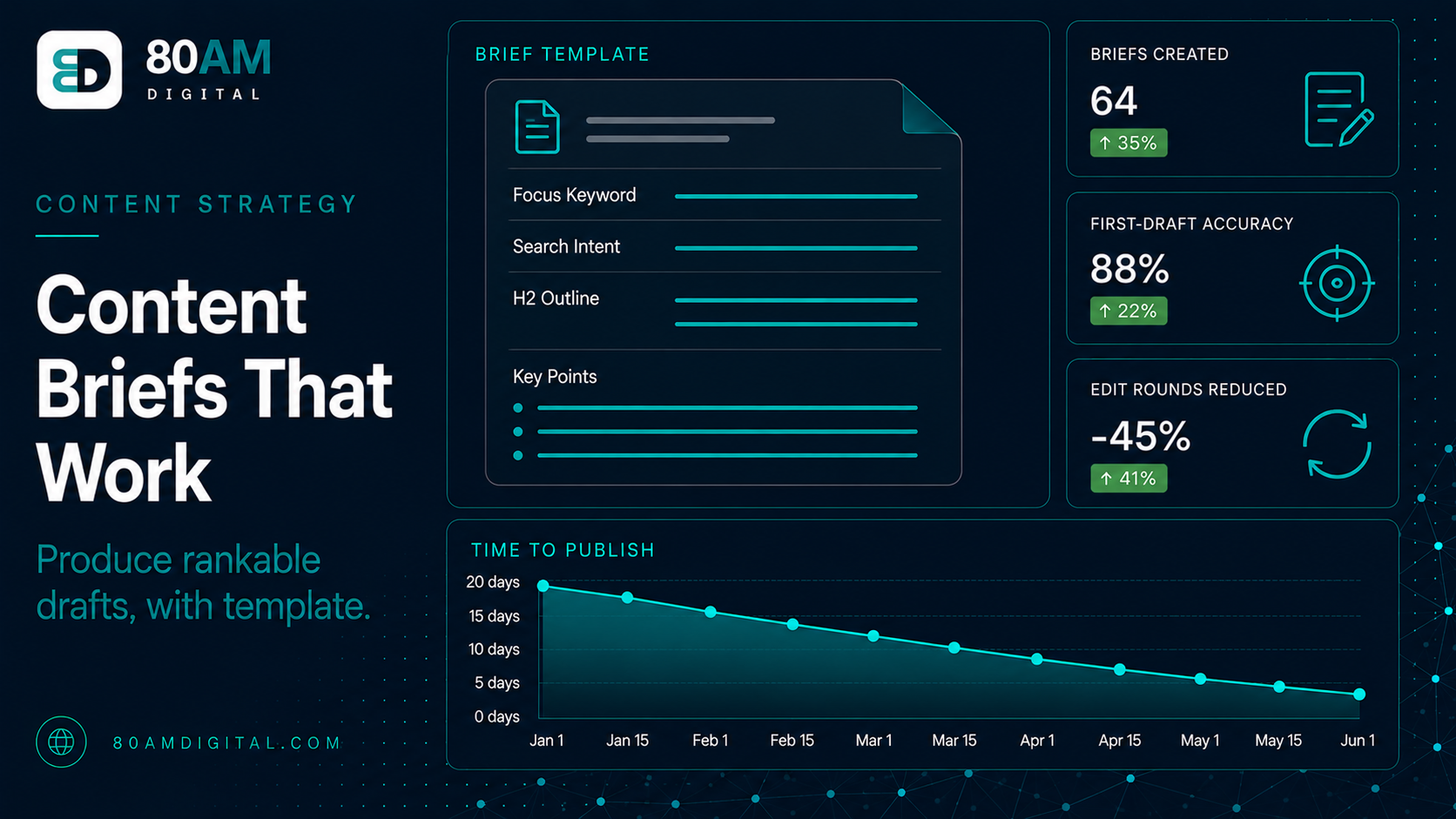
The content brief template
| Section | What it locks down |
|---|---|
| 1. Page overview | Working title, SEO title, URL slug, focus + secondary keywords, meta description |
| 2. Intent and audience | Search intent type, target reader profile, funnel stage |
| 3. SERP analysis | Top 3 ranking URLs, their format, content gaps, SERP features to target |
| 4. Outline and angle | Differentiating angle, H2/H3 structure, word count range |
| 5. Key points to cover | Research-critical facts, data points, or examples per section |
| 6. Internal links | Links to include with anchor text, and existing pages to update |
| 7. Call to action | The specific action and page, plus placement in the article |
1. Page overview
Working title: The H1 the writer should use or closely follow
SEO title: The meta title (under 60 characters) targeting the focus keyword
URL slug: The final page URL path
Focus keyword: The primary term the page is optimised for
Secondary keywords: 3–5 related terms the page should naturally cover
Meta description: 150–160 characters that earn the click from the SERP
2. Intent and audience
Search intent: Informational / Commercial / Transactional (with a one-sentence explanation)
Target reader: Who they are, what they already know, what they’re trying to accomplish
Funnel stage: TOFU / MOFU / BOFU — determines tone and CTA
This section is worth spending time on. A TOFU article explaining a concept to someone new to the topic reads very differently from a MOFU article helping an experienced practitioner choose between two approaches. If the writer doesn’t know which they’re writing, the result is a page that serves neither reader.
3. SERP analysis
Top 3 ranking URLs: What’s currently ranking and why
Format of top results: Are they guides? Listicles? Tools? Templates?
Content gaps: What the top results don’t cover well — this is where the page should differentiate
SERP features: Are there featured snippets, People Also Ask, or knowledge panels to target?
The format section is particularly important. If the top three results are all numbered lists and your brief asks for a long-form guide, you’re asking the writer to fight the SERP instead of compete within it.
4. Outline and angle
Angle: The unique take or framing that differentiates this page from what’s already ranking
Proposed H2 structure: The section headers the page should include, in order
Suggested H3s: Sub-sections within each H2 where relevant
Word count range: Minimum and target, based on what’s ranking and how complex the topic is
The outline is the most time-intensive part of the brief — and the most valuable. A writer who has a validated outline can focus entirely on quality of prose, examples, and depth. A writer who has to build the outline themselves is doing research work on your time, and the result is less predictable.
5. Key points to cover
For each major section: what does the reader need to know? What questions should be answered? Are there specific data points, examples, or case studies to include?
This doesn’t need to be exhaustive — the writer will fill in the substance — but it should flag anything research-critical: “include the 2025 Core Web Vitals thresholds here” or “contrast the agency model vs. in-house at this point.”
6. Internal links
Links to include: The specific pages this article should link to, with suggested anchor text
Links from existing pages: Which existing pages should be updated to link to this new article
This section prevents internal linking from being a post-publish afterthought. Including it in the brief means the cluster structure is maintained from the first draft.
7. Call to action
Primary CTA: The specific action the reader should take and the page it links to
Placement: Where in the article the CTA should appear (bottom only? After the key section?)
What to cut for faster workflows
If you’re running a high-volume content operation and a full brief for every article isn’t feasible, the non-negotiables are: target keyword + intent + audience + H2 outline + key points per section. Everything else can be inferred by an experienced writer — but not these. Without them, you’re sending the writer into the article without a map.
For the overall system that makes briefs work as part of a content engine, see how to build a content engine that compounds.
What a good brief actually saves
Time invested vs. time saved
A worked example: the same assignment, two briefs
A marketing team assigned a freelance writer “an article about choosing a CRM for small agencies” with no brief beyond that sentence. The first draft came back as a 900-word listicle of generic CRM features — competent writing, wrong everything else. The current SERP for the target keyword was dominated by detailed comparison guides with pricing tables and specific agency use cases, not feature listicles. The draft needed a full rewrite, not an edit.
For the next assignment in the same cluster, the team spent 45 minutes building a proper brief: SERP analysis showing the comparison-table format, an outline with five named CRMs and a specific “agency-specific feature” angle the current top results didn’t emphasize, and key points flagging which pricing tiers to verify before publishing. The resulting first draft needed only minor copy polish before publishing — no structural rework, no second SERP check mid-edit. The 45 minutes spent on the brief replaced what had been several hours of back-and-forth revision on the previous piece.
Frequently asked questions
The brief pays for itself in editing time
The investment in a good brief is a forward-looking edit. Every hour spent on the brief before a draft is written reduces two to three hours of structural editing after. Over the course of a content programme, that compounds significantly — fewer revision cycles, more consistent output, and a content library where each piece was built for its specific intent rather than assembled by trial and error.
If you’d like support building a brief workflow or auditing your current content process, see how we approach content strategy.