How to Track AI and Zero-Click Visibility When Clicks Don’t Follow
When AI Overviews answer queries without clicks, standard SEO metrics miss the visibility. Learn how to measure brand presence in AI search and zero-click results.
The traditional SEO measurement model is built around clicks: traffic from organic search, tracked in GA4, attributed to sessions and conversions. When AI Overviews answer queries without clicks — when users get what they need from the SERP and don’t visit any website — this model misses the visibility entirely. A brand can appear in the AI Overview for hundreds of queries every day, be cited as a source, build brand recognition in a new audience, and register zero organic sessions from those interactions.
Measuring AI and zero-click visibility requires a different set of metrics and a different measurement infrastructure than traditional traffic analytics. This article covers the four practical metrics available today, plus a worked example of how one site used them together to build a credible picture of AI visibility despite no single tool covering the whole story.
The Short Version
No single tool measures AI visibility reliably yet, so triangulate across four signals: Search Console impressions vs CTR (a widening gap suggests AI Overview absorption), branded search volume growth (a proxy for AI-driven brand recognition), AI referral traffic in GA4 from Perplexity and ChatGPT, and manual monthly spot-checking of your top 20–30 queries across Google, Perplexity, and ChatGPT. Report these with explicit methodology notes rather than vague “AI visibility is improving” claims.
Table of Contents
| Metric | Source | What it signals |
|---|---|---|
| Impressions vs CTR gap | Search Console | Widening gap suggests AI Overview absorption |
| Branded search volume | Search Console | Growing brand recognition from AI citation |
| AI referral traffic | GA4 | Direct clicks from Perplexity, ChatGPT, etc. |
| Manual spot-checking | Direct queries | Ground-truth citation rate for top queries |
Metric 1: Impressions in Search Console
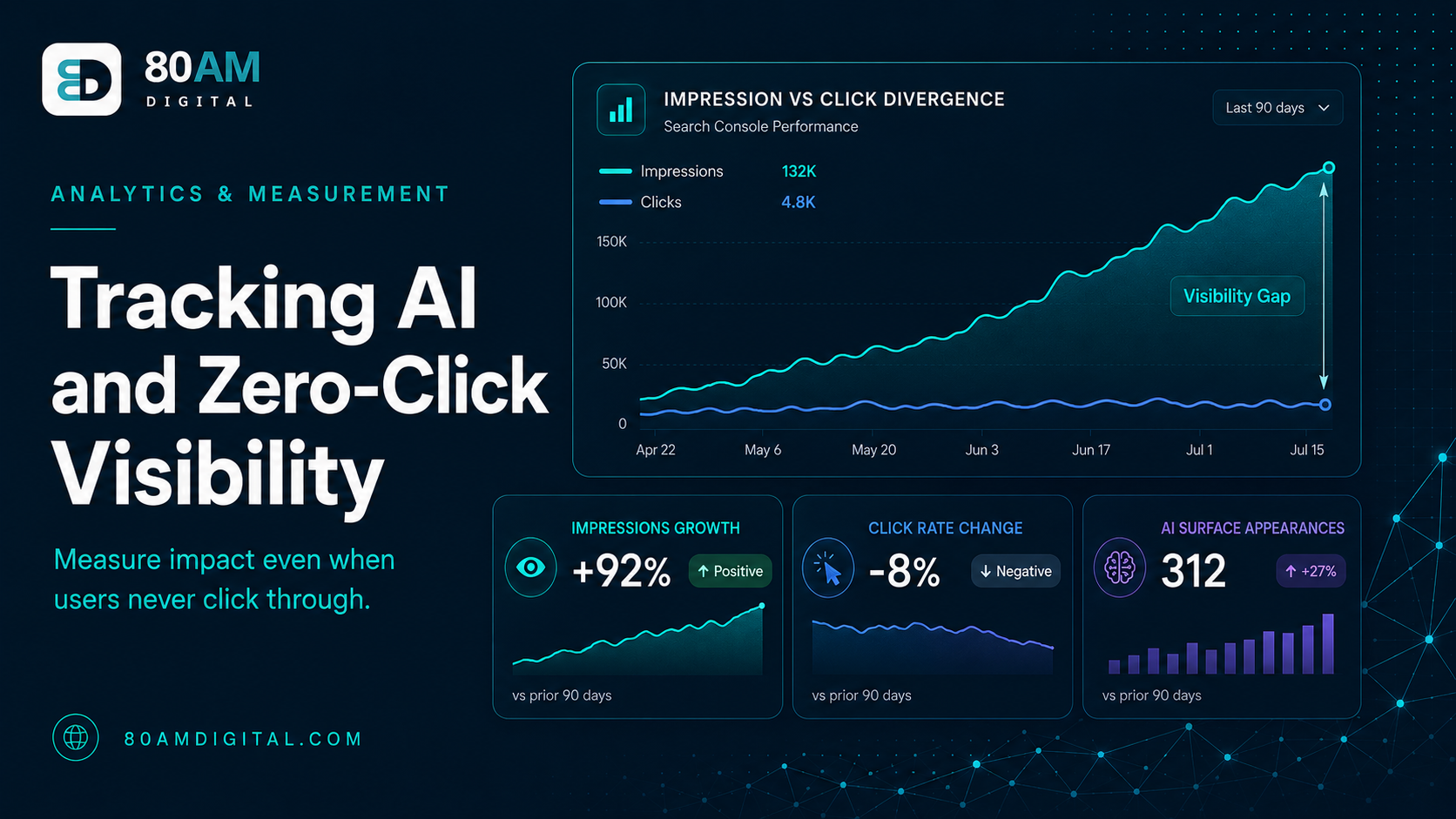
Search Console’s Performance report shows impressions — the number of times your site appeared in search results, regardless of whether anyone clicked. For zero-click queries where your page appears but isn’t clicked, impressions without corresponding clicks is the primary metric. Track impressions separately from clicks, and monitor whether impression growth is translating to proportional click growth or whether the gap is widening (which indicates increasing zero-click behaviour for your queries).
Impressions are available by query, by page, by country, and by device. The most useful view for AI Overviews monitoring: impressions and CTR for your top 20 informational queries. If impressions are stable or growing but CTR is declining, AI Overviews are likely absorbing the answers for those queries.
Metric 2: Branded Search Volume
When AI systems cite your brand in answers, some users subsequently search for your brand name directly. Branded search volume — visible as clicks and impressions for queries matching your brand name in Search Console — is one of the indirect signals of AI visibility. A brand that’s consistently cited in AI Overviews for its topic area will see growing branded search over time even as non-branded organic click rates remain flat or decline.
Track branded query impressions and clicks as a separate metric, isolated from non-branded performance. Growing branded impressions alongside flat non-branded clicks is a pattern consistent with increased AI Overview visibility (brand recognition without direct click attribution).
Metric 3: AI Referral Traffic in GA4
Some AI search platforms send referral traffic to cited sources. In GA4, look for referral sessions from perplexity.ai, chat.openai.com (ChatGPT web search), and similar AI search platforms. These appear in the Acquisition reports under referral traffic. Set up a custom channel group in GA4 that combines these AI referral sources into a single “AI Search” channel for easier monitoring.
Google AI Overview traffic, when users click the citation links, appears in GA4 as organic search traffic (it comes from google.com searches). It’s not separately identifiable in standard GA4 reports, but the presence of very short-session, high-intent organic visits on pages where you’re likely cited in AI Overviews is a weak proxy signal.
Metric 4: Manual AI Citation Spot-Checking
The most direct way to measure AI visibility is to regularly check whether your content is being cited in AI Overviews and AI search platforms for your target queries. Build a list of your 20–30 most important non-branded queries and check them monthly in Google (for AI Overviews), Perplexity, and ChatGPT with web search. Record which platforms cite your content and for which queries. This is manual but provides data that no current tool delivers automatically with high reliability.
Tools including SE Ranking, BrightEdge, and Semrush are adding AI Overview tracking to their rank monitoring features — check the current state of these tools’ AI coverage for your preferred platform. The landscape is evolving rapidly.
For how zero-click trends affect your overall search strategy, see zero-click search. For how AI Overviews choose which sources to cite, see how AI Overviews choose their sources.
A Worked Example
A financial planning content site noticed organic clicks plateauing on its 15 highest-impression informational pages despite impressions continuing to grow steadily in Search Console — a pattern the team suspected was AI Overview absorption rather than a ranking problem, since average position on those pages hadn’t moved.
They built a monthly tracking routine combining all four metrics: the impressions-vs-CTR gap confirmed the widening pattern on those 15 pages specifically (not site-wide); branded search volume had grown 22% over the prior two quarters with no corresponding PR or ad activity to explain it; GA4 showed a small but real and growing trickle of Perplexity referral sessions; and manual spot-checking across 25 target queries found the site cited in Google AI Overviews for 9 of them, and in Perplexity for 4.
No single metric proved the AI visibility story on its own, but together they built a credible, internally consistent picture: the site’s informational content was indeed being absorbed into AI answers at increasing rates, branded recognition was growing as a downstream effect, and a small amount of that recognition was now generating direct clicks from AI platforms. The team used this combined picture, with the methodology fully disclosed, to justify continued investment in deepening that content rather than abandoning it after the click plateau looked discouraging in isolation.
Frequently Asked Questions
Measure What You Can; Prepare for Better Data
The measurement infrastructure for AI search visibility is still catching up to the reality of AI search behaviour. The pragmatic approach: use the metrics available now (Search Console impressions, branded search volume, AI referral traffic, manual citation spot-checking), track them consistently, and add better tools as they become available. A measurement gap isn’t an excuse to ignore AI visibility — it’s a reason to document current methods clearly so you can compare like-for-like as measurement improves.
If you’d like help setting up AI visibility tracking alongside your standard SEO measurement, get in touch.