How to Forecast SEO Results (Without Overpromising)
SEO forecasting is uncertain by nature — but useful forecasts are possible. Learn the framework for projecting organic traffic and revenue potential without overpromising.
The hardest thing to say to a stakeholder or client who asks “what results will we get from SEO?” is: “I can give you a range based on reasonable assumptions, but not a precise number.” The honest answer is unpopular. The dishonest alternative — confident projections with specific traffic and revenue numbers — is what causes the SEO industry’s credibility problem when results don’t materialise.
Useful SEO forecasting is possible, but it requires a specific framework, transparency about the assumptions underlying the numbers, and a deliberate distinction between what can be estimated with reasonable confidence and what is genuinely unknowable. This article walks through the keyword-based forecast model, how to communicate the uncertainty honestly, and a worked example of a forecast that held up against the gap between projection and reality.
The Short Version
The standard SEO forecast model: pick target keywords, estimate an achievable ranking position, apply a CTR-by-position curve to get projected clicks, then multiply by your current organic conversion rate for projected leads or revenue. Present the result as a range, not a point estimate — “800–1,400 sessions, most likely 1,100” is honest; “1,100 sessions” is not. Revise the forecast quarterly against actual performance rather than setting it once and never revisiting it.
Table of Contents
The Keyword-Based Forecast Model
The most common and most useful SEO forecast is keyword-based: identify target keywords, estimate the ranking position achievable for each, apply an industry-standard CTR curve to estimate clicks, and multiply by conversion rate to project outcomes. Here’s the model:
- Identify target keywords: Select keywords you’re currently ranking in positions 4–20 (achievable rank improvements) or keywords for which you have planned content (future rankings). For each keyword, record the current monthly search volume from Search Console or a keyword tool.
- Estimate achievable ranking position: Based on the site’s current domain authority, the difficulty of the keyword (competitor domain strengths), and the timeline of the forecast, estimate a realistic target position. Be conservative — it’s better to exceed a reasonable forecast than miss an optimistic one. For a 6-month forecast: moving from position 15 to position 7 is conservative; from 15 to 1 is not.
- Apply CTR by position: Industry CTR data (Advanced Web Ranking, Sistrix, or your own Search Console CTR by position data) gives the approximate click-through rate at each position. Your actual CTR varies by query type (navigational queries have very different CTR distributions from informational ones).
- Multiply to get projected clicks: Monthly search volume × estimated CTR at target position = projected monthly clicks from that keyword.
- Apply conversion rate: Use your current organic search conversion rate from GA4 as the baseline. Projected clicks × organic conversion rate = projected conversions or leads. Multiply by average deal value for revenue projection.
| Position | Approximate CTR |
|---|---|
| 1 | 28–32% |
| 3 | 9–11% |
| 5 | 6–8% |
| 7 | 4–5% |
| 10 | 2–2.5% |
Communicating Uncertainty Honestly
Every step in the above model has uncertainty. Search volume data from tools is an estimate. The CTR at a given position varies by query. The ranking achievable in a given timeframe depends on Google’s crawl schedule, algorithm updates, and competitor activity — all of which are outside your control. Conversion rates from new traffic may differ from existing conversion rates.
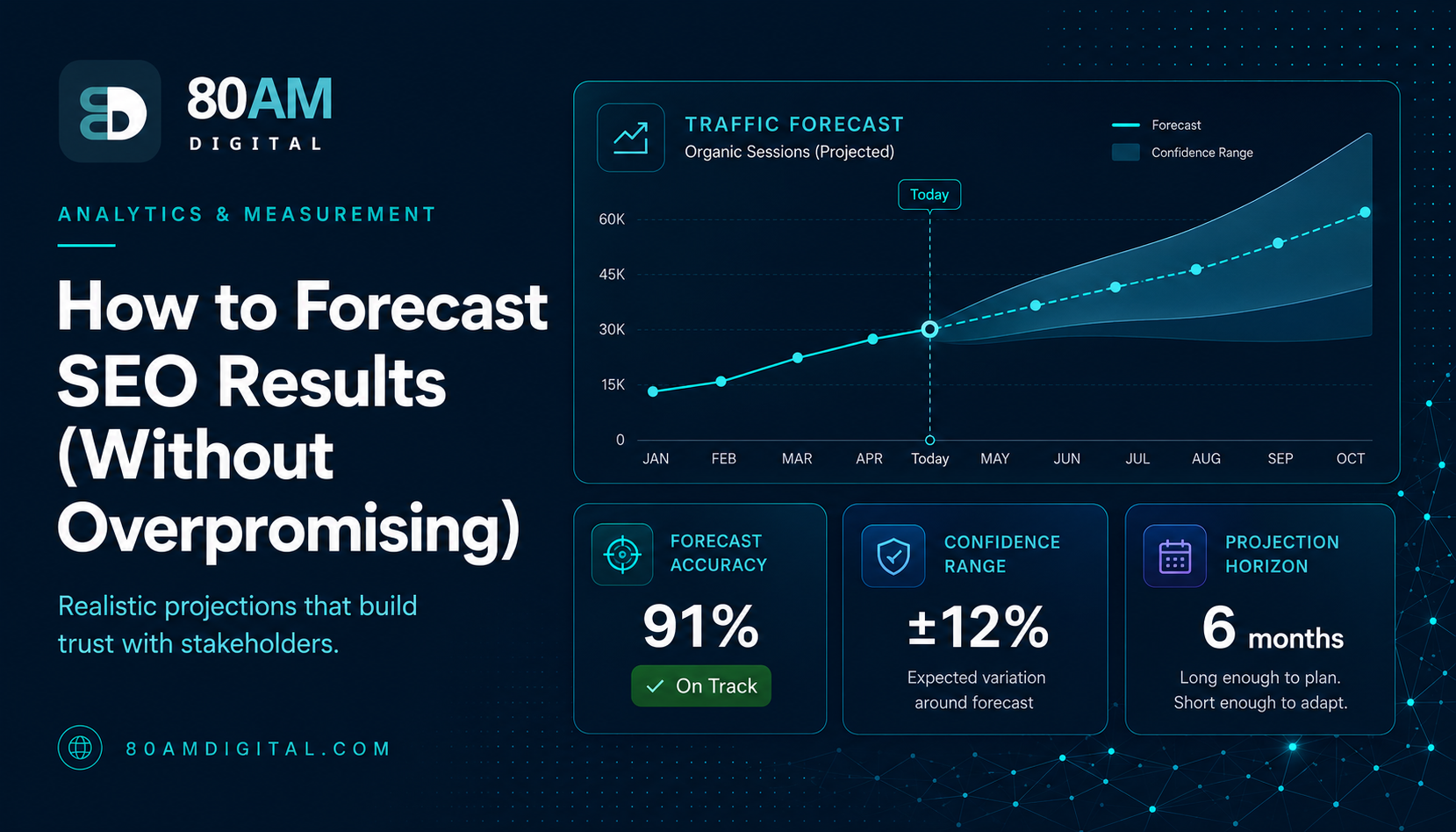
The right format for an SEO forecast is a range, not a point estimate. “Based on these assumptions, we project 800–1,400 additional organic sessions per month by month 9, with a most-likely scenario of 1,100.” This is honest. It also provides a structure for updating: if month 6 shows 600 sessions rather than 800, the forecast needs revision, and the model shows where the assumption was wrong.
For how to present these forecasts to stakeholders, see reporting SEO to executives. For the timeline expectations that underpin realistic forecasts, see SEO timelines and expectations.
A Worked Example
A legal services firm asked for a 9-month SEO forecast before committing budget. The team identified 22 target keywords currently ranking positions 6–18, applied conservative position improvements (most projected to reach positions 4–8, none projected to reach position 1), and used the firm’s own Search Console CTR-by-position data rather than generic industry benchmarks, since their CTR at position 5 was notably below average due to weak existing meta titles.
The resulting range was 340–620 additional monthly organic sessions by month 9, with a most-likely scenario of 460, translating to roughly 9–16 additional qualified leads per month at the firm’s existing 2.8% organic conversion rate. The team presented this explicitly as a range with the underlying assumptions listed, rather than a single confident number.
At month 9, actual additional sessions came in at 510 — within the projected range and close to the most-likely scenario, despite one target keyword underperforming due to an unanticipated competitor content push and another overperforming due to a Google update that favoured the firm’s content style. The range format meant neither variance broke the forecast’s credibility; both fell inside the band that had been honestly communicated from the start.
Frequently Asked Questions
The Forecast Is a Commitment to a Process, Not a Number
An SEO forecast’s value is less in the specific numbers than in the discipline it creates: explicit assumptions about what will change, explicit metrics for whether the changes are happening, and explicit checkpoints to update the forecast based on actual performance. A team that forecasts, tracks, and revises iteratively learns faster and makes better decisions than a team that either doesn’t forecast (no accountability) or sets forecast numbers once and never revisits them (stale assumptions).
If you’d like help building an SEO forecast for your business or validating an existing one, get in touch.