Reporting SEO to Executives: What to Say and What to Skip
Executives don’t need keyword rankings and domain authority scores. They need to know whether organic search is making or saving money. Here’s how to translate SEO into that language.
Most SEO reports are written for SEO practitioners. They contain rankings, domain authority scores, organic session counts, top landing pages by sessions, and Click-through rate from Search Console. These are useful for the person managing SEO. They’re largely meaningless to an executive who doesn’t know what domain authority is, doesn’t care what position they rank for a specific keyword, and is trying to decide whether to increase or reduce the SEO budget.
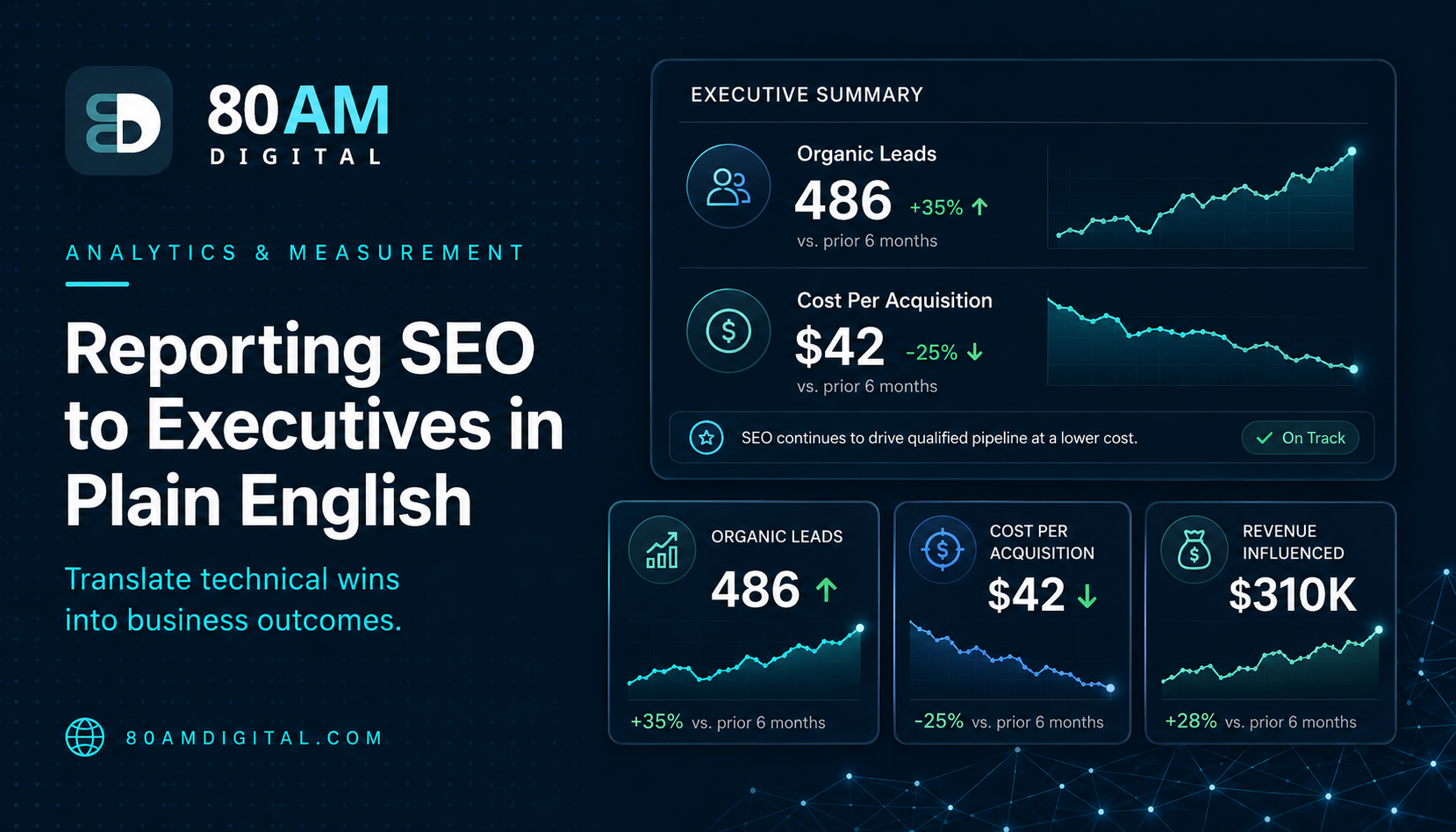
Executive SEO reporting has one goal: connect organic search performance to business outcomes that executives already track. If the business tracks revenue, show organic search’s revenue contribution. If it tracks leads, show organic search’s lead contribution. If it tracks customer acquisition cost, show what organic search costs per acquisition vs paid search. This article covers the four metrics that belong in an executive report, what to deliberately leave out, and a worked example of a report rebuild that changed how a leadership team viewed the SEO budget.
The Short Version
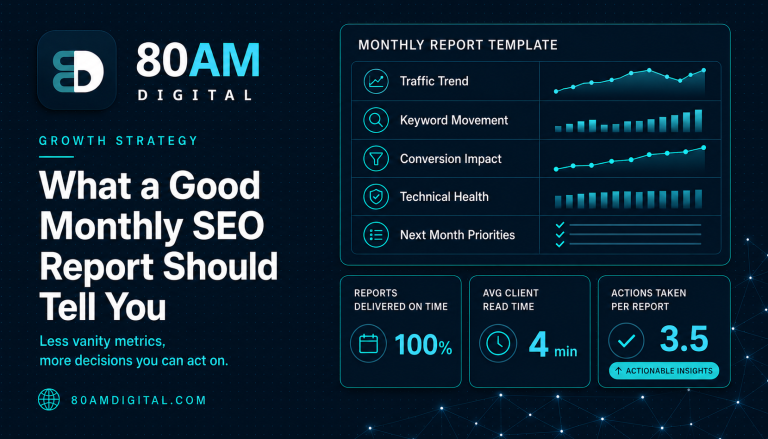
Executive reports need four things: organic revenue or leads vs the same period last year, cost per organic acquisition vs paid, organic traffic trend with one leading indicator, and a brief note on notable events and their impact. Leave out domain authority, individual keyword rankings, impressions without context, and raw technical SEO status — translate those into one-line business impact statements instead. Target one page, four sections, one chart.
Table of Contents
| Include | Leave out |
|---|---|
| Organic revenue/leads vs prior period | Domain Authority / Domain Rating |
| Cost per organic acquisition vs paid | Individual keyword rankings |
| Traffic trend + one leading indicator | Impressions without context |
| Notable events and their impact | Raw technical SEO status items |
The Four Metrics That Belong in an Executive SEO Report
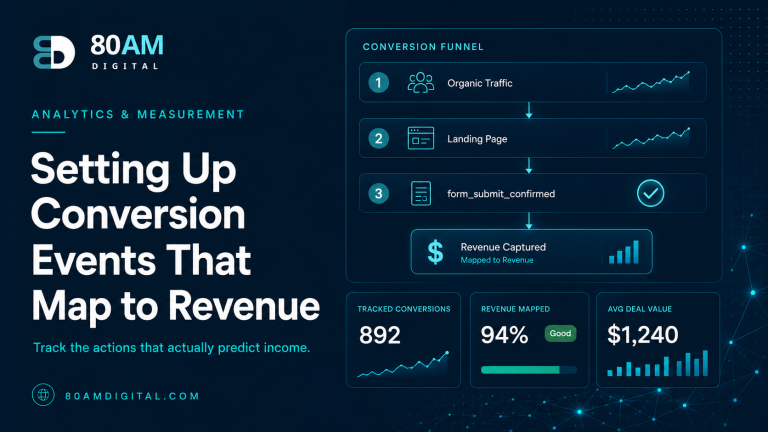
1. Organic search revenue or leads (with conversion value): How many leads or how much revenue did organic search drive this period, compared to the same period last year? This is the output metric that executives care about most. If you can’t show this because conversion tracking isn’t set up, establishing conversion tracking is the first priority — not because it makes for a better report, but because it’s the only way to know whether the SEO investment is working.
2. Cost per organic acquisition (vs paid): If paid search generates a lead at £80 and organic search generates a comparable lead at £20 (total SEO investment divided by leads generated), the organic channel is significantly more cost-efficient. Executives who fund both organic and paid benefit from seeing this comparison — it provides the business case for SEO investment without requiring them to understand SEO mechanics.
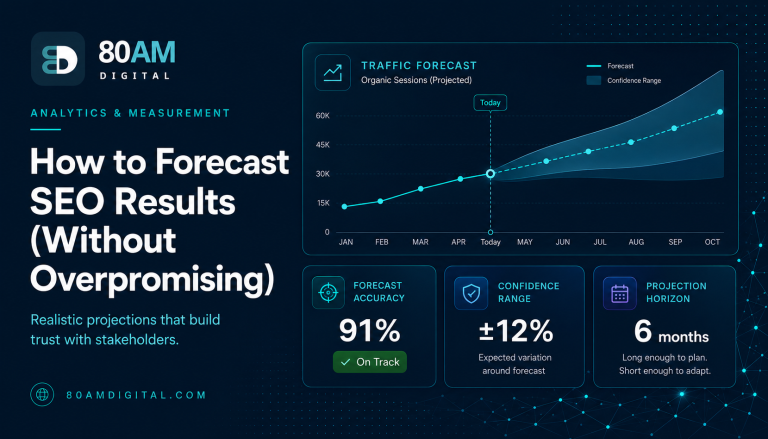
3. Organic traffic trend (with one leading indicator): Total organic sessions year-over-year. One leading indicator that predicts future traffic: keyword rankings improving or declining for the top 10 target queries. Ranking improvements now predict traffic growth in 1–3 months; declining rankings predict future traffic loss. This gives the executive a forward-looking signal alongside the backward-looking traffic number.
4. Notable events and their impact: A brief narrative of what happened in the period — a core update that temporarily affected rankings, a new content cluster published, a technical fix deployed — with a note on the expected impact on the next period. This prevents executives from asking “why did traffic drop in October?” when the answer is “Google core update, we’re monitoring recovery” — proactive explanation maintains trust.
What to Leave Out of Executive Reports
- Domain Authority / Domain Rating: Third-party metrics from Moz or Ahrefs that executives can’t action and that don’t directly correlate to the revenue metrics they care about.
- Individual keyword rankings: Unless a specific keyword has been called out as a strategic target, individual rankings are too granular for executive reporting. The trend across a portfolio of target keywords is the useful signal.
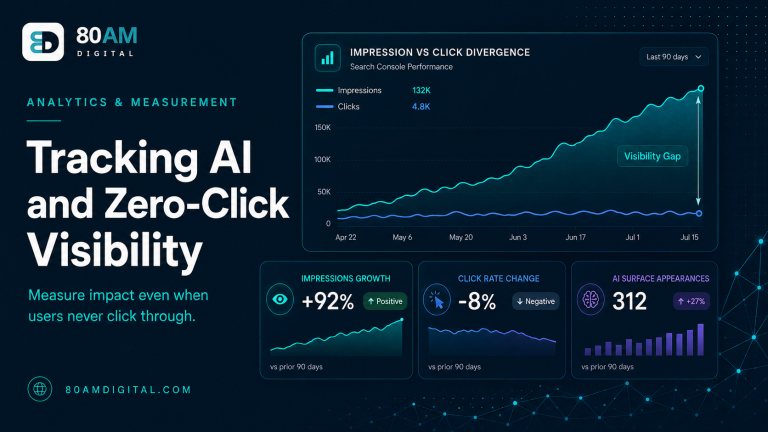
- Impressions without context: “Impressions grew 40% this month” without connecting it to whether that means more visibility for queries that drive revenue is not useful information for an executive.
- Technical SEO status items: Core Web Vitals scores, crawl error counts, schema validation results — these belong in the practitioner report. In the executive summary, they appear only as “resolved crawlability issue that was preventing 23 pages from indexing — those pages now indexed and expected to generate traffic in the coming 4 weeks.”
For how to build the underlying analytics infrastructure, see the Looker Studio SEO dashboard. For the attribution model that makes organic search revenue visible, see organic search attribution.
A Worked Example
A logistics technology company’s SEO team had been sending a 12-page monthly PDF to the CMO — rankings tables for 80 keywords, Core Web Vitals scores, a backlink summary, and several Search Console charts. The CMO admitted in a casual conversation that she rarely opened past page two, and the SEO budget had been flat for two years despite the team believing performance was strong.
The team rebuilt the report to one page: organic leads this month vs last year (up 34%), cost per organic lead vs paid (£18 vs £64), one chart of 12-month organic sessions, and three sentences on notable events. The keyword tables, Core Web Vitals data, and backlink summary moved to a separate practitioner-only appendix that existed but wasn’t the headline document.
The very next monthly review, the CMO asked a follow-up question about the paid comparison that she had never asked about SEO before — the cost-per-acquisition gap was the number that finally registered. Within two quarters, the SEO budget was increased for the first time in two years, justified directly by that comparison rather than by anything in the old 12-page report, which had contained largely the same underlying performance the whole time.
Frequently Asked Questions
Translate, Don’t Educate
Executives who fund SEO don’t need to become SEO practitioners. They need to know whether the investment is working, what to expect, and whether to maintain, increase, or reduce it. Translating SEO activity and metrics into the business outcomes they already track — revenue, leads, acquisition cost — is the job. Teaching them what domain authority means is not the job. The simpler the executive report, the more trust it builds: it signals that you understand what matters, not just what you measure.
If you’d like help building an executive SEO reporting framework that connects to your business’s specific KPIs, get in touch.