Organic Search Attribution: How to Credit SEO for the Revenue It Actually Drives
Last-click attribution systematically undercredits SEO. Learn how to measure SEO’s true contribution to revenue using GA4’s multi-touch models and data-driven attribution.
Last-click attribution — the default in most analytics setups — credits the final touchpoint before conversion with 100% of the revenue value. In practice, this systematically undercredits organic search. An organic blog post that introduces a prospect to your brand in March, followed by a direct visit in April after they’ve done more research, followed by a Google Ads click in May that drives the conversion — that blog post gets zero credit. The paid click gets 100%.
This attribution model makes SEO look less valuable than it is and paid search look more valuable than it is. The result: SEO investment is harder to justify to stakeholders who see the last-click data, and budget allocation shifts toward paid channels even when organic search is driving most of the awareness and consideration that makes those paid clicks convert. This article covers the attribution models available in GA4, how to surface the “hidden credit” organic search generates, and a worked example of what changes when a business stops relying on last-click alone.
The Short Version
Last-click attribution undercredits organic search by 30–50% for businesses with multi-touch consideration cycles, because it gives 100% of the credit to whatever channel happened to be clicked last. GA4’s data-driven attribution (with 300+ monthly conversions) or linear attribution (for lower volume) give a fairer picture. The single most useful report for justifying SEO budget is Advertising → Attribution → Model Comparison — it shows the gap between what last-click credits organic and what a multi-touch model credits it.
Table of Contents
Attribution Models in GA4
GA4 offers multiple attribution models, each of which treats organic search differently:
- Last click: 100% credit to the final touchpoint. Systematically undercredits organic search for businesses with longer consideration cycles.
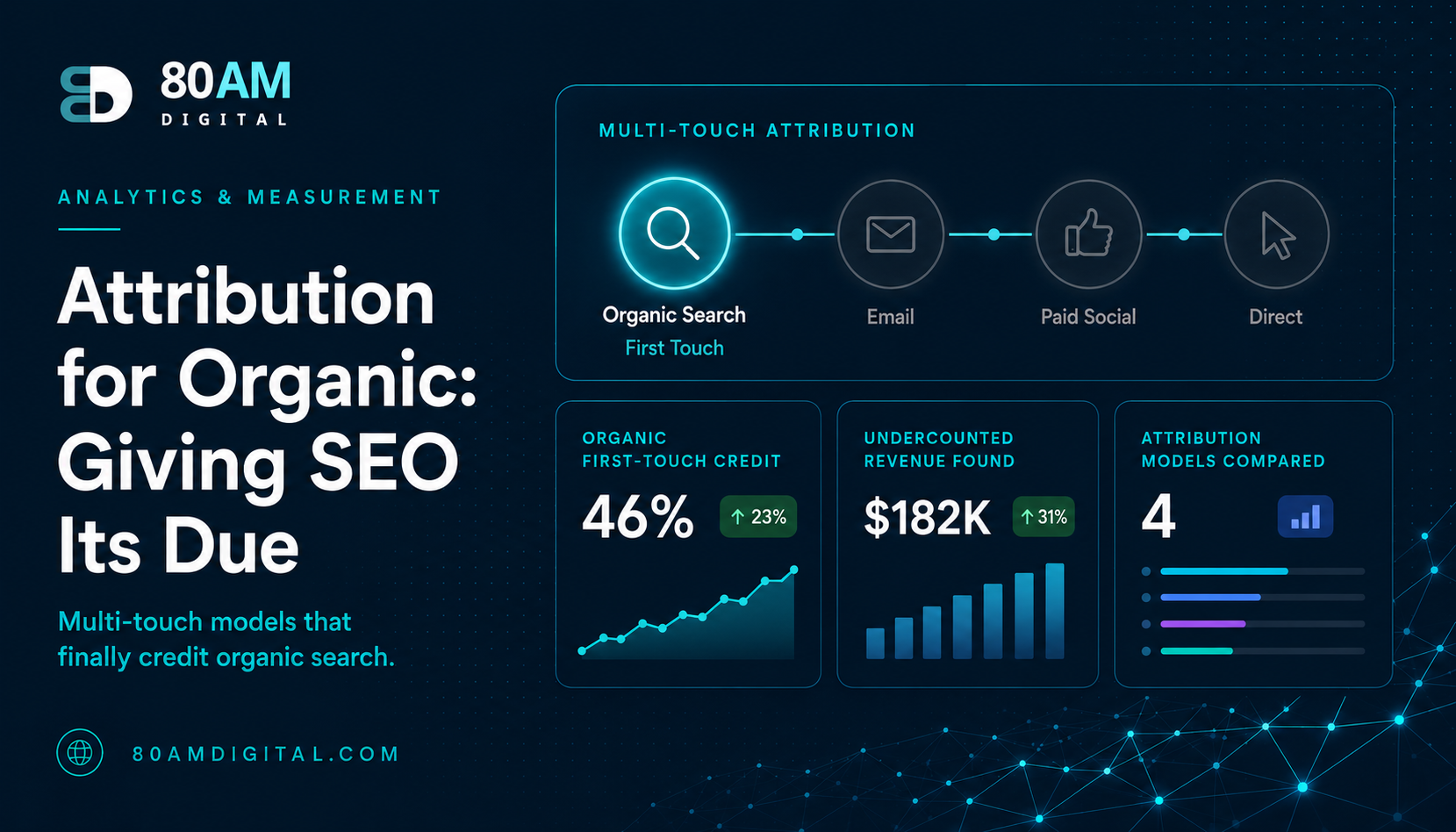
- First click: 100% credit to the first touchpoint. This tends to over-credit organic search for businesses where paid search or direct drives the final conversion — but useful for understanding which channels introduce customers to the brand.
- Linear: Equal credit to all touchpoints in the conversion path. A fairer model for multi-touch journeys; organic search gets credit proportional to its presence in the path.
- Time decay: More credit to recent touchpoints, less to earlier ones. Better than last-click but still disadvantages organic search in long consideration cycles.
- Data-driven attribution (DDA): Uses Google’s ML to allocate credit across touchpoints based on their actual contribution to conversion, estimated from your conversion data. Requires sufficient conversion volume (typically 300+ conversions per month) to produce reliable results. When available, DDA is the most accurate model and typically gives organic search more credit than last-click while being more accurate than simple multi-touch models.
| Model | Typical effect on organic credit | Data needed |
|---|---|---|
| Last click | Undercredits, often severely | None — works on any volume |
| First click | Overcredits relative to other channels | None — works on any volume |
| Linear | Fairer, proportional to presence in path | None — works on any volume |
| Time decay | Better than last-click, still skewed | None — works on any volume |
| Data-driven (DDA) | Most accurate, usually favours organic | 300+ conversions/month |
How to View Multi-Touch Attribution in GA4
In GA4: Advertising → Attribution → Model Comparison. Select different attribution models and compare how organic search performance changes across models. The difference between last-click and linear or data-driven attribution is the “hidden credit” organic search was generating but not getting recognised for. This view is the most important single report for justifying SEO investment to stakeholders who see only last-click data.
Also useful: Advertising → Attribution → Conversion Paths. This shows the actual sequences of touchpoints in conversion paths — what organic search touches typically appear as, where in the path they appear, and what follows them. For most B2B service businesses, organic search appears heavily in the early and middle stages of the path, with direct or branded paid search appearing at the final conversion step.
For the SEO reporting framework, see reporting SEO to executives. For which metrics tell the real story, see leading and lagging SEO indicators.
A Worked Example
A B2B insurance brokerage had been cutting its content budget for three consecutive quarters, justified by last-click reports showing organic search contributing under 8% of new business revenue, while paid search and direct showed the bulk of credit. The marketing lead suspected this didn’t reflect what was actually happening, since most new clients mentioned reading several articles before ever filling out a quote form.
Running the Model Comparison report in GA4 confirmed it: under data-driven attribution, organic search’s contribution rose from 8% to 31% of new business conversions. The Conversion Paths report showed why — organic search appeared in the early-to-middle stage of the path in over 60% of conversions, almost always followed by a branded paid search click or a direct visit that closed the deal, with the paid click absorbing 100% of the last-click credit for a journey organic search had actually started.
Presenting both numbers side by side — with the mechanism explained — reversed the budget conversation. Content investment that had been on track for further cuts was instead increased the following quarter, and the brokerage adopted data-driven attribution as the standard reporting model going forward rather than reverting to last-click once the immediate argument was won.
Frequently Asked Questions
Show the Real Picture
Organic search attribution is fundamentally an argument for accurate measurement. Last-click data that undercredits SEO by 30–50% isn’t neutral — it systematically shifts budget decisions away from a channel that’s often generating the majority of the consideration that makes other channels convert. Moving to multi-touch attribution and showing stakeholders the full conversion path isn’t special pleading for SEO — it’s correcting a measurement bias that affects every business decision that uses the data.
If you’d like help setting up multi-touch attribution in GA4 and building the case for SEO investment, get in touch.