Leading and Lagging SEO Indicators: What to Track and When
Traffic is a lagging indicator — it tells you what happened, not what will happen. Learn which leading indicators predict SEO performance before results appear in traffic data.
Organic traffic is a lagging indicator. It tells you what happened — it doesn’t tell you what will happen. By the time a traffic decline appears in your GA4 reports, the cause may have occurred 3–6 months earlier: a crawlability issue that prevented new content from indexing, a ranking decline that’s been gradually eroding traffic for weeks, or a content quality problem that’s been accumulating over many publishing cycles.
Leading indicators in SEO are metrics that predict future traffic performance. Tracking them gives you advance warning of problems and confirmation of success before they show up in traffic data. The combination of leading and lagging indicators is what makes SEO reporting useful for decision-making rather than just informative about the past. This article covers both categories in detail, the typical lag between them, and a worked example of a team that caught a traffic problem weeks before it would otherwise have appeared.
The Short Version
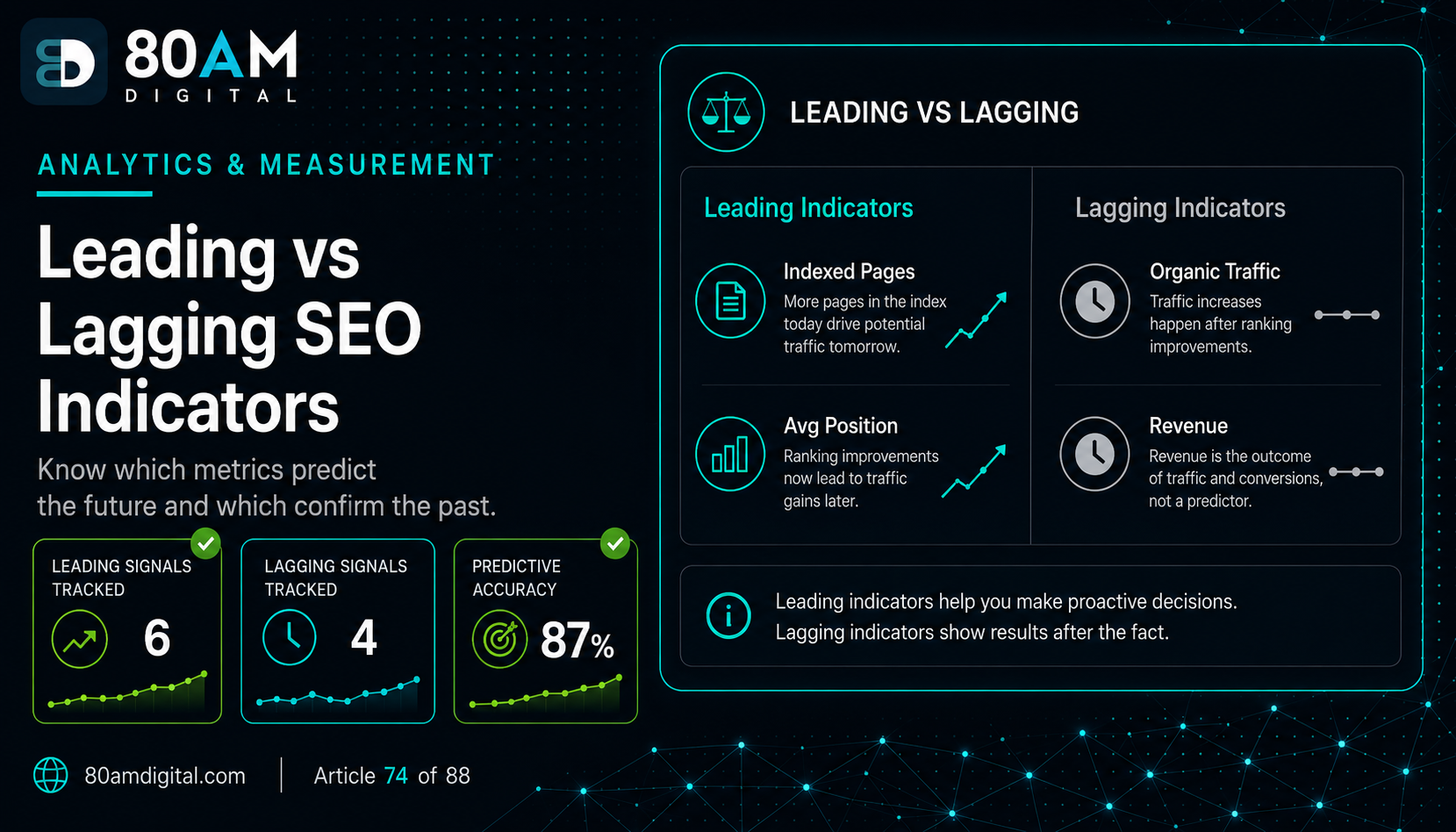
Lagging indicators (traffic, conversions, revenue) measure outcomes that already happened. Leading indicators (indexed pages, crawl-to-index ratio, average position for target keywords, Core Web Vitals pass rate, content indexed within 30 days, backlinks acquired) predict outcomes 2–16 weeks ahead, depending on the indicator. Track 3–5 leading indicators alongside your lagging ones — more creates measurement overhead without proportional insight, and the discipline of watching the right few beats tracking everything.
Table of Contents
Key Lagging SEO Indicators
Lagging indicators measure outcomes. They’re important for accountability and for measuring ROI, but they’re backwards-looking:
- Organic traffic (sessions, users): The headline number. Reflects ranking performance from 4–12 weeks ago depending on indexation lag and ranking volatility.
- Organic conversions and leads: The most important lagging indicator for business decisions. Lags behind traffic by the length of the conversion cycle.
- Organic revenue: The ultimate lagging indicator. Critical for executive reporting; not actionable in the short term.
- Keyword rankings: Technically a leading indicator for traffic, but a lagging indicator for the SEO activities that produced the ranking — content published 3 months ago is now ranking, so the ranking confirms the earlier investment.
Key Leading SEO Indicators
Leading indicators measure inputs and early signals that predict future outcomes:
- Indexed pages: Total number of pages Google has indexed from your site (visible in Search Console’s Coverage report). Rising indexed pages (following new content publication) indicates that new content is being found and will begin ranking. Stagnant indexed pages despite publishing activity indicates a crawl or indexation problem that will suppress future traffic.
- Crawl budget usage: How efficiently Google is crawling your site (visible via Search Console’s Crawl Stats). A healthy crawl-to-index ratio (pages crawled that get indexed vs pages crawled that don’t) indicates your content is passing Google’s quality bar. A high crawl-to-low-index ratio suggests thin or duplicate content that Google is recrawling but not indexing.
- Average position for target keyword set: Average ranking position across a defined set of target keywords (your 20–50 most strategically important non-branded queries). If average position is improving month over month, organic traffic will grow in the coming weeks. If average position is declining, traffic will decline before the traffic data shows it.
- Core Web Vitals pass rate: The percentage of your pages passing Google’s Core Web Vitals thresholds (visible in Search Console’s Core Web Vitals report). Pages failing LCP, INP, or CLS are at a ranking disadvantage. A declining pass rate predicts future ranking pressure before rankings actually move.
- New content published (and indexed within 30 days): The volume and speed of new content entering Google’s index is a leading indicator of future organic growth. Sites that consistently publish content that indexes quickly and begins ranking are building a compounding organic asset; sites with high content-rejection rates (published but not indexed) have a content quality problem that will cap future growth.
- Backlinks acquired: New backlinks from relevant, authoritative domains (visible in Ahrefs or Semrush) are a leading indicator of future ranking improvement for pages receiving those links, typically with a 4–8 week lag before rankings respond.
| Leading indicator | Typical lag to traffic impact |
|---|---|
| Average position improvement | 2–6 weeks |
| New content indexed | 6–16 weeks |
| Core Web Vitals improvement | 4–12 weeks |
| Backlinks acquired | 4–10 weeks |
For how to build a dashboard that tracks both types of indicators, see the Looker Studio SEO dashboard. For how to present this in executive reporting, see reporting SEO to executives.
A Worked Example
A subscription box company tracked average position for its 30 target keywords monthly alongside traffic, having set up the leading-indicator dashboard six months earlier after repeatedly being surprised by traffic drops with no apparent warning. In one monthly check, average position across the target set had slipped from 6.8 to 9.4 over four weeks, while traffic itself hadn’t moved yet — the lag hadn’t caught up.
The team investigated immediately rather than waiting for the traffic decline to materialise. A site migration three weeks earlier had introduced a redirect chain issue affecting roughly 40 product pages, silently diluting their ranking signals. Because the leading indicator had flagged the problem early, the team fixed the redirect chains within a week of identifying the cause.
Traffic dipped only slightly and recovered within three weeks, instead of the 10–15% sustained decline a similar issue had caused the previous year when it was only caught after showing up in the traffic data itself, by which point the fix took a month longer to identify and the recovery took twice as long. The four-week head start from watching average position, not traffic, was the entire difference between a minor blip and a quarter-defining problem.
Frequently Asked Questions
Track the Future, Not Just the Past
Traffic data tells you what happened. Leading indicators give you the ability to act before the outcome is determined. A team that monitors average position, indexed page growth, and Core Web Vitals monthly has 4–8 weeks of advance notice of traffic changes that an organisation tracking only organic sessions won’t see until the traffic has already moved. That advance notice is what makes SEO measurable and manageable rather than reactive.
If you’d like help defining and tracking the right leading indicators for your specific SEO programme, get in touch.