How to Set Realistic SEO Timelines and Expectations
How long does SEO take? Longer than ads, shorter than you fear if you prioritize right. Learn what to expect at 3, 6 and 12 months—and what speeds results up.
The honest answer to “how long does SEO take?” is: longer than paid ads, shorter than you’ve been told if you start in the right place.
Most sites see meaningful movement — improved rankings, measurable traffic growth, clearer attribution to leads — within four to six months when the work is prioritised correctly. The full compounding effect — where content, authority, and technical health build on each other — takes 12 to 18 months on most sites. But that doesn’t mean nothing happens in the first 90 days.
This article breaks down what typically happens at each milestone, what makes results come faster, what to track at each stage, and a worked example of a site that moved through the full timeline on schedule.
The Short Version
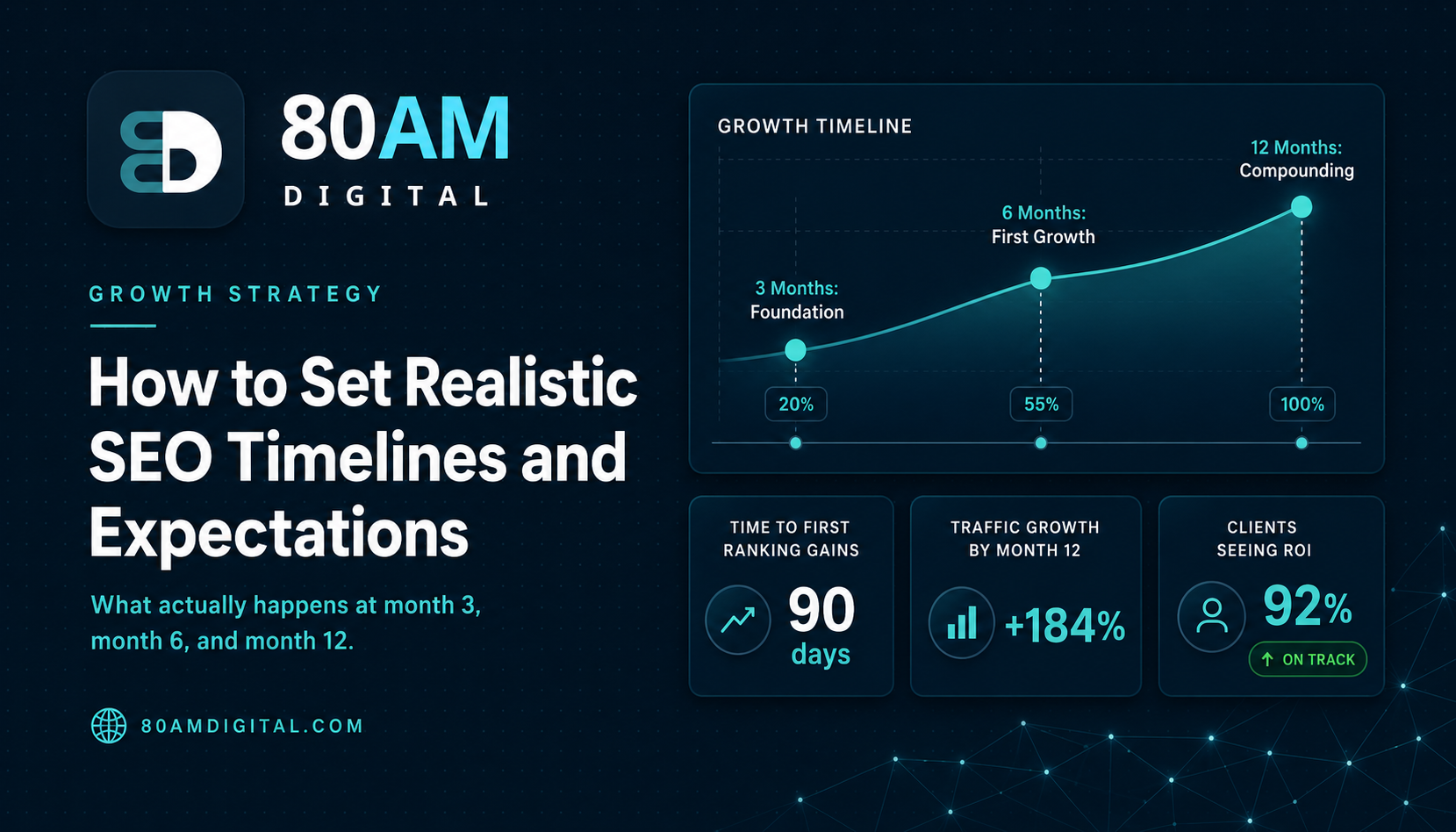
Months 1–3 are foundation work — technical fixes, internal linking, priority content — that won’t show in traffic yet but unblocks everything after. Months 4–6 typically bring the first measurable traffic and lead growth. Months 7–12 bring compounding: pillar pages pass authority to spokes, and growth accelerates rather than plateaus. Six months is the realistic minimum to judge whether SEO is working; anyone promising significant traffic gains inside three months on a new site is either overstating or cutting corners that create long-term risk.
Table of Contents
Why SEO Takes Time (And Why That’s Not a Flaw)
Paid ads produce results the day you fund them. Turn off the budget and the traffic stops. SEO builds a different kind of asset: pages that rank, earn traffic, and convert — without paying for each visit. That asset takes time to build, but it persists and compounds in a way paid media doesn’t.
The reason it takes time is that Google’s ranking signals are mostly based on accumulated evidence: how long the page has existed, how much content the site has on this topic, how many other sites link to it, whether users have engaged positively with it over time. You can’t fake that evidence quickly. But you can lay the foundation for it much faster than most SEO timelines suggest — if you start with the right things.
What to Expect at Each Stage
| Stage | Focus | What you’ll see |
|---|---|---|
| Months 1–3 | Technical fixes, internal linking, priority content | Improved coverage, early position movement on worked pages |
| Months 4–6 | Content maturing, secondary keywords | First measurable traffic growth, early attributable leads |
| Months 7–12 | Cluster compounding, authority distribution | Accelerating (not plateauing) traffic, head-term rankings |
Months 1–3: Foundation and Early Signals
The first three months on most sites involve: fixing technical issues that are preventing proper indexation, improving internal linking to route authority to the pages that need it, and publishing or refreshing the highest-priority content. This is work that doesn’t produce immediate ranking jumps — but it removes the constraints that are preventing ranking growth.
What you will see in months 1–3: improved crawl coverage in Search Console, new pages being indexed, and for pages with existing impressions, early position movement as Google re-evaluates recently improved content. Search Console position data should start moving by week six to eight on the pages that were worked on first.
Months 4–6: First Measurable Traffic Growth
For most sites starting SEO with a solid technical foundation (or after fixing the foundation in months 1–3), months four to six produce the first clear organic traffic growth. Pages that have climbed from page two to page one start generating meaningful click volume. Content published in month one or two starts ranking for secondary keywords.
This is the stage where the work starts producing leads or conversions that are attributable to organic — often for the first time with any reliability. It’s also the stage when clients who started SEO with unrealistic month-one expectations have already left, and those who understood the timeline start to see why the patience was worth it.
Months 7–12: Compounding and Coverage Expansion
In the second half of year one, the cluster structure begins to work as a whole. Pillar pages that have built authority pass some of that authority to spokes through internal links. Spokes start ranking for their target keywords and sending traffic through to service pages and conversion paths. Content published in earlier months now has enough age and engagement data to hold strong positions against competitors.
Traffic growth during this period tends to accelerate, not plateau — because each new piece of content benefits from the authority that’s been accumulated in the site’s history, rather than starting from zero. This is the compounding effect that makes SEO worth the early investment.
What Speeds Results Up
Several factors consistently produce faster results — not magic, just better sequencing:
- Starting with a diagnostic: Sites that begin with a genuine audit of what’s limiting growth and fix those constraints first see results faster than sites that start with a content calendar. You can’t content your way past a crawlability problem.
- Targeting long-tail keywords first: Lower-competition, higher-intent keywords produce initial rankings faster than head terms. This builds momentum and authority that eventually supports ranking for more competitive terms.
- Refreshing existing content before writing new: Pages that already have some impressions and a ranking history respond to improvement faster than brand-new pages that start from zero.
- Earning early external links: A single link from a relevant, authoritative site can meaningfully accelerate the ranking timeline for a new page — particularly in competitive spaces.
What to Track at Each Stage
- Month 1–3: Coverage improvements in Search Console (indexed pages), crawl errors resolved, internal link additions to target pages, position movement on recently improved pages
- Month 4–6: Organic sessions (GA4), keyword rankings for target pages, Search Console clicks on newly ranking pages, first conversion attributions from organic
- Month 7–12: Organic revenue or lead volume, rankings for competitive head terms, traffic growth rate, conversion rate on organic landing pages
For the full measurement framework, see leading and lagging SEO indicators and how to forecast SEO results.
A Worked Example
A B2B equipment rental company started SEO with a site that had decent existing content but a serious crawlability problem — a faceted navigation setup generating tens of thousands of near-duplicate URLs that was burning Google’s crawl budget on junk pages instead of the genuinely useful ones. The team set explicit timeline expectations at the outset, in writing, matching the three-stage model above.
Months 1–3 were spent almost entirely on fixing the faceted navigation issue, consolidating thin duplicate pages, and improving internal links to the 20 highest-priority service pages — with no expectation of traffic movement, communicated clearly to the client in advance. Indexed page count in Search Console began climbing for the right pages by week seven, exactly within the expected window.
By month five, organic sessions had grown 40% against the pre-engagement baseline, with the growth concentrated on the 20 pages that had received the early internal-link investment — confirming the foundation work had paid off as predicted rather than as a hopeful guess. By month ten, growth had accelerated further as new cluster content began benefiting from the authority those original pages had accumulated, matching the months 7–12 compounding pattern almost exactly. Because expectations were set explicitly at each stage, no part of this trajectory came as a surprise to the client.
Frequently Asked Questions
The Timeline That Matters Is Your Own Baseline
The industry average timeline isn’t particularly useful — what matters is where your site starts and what’s constraining it. A site with solid technical health and some existing content moves faster than a new site with neither. A site that starts with an audit and fixes the highest-impact constraints first moves faster than one that starts with a content calendar.
If you’d like to understand where your site sits relative to what’s possible and what a realistic timeline looks like for your specific situation, request an audit — we’ll tell you what’s constraining growth and what’s realistic to expect.