When to Hire an SEO, an Agency, or a Studio
Freelancer, agency, or studio? Each fits a different stage and need. Learn how to choose the right SEO partner for your situation — and the trade-offs of each.
Table of Contents
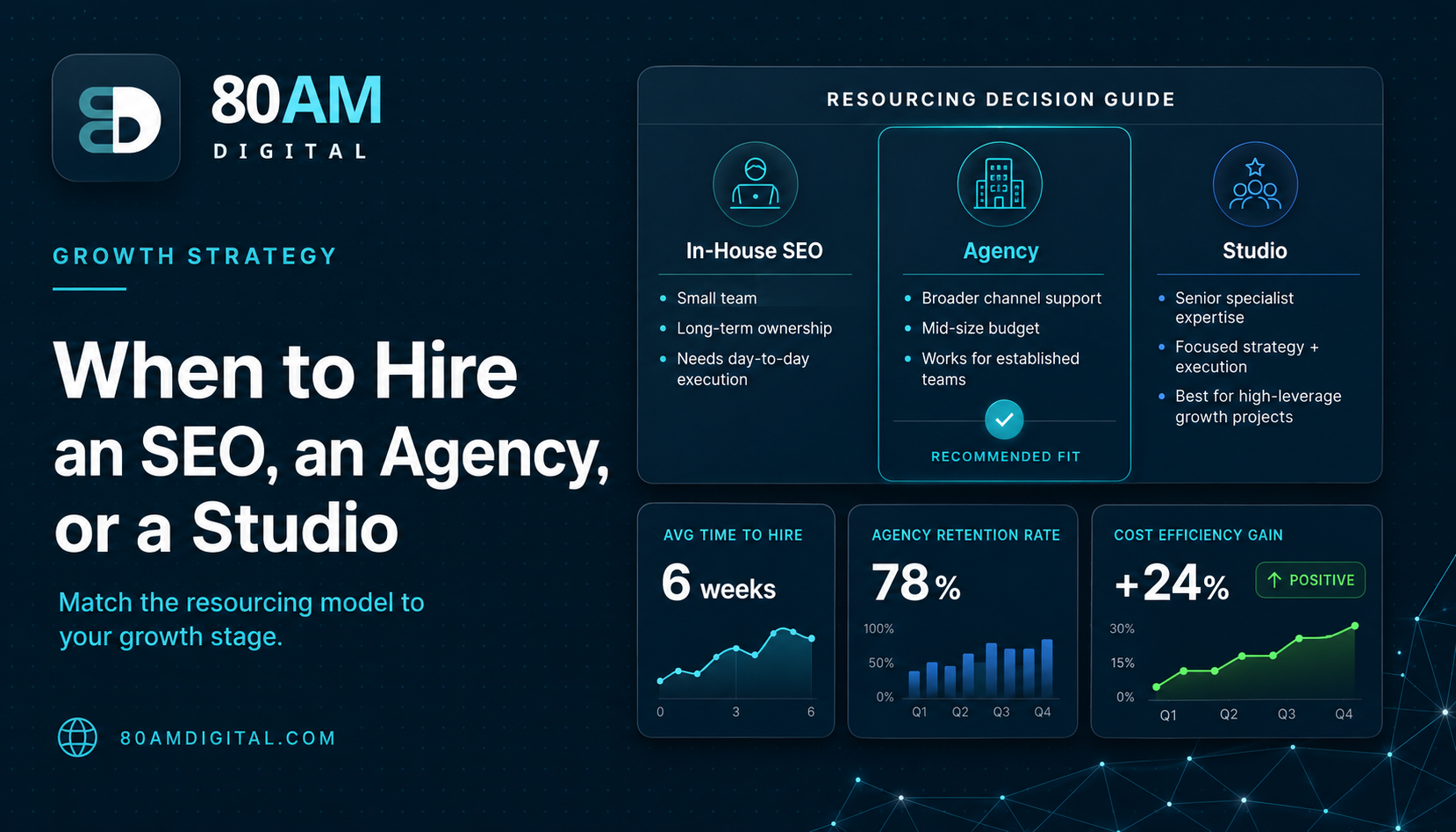
The right answer to “should I hire an SEO, an agency, or a studio?” depends on three things: how much SEO is central to your growth model, what stage you’re at, and whether you need one discipline or the whole stack. A freelance specialist is the right call when the problem is bounded and technical. A full-service agency makes sense when you need a large team, multiple channels, and are willing to pay for coordination. A specialist studio — small, senior, narrower scope — is usually the best fit for growth-stage businesses that need execution, not account management.
This guide maps the trade-offs honestly so you can match the right model to your situation without discovering the mismatch six months into a contract.
The Short Version
- Freelancers suit bounded, technical problems with a defined scope. Agencies suit large teams needing multiple channels. Studios suit growth-stage businesses that need execution without account-management overhead.
- The biggest risk is hiring before the problem is properly diagnosed — the contract locks you in before you know what you actually need.
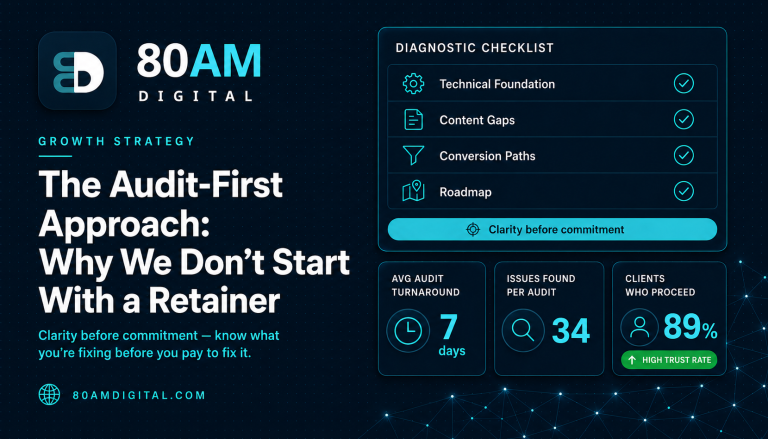
- Any provider who won’t audit before proposing a retainer is optimising for their revenue, not your results.
- A good specialist studio works like a fractional in-house team: senior people, direct access, no layers between you and the work.
The three options: freelancer, agency, studio
Freelance specialist
A freelancer is typically one senior practitioner with deep expertise in one or two disciplines — technical SEO, link building, content strategy. They work directly with you, have low overhead, and charge for their actual time rather than an agency rate that includes account management and sales costs.
- The problem is specific and bounded
- You need a specialist skill you can’t find internally
- You have strong internal project management
- Budget is limited but quality matters
- You need an honest second opinion on current work
- Availability — top freelancers are often booked
- Bandwidth limits — one person can only do so much
- Coverage gaps if you need multiple disciplines
- Dependency risk if they’re unavailable
Full-service agency
A full-service agency has large teams, specialists across disciplines, and systems for managing multiple accounts. You get breadth, bench depth, and coordination — at a price that reflects the overhead of maintaining all of that.
- You have a large site (100K+ pages)
- You need multi-channel coordination (SEO + paid + PR)
- You’re in a complex enterprise org with many stakeholders
- You need guaranteed bench depth and redundancy
- Budget isn’t the constraint
- Junior-heavy delivery teams despite senior sales
- Retainer bloat: paying for coordination, not output
- Slow to adapt — large agencies run on process
- You may be a small fish in a big client pool
- 12-month lock-ins before you’ve seen deliverables
Specialist studio
A studio is a small, senior team with a narrow, defined focus — typically covering two or three disciplines under one roof (for example: technical SEO + content systems + conversion copy). Low overhead, direct access to the senior practitioners who actually do the work, and a scope of work that’s more focused than an agency but broader than a single freelancer.
- You need technical + content + CRO under one roof
- You want direct access to the practitioner, not an AM
- Growth-stage company: smart, fast, execution-focused
- You want strategy and execution from the same team
- Boutique pricing that doesn’t carry agency overhead
- Scope outside the studio’s specialty — know what they don’t do
- Smaller team means less redundancy than a large agency
- May not suit enterprises needing multi-country coordination
When to choose each one
The hybrid option: in-house plus specialist
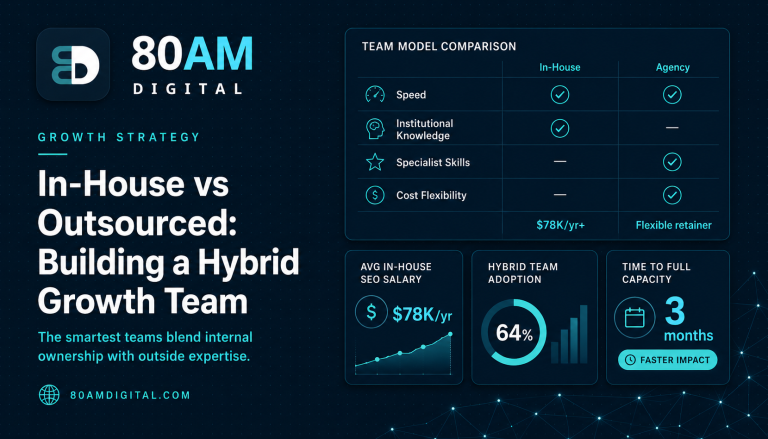
The strongest setup for most growth-stage businesses isn’t fully in-house or fully outsourced — it’s a hybrid: in-house ownership of the problem and implementation, with a specialist partner for strategy, audits, and the discipline you don’t have covered internally.
The division that works best: keep context, prioritisation decisions, and cross-functional coordination in-house. Bring in specialists for the technical depth, content architecture, and expertise that would take years to build on staff — especially if you don’t need that depth full-time.
Hybrid model: what goes where
- Ownership of goals and priorities
- Implementation of fixes and content
- Cross-functional coordination (dev, design, marketing)
- Customer and product context
- Day-to-day performance monitoring
- Initial audit and prioritised action plan
- Technical SEO depth (crawl, structured data, CWV)
- Content cluster architecture and briefs
- Conversion copy and page optimisation
- Quarterly strategy reviews
Signs you’ve outgrown your current setup
- Recommendations are being made but never implemented. The audit PDF from six months ago is still in someone’s inbox. This is a resourcing and prioritisation problem — either you need more internal bandwidth or a partner who owns implementation, not just advice.
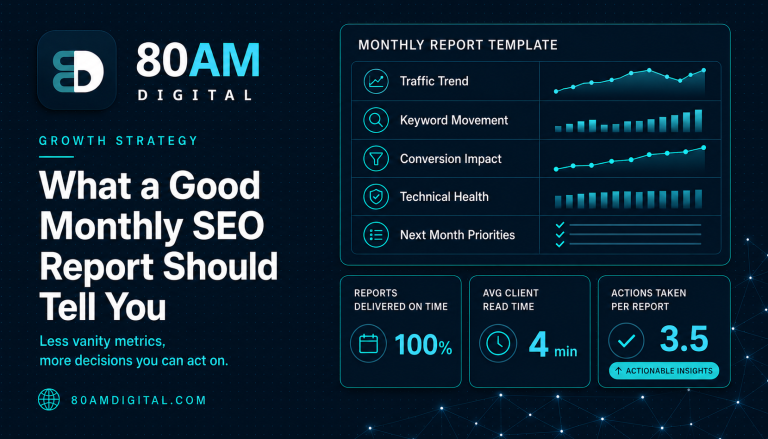
- Your current agency can’t explain why traffic is up or down. If the monthly report is a table of numbers without a clear explanation of what caused the change and what you should do about it, you’re not getting the analysis you’re paying for.
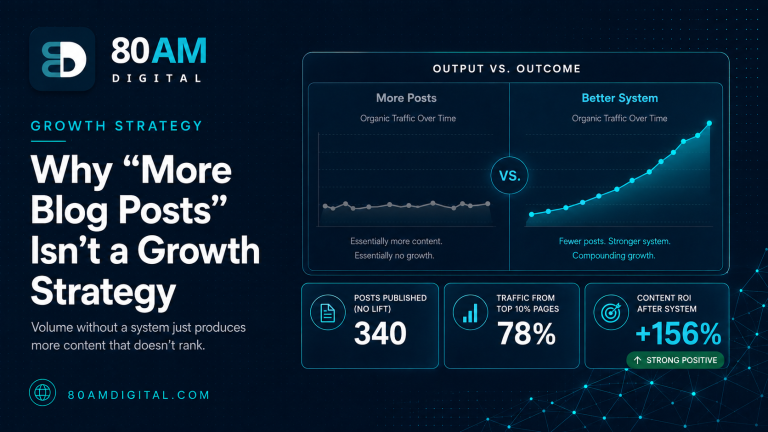
- There’s no cluster architecture — just a pile of posts. Random publishing without topic clusters doesn’t compound. If there’s no deliberate architecture linking your content, the engine isn’t built yet.
- SEO and content aren’t talking to each other. The content team is writing posts; the SEO team is building links. Nobody is connecting them into a coherent system. This is the classic sign that these disciplines are siloed when they need to be integrated.
- You’re getting traffic but not conversions. The SEO is working on one dimension (rankings, traffic) but the conversion layer isn’t being touched. That’s the system leaking between the silos. Our traffic-but-no-conversions diagnosis covers how to find and fix that specific leak.
Questions to ask before hiring anyone
These questions apply whether you’re evaluating a freelancer, an agency, or a studio. The answers reveal more about a provider’s actual approach than any case study or testimonial.
- “Walk me through how you’d approach our site specifically.” A good provider will ask you questions before answering. A bad one will present a generic slide deck about their process.
- “Who will actually be on my account?” Get names. Look at their work. The person presenting is not necessarily the person executing.
- “What do you not do well?” Honest providers have an answer. Providers who claim to do everything equally well are usually mediocre at most of it.
- “Do you start with an audit, or do you start with a retainer?” The right answer is: audit (or at minimum a scoping call that surfaces the key problems) before any ongoing commitment. Retainer-first is the model that benefits the provider, not you.
- “Can you show me an example deliverable — an audit, a brief, a strategy doc?” Real deliverables reveal the quality of thinking. Slide decks with big numbers don’t.
Frequently asked questions
The right hiring decision is the one that matches your stage and problem — not the biggest budget or the most impressive agency deck. Most businesses get further faster with a focused partner who understands the full-funnel system than with a large agency that optimises one slice of it. The full-funnel organic growth playbook covers how that system should work once the right partners are in place.
If you’re not sure where to start, an organic growth audit is the lowest-risk first step: it gives you a clear picture of what your site actually needs before you commit to who should do the work.