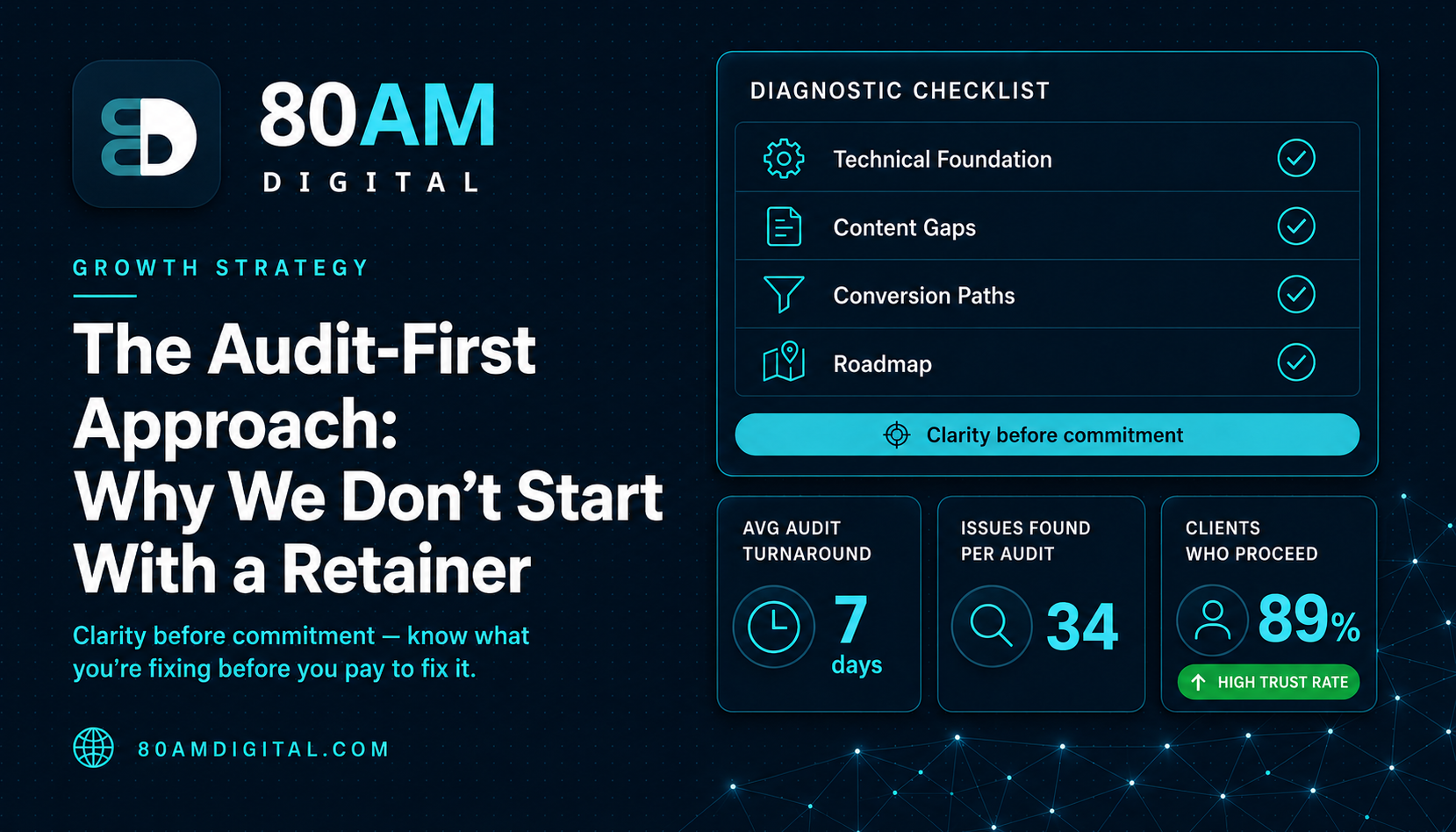
The Audit-First Approach: Why We Don’t Start With a Retainer
Locking into a retainer before anyone knows the problem is backwards. Learn why an audit-first approach gives you clarity, priorities and proof first.
Table of Contents
Most SEO agencies want to sign you to a retainer before they’ve looked at your site. They’ll run a quick discovery call, send a proposal with deliverables, and ask you to commit to six months before anyone has done a single hour of actual diagnostic work.
That model has a built-in problem: the scope of the retainer is decided before anyone knows what the site actually needs. So either you’re paying for work the site doesn’t need yet, or you’re missing the work that would actually move the needle first. There’s a better sequence, and it starts with a diagnostic.
The Short Version
- Retainer scope decided before an audit is built on agency packages and guesswork, not on what your site actually needs.
- A real diagnostic tells you which constraints are limiting growth right now, and the order to fix them in — sequencing matters as much as the list itself.
- The audit stands on its own: implement it yourself, take it to another agency, or continue with us. No obligation either way.
- You get clarity before you commit budget, and the first proof point lands sooner because work starts on the highest-impact item, not the easiest one to show activity on.
The problem with leading with a retainer
A retainer is a commitment to ongoing work. The question is: ongoing work on what?
When a retainer is sold before an audit, the scope is usually decided based on three inputs, none of which have anything to do with what the site actually requires to grow:
- What the agency’s standard packages include.
- What the client thinks they need based on what they’ve read.
- What the agency can deliver within its existing team structure.
And yet those three inputs determine where six months of budget gets spent. The result is predictable: three months in, the agency is delivering work against a roadmap that was never grounded in a genuine site assessment. Reporting shows activity — content published, links built, tags fixed — but performance hasn’t moved, because the roadmap was built on assumptions, not evidence.
What an audit actually tells you
A proper diagnostic isn’t a list of everything that could be better. Every site has a hundred things that could theoretically be improved; that list isn’t useful — it just creates the illusion of thoroughness while obscuring the actual priorities. What a diagnostic tells you is which constraints are limiting growth right now, and in what order they need to be resolved. Those constraints look different on different sites:
| Site profile | The real constraint | What it looks like if misdiagnosed |
|---|---|---|
| Good content, poor technical architecture | Invisible in search regardless of writing quality | Agency keeps producing content that never gets crawled or indexed properly |
| Solid traffic, weak conversion paths | Growing an audience that never becomes a customer | Traffic charts look great in reporting; revenue doesn’t move |
| Good traffic and conversions, no content depth | Hits a ceiling that link building alone won’t raise | Budget spent on backlinks for a site with nothing new to rank |
Each of those problems requires a different first move, and the first move matters because it determines what the next six months of work should actually be.
Why sequencing matters as much as the list
Most site audits produce a list of everything that could be better, then leave you to figure out what to actually do next. The diagnostic-first approach exists because the sequencing matters as much as the list. Consider a site that needs all of the following:
- Core Web Vitals improvements.
- Better internal linking structure.
- New content targeting bottom-of-funnel keywords.
- Updated meta titles on twenty underperforming pages.
- A revised CTA on the main service page.
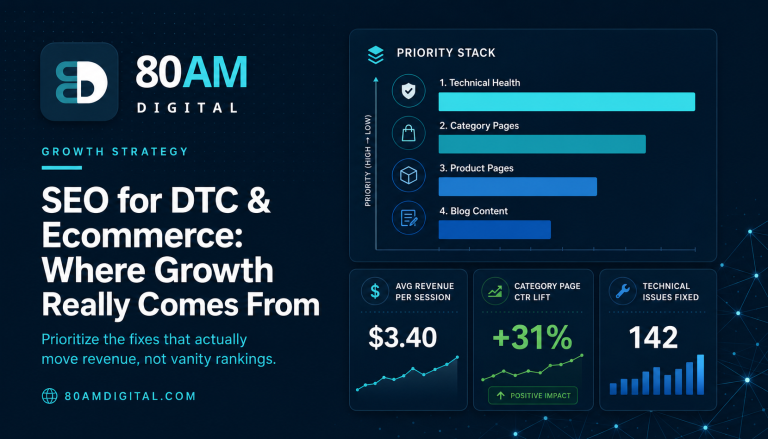
In isolation, each item is legitimate. But if Core Web Vitals are failing badly enough that Googlebot is deprioritizing crawl budget, then no amount of new content or meta title updates will move rankings — because the pages aren’t being fully indexed in the first place. Fix Core Web Vitals first. Then build the content the newly crawlable site can support. Then improve the CTAs on pages that are now actually receiving traffic. That’s not a longer list — it’s the same list in the right order, and the order is what the audit reveals.
How the audit-first approach works in practice
The engagement starts with a focused diagnostic — not a discovery call where you tell us what you think the problem is, but an actual review of the site, its data, and its current performance, following the same structure as our full SEO audit checklist. That diagnostic covers three layers:
The three layers of the diagnostic
At the end of the audit, you receive a prioritized plan: the specific changes that will have the most impact, in the order they should happen, with the reasoning for each sequencing decision explained. Then you decide what to do with it — implement it internally, take it to another agency, or continue with us on implementation. The audit stands on its own: there’s no obligation to continue, and no pressure to sign up for ongoing work before you’ve seen what the work actually involves.
Audit-first vs. retainer-first
| Dimension | Retainer-first | Audit-first |
|---|---|---|
| Scope decided by | Agency packages and assumptions | Actual site data and current performance |
| First 90 days typically produce | Activity (content, links, fixes) with unclear impact | A sequenced plan, then high-impact work starting immediately |
| Risk if wrong | Six months of budget on the wrong priorities | A modest audit fee and a week of time |
| Exit if it’s not a fit | Locked into a multi-month contract | No obligation — take the plan anywhere |
What this means for you as a client
Three things are different when an engagement starts with a diagnostic rather than a retainer proposal.
You have clarity before you commit. The audit tells you what the site actually needs. If that scope matches what you’re ready to invest, ongoing work makes sense. If it doesn’t, you’ve lost a week and a modest audit fee — not six months of retainer budget.
The roadmap is built on evidence. Every recommendation comes from what the site’s own data shows, not from a template deliverable list. That means the work is specific to your site’s constraints — not a general-purpose SEO package applied to your domain.
The first proof point comes early. When implementation starts with the highest-impact items identified in the audit, you see results sooner than you would from a roadmap that starts with lower-hanging fruit to show early activity. The audit tells us where to start — and starting in the right place matters more than starting fast.
A worked example: the same list, two orders
Take a mid-market B2B site with a five-item backlog: fix Core Web Vitals, rebuild internal linking, write three bottom-of-funnel pages, refresh twenty meta titles, and rewrite the main service page CTA. A retainer-first agency, working from a standard package, might tackle this in the order the client requested it — CTA and meta titles first because they’re fast and visible, content next, technical last because it’s “infrastructure work” that’s harder to bill against in a monthly report.
An audit first reveals that Googlebot is only crawling 40% of the site’s pages because of a Core Web Vitals failure on the templated product pages — so the new bottom-of-funnel content, however well written, won’t get indexed quickly, and the CTA rewrite won’t show a conversion lift because the pages with the new CTA aren’t receiving meaningfully more traffic yet. The audit-first sequence inverts the order: Core Web Vitals first, then internal linking (which now has a healthier crawl to work with), then the new content (which gets indexed promptly), then the CTA and meta title polish — by which point there’s enough traffic flowing through those pages for the polish to actually register in the data.
Frequently asked questions
Start with the diagnostic
If you’re considering SEO support — or if you’ve had ongoing work that hasn’t produced the results you expected — the most useful first step is a site diagnostic, not a proposal. The audit tells you what the site actually needs, in what order, and why. Everything after that becomes easier, including the decision about whether to continue with us.
Request an audit and we’ll send back a plan.