How to Brief an SEO Project: What Good Agencies Actually Need From You
A weak brief produces weak SEO work. Here’s what to include when briefing an agency, consultant, or freelancer so the engagement starts with shared context and clear expectations.
Most SEO briefs are too thin. “We want to rank higher” is not a brief. “We want to increase organic traffic by 30%” is closer, but still missing the context that makes the difference between a generic SEO engagement and one that produces outcomes specific to your business. The quality of the brief determines the quality of the work. An agency operating from a weak brief makes assumptions, fills in context gaps with guesses, and delivers work that may be technically competent but misaligned with your actual situation.
This article covers the five things a good SEO brief contains, the most common mistakes that undermine a brief, and a worked example of how a stronger brief changed the quality of agency proposals received.
The Short Version
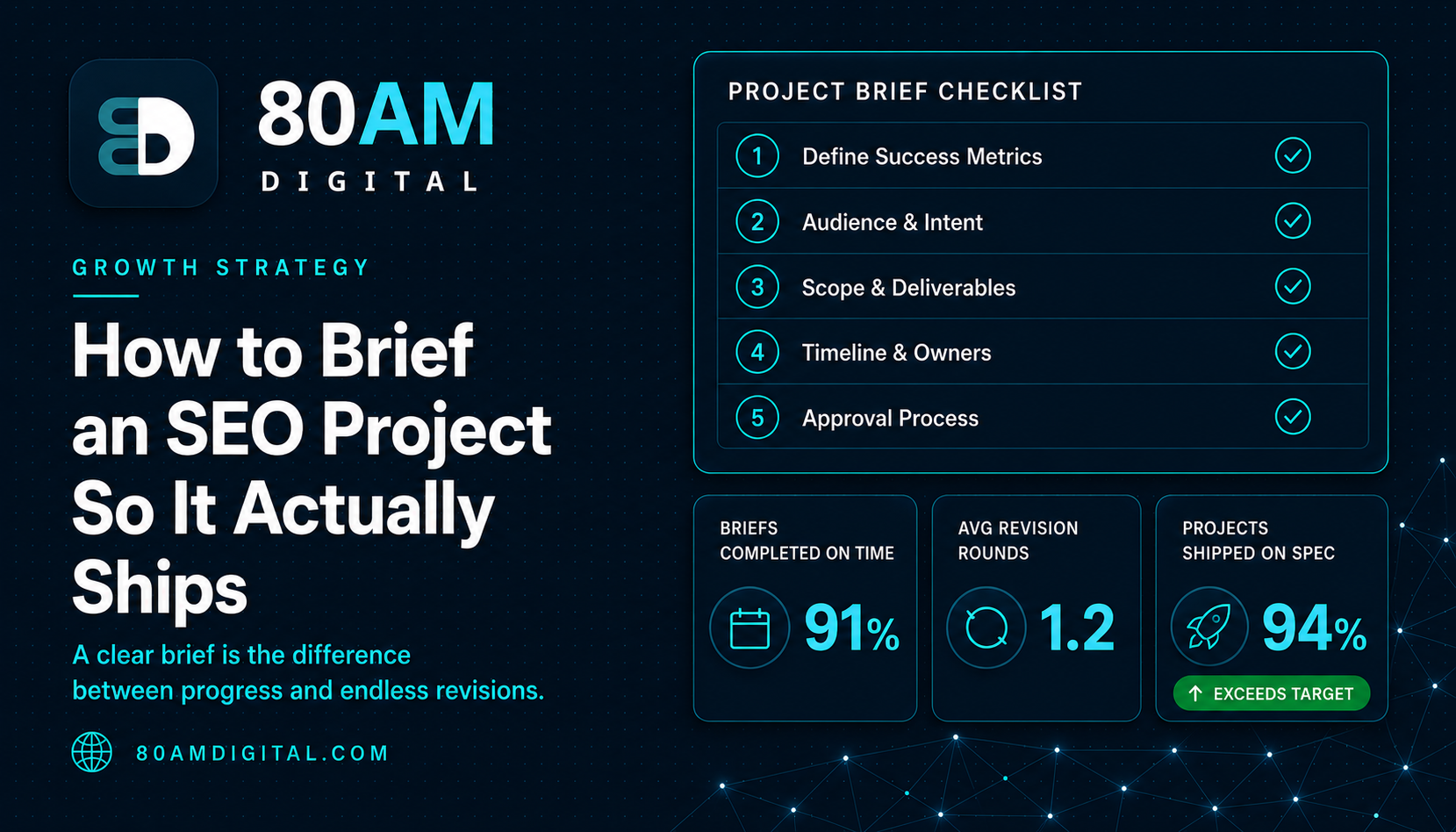
A complete SEO brief covers five things: business context (who you serve, how SEO fits the growth picture), current state and history (analytics access, past events, prior agency relationships), goals tied to business outcomes (not just rankings), scope and timeline (strategy-only vs strategy-plus-execution), and access and permissions (who approves what, and how fast). 2–5 pages is typical. Briefs fail far more often from being too thin than too long — a thin brief produces 2–3 months of an agency guessing at context they should have had on day one.
Table of Contents
| Section | Key question it answers |
|---|---|
| 1. Business context | What do you do, and how does SEO fit the growth picture? |
| 2. Current state and history | What’s the baseline, and what’s already happened? |
| 3. Goals and success criteria | What does success actually look like, in business terms? |
| 4. Scope and timeline | What exactly is being delivered, and by when? |
| 5. Access and permissions | Who approves what, and how fast? |
1. Business Context
What does your business actually do, who are your customers, and how does SEO fit into the growth picture? This sounds obvious but is frequently omitted. An agency that doesn’t understand your product, your customer acquisition model, and your competitive position can’t prioritise correctly. Provide: your business model (SaaS, ecommerce, professional services, lead gen), your target customer profile (who you’re trying to reach, what they’re searching for, what drives their decision), your typical sales cycle and conversion path, and your current position relative to competitors (are you the challenger, the incumbent, the specialist, the price-competitive option?).
2. Current State and History
What do you already know about your SEO situation? Share access to Google Search Console and GA4 (or summarise the key metrics if access-sharing isn’t immediately practical). Flag any major historical events: site migrations, algorithm updates that correlated with traffic changes, previous agency relationships and why they ended, technical issues you know about. An agency inheriting a site with a history of aggressive link building needs to know that before they audit the link profile. An agency starting work on a site that just went through a migration needs to understand what changed and when.
3. Goals and Success Criteria
Define what success looks like in terms that connect to business outcomes, not just SEO metrics. “Rank #1 for [keyword]” is a poor success criterion — it’s a means, not an end, and ignores whether that ranking produces the outcome you actually care about. Better: “Increase organic-sourced trial signups by 40% within 12 months.” Best: “Increase organic-sourced trial signups by 40% within 12 months, with a secondary goal of reducing cost per organic acquisition to below £25 by month 18.”
Also specify any constraints: keywords or topic areas you don’t want to target (competitive reasons, brand positioning reasons), channels where you don’t want content to appear (competitors’ publications, low-quality sites), or content tones and approaches that conflict with your brand.
4. Scope and Timeline
What exactly are you asking the agency to deliver? An SEO audit and recommendations is a different engagement from ongoing monthly retainer management, which is different again from a one-time content strategy project. Be explicit about: what deliverables you expect and when, whether the agency is responsible for strategy only (recommendations for your team to implement) or strategy plus execution (they write the content, manage the link building, make the technical changes), and what the timeline looks like for each phase.
If you have internal resource constraints that affect execution — a developer who can only commit 5 hours per month to technical changes, a content team that can produce one piece per week — include this. An implementation plan that assumes 20 hours of developer time per month will fail silently if that resource isn’t available.
5. Access and Permissions
List what access you’ll provide and who has authority to approve changes. Specifically: Search Console access (add agency as an owner or full user), GA4 access, CMS access (will the agency be able to publish directly or submit for approval?), access to your developer or technical team, and the approval process for content and technical changes. “All recommendations need sign-off from our Head of Marketing” is useful context. “We’ll need 4 weeks to get legal approval on any content mentioning competitors” will affect the implementation timeline and needs to be in the brief.
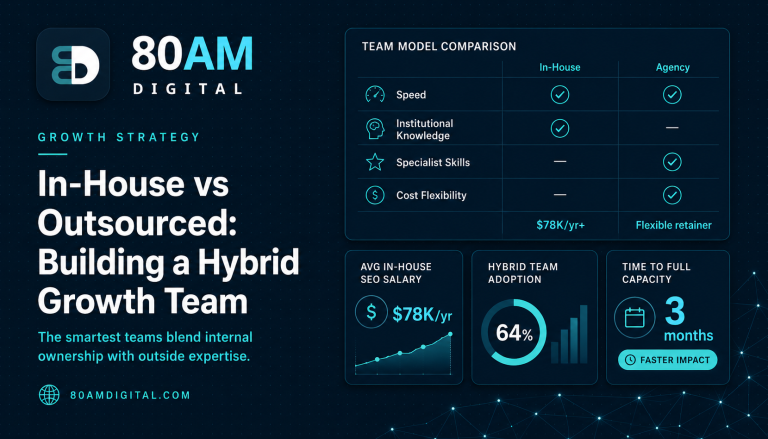
For the in-house vs outsourced decision that precedes the brief, see in-house vs outsourced SEO.
A Worked Example
A mid-size insurance brokerage sent out a one-paragraph brief to five agencies asking for “proposals to improve our organic rankings and traffic.” The five proposals that came back were nearly interchangeable — generic audits, generic content calendars, and a wide range of quoted prices with no clear way to compare them on substance, since none of the agencies had enough context to differentiate their thinking.
The team rewrote the brief using the five-section structure: explained their specific business model and the two customer segments they served differently, shared a 90-day Search Console export and flagged a prior agency relationship that had ended over a disagreement on aggressive link building, set a specific goal (organic-sourced quote requests up 35% in 12 months, not just “more traffic”), specified that the engagement was strategy-plus-execution with a content team of one in-house writer for support, and listed the legal approval process for any content naming competitors.
The same five agencies, when re-approached with the rewritten brief, returned genuinely differentiated proposals — two specifically addressed the link-building history with a remediation plan, one proposed a phased approach that explicitly worked around the one-writer content constraint, and pricing variation now reflected real differences in approach rather than unexplained spread. The brokerage selected an agency with far more confidence than the first round had allowed, and the chosen agency’s first 90 days moved noticeably faster because almost none of that period was spent re-deriving context the brief had already supplied.
Frequently Asked Questions
The Brief Is the Foundation of the Engagement
A good brief doesn’t constrain the agency — it gives them what they need to do better work faster. Context about your business model, your current organic situation, your constraints, and your success criteria eliminates the guesswork that otherwise consumes the first two or three months of an engagement while the agency tries to piece together context they should have had from day one. The time you spend on a good brief is paid back in more focused work from the first month.
If you’re evaluating whether to engage with 80AM and want to discuss your brief before sending it, get in touch.