
In-House vs Outsourced SEO: How to Make the Right Call for Your Business
Building SEO capability in-house gives you control and institutional knowledge. Outsourcing gives you speed and specialisation. Here’s how to decide which model fits your situation.
Every business that invests in SEO eventually faces the build-vs-buy decision: hire in-house SEO talent and build internal capability, or work with an agency or consultant who brings the expertise externally. The answer isn’t universal — it depends on your scale, your SEO maturity, your budget, your internal team’s bandwidth, and what kind of SEO work you actually need done. Getting this decision wrong is expensive in both directions: over-investing in an in-house team before you have the volume to justify it, or over-relying on an agency that lacks the context to execute the work well.
This article covers the case for each model, the hybrid structure most mid-size businesses converge on, and a worked example of a company that switched models as it scaled.
The Short Version
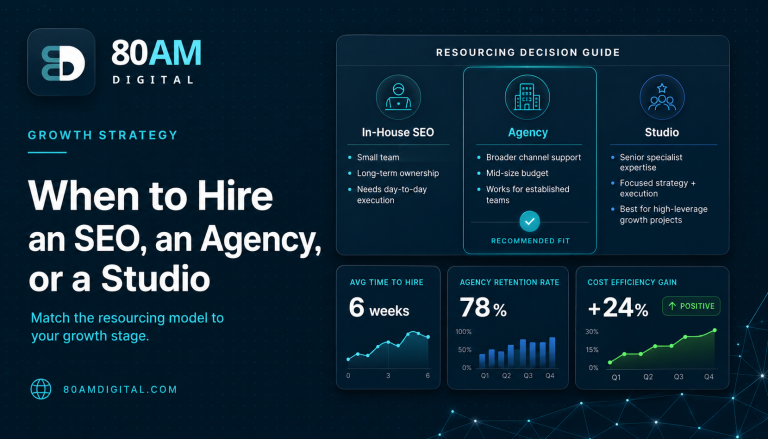
In-house wins on institutional knowledge, cross-functional advocacy, and execution speed — but needs enough recurring volume to justify a salary. Outsourcing wins on specialisation, speed to competent work, and flexibility — but depends on internal capacity to evaluate and act on recommendations. The cost comparison is closer than most assume: a mid-level in-house SEO hire and a solid agency retainer often land in the same £25,000–£75,000/year range. Most mid-size businesses converge on a hybrid: an in-house generalist owning the roadmap, paired with an external specialist for strategy, audits, and link acquisition.
Table of Contents
| Model | Strongest at | Best fit when |
|---|---|---|
| In-house | Institutional knowledge, cross-functional advocacy, speed of execution | Enough recurring volume to justify a full-time salary |
| Outsourced | Specialisation, speed to competent work, flexibility | Volume doesn’t justify a hire, or an urgent problem needs fast expertise |
| Hybrid | Roadmap ownership plus specialist depth | Mid-size businesses past the earliest stage |
The Case for In-House SEO
Institutional knowledge compounds. An in-house SEO hire learns your product, your customers, your competitive landscape, your brand voice, and your internal processes over time. That accumulated context makes their work progressively better and faster. An agency or consultant restarts this learning curve each time the relationship changes and has competing attention across multiple clients.
Cross-functional integration. SEO touches content, product, engineering, sales, and marketing. An in-house hire has direct access to all these teams and can advocate for SEO requirements in product roadmaps, content calendars, and engineering sprints. An external agency operates from outside these processes and depends on your internal team to translate and champion their recommendations.
Execution speed. When an in-house SEO identifies a quick win — a title tag change, an internal link addition, a content update — they can often implement it directly or escalate through a familiar team. An external agency submits recommendations, waits for approval, and depends on internal implementation bandwidth to act.
When in-house makes sense: Your business has a large enough content surface area and enough recurring SEO work to justify a full-time salary (roughly: if you’re spending £3,000+/month with an agency and expecting sustained engagement, in-house may be comparable in cost). You have an internal team the SEO hire can collaborate with. You value deep institutional knowledge over breadth of client-side experience.
The Case for Outsourced SEO
Specialisation without the hiring risk. A good SEO agency or consultant brings expertise accumulated across dozens of engagements, tools subscriptions you won’t maintain yourself, and pattern recognition from seeing what works across different industries and business models. A first in-house SEO hire at a business with limited SEO experience has a much steeper learning curve.
Speed to competent work. Hiring an in-house SEO takes months: recruiting, interviewing, offer, onboarding. A capable agency or consultant can begin delivering within weeks. For businesses with an urgent SEO problem (a traffic drop, a site migration, a competitive gap opening), outsourcing is faster.
Flexibility. Agency retainers can be scaled up or down. An in-house hire has a fixed cost structure — salary, benefits, employment obligations — that doesn’t scale with your SEO needs. For businesses with seasonal SEO intensity or changing investment levels, the flexibility of an external relationship is valuable.
When outsourcing makes sense: You don’t yet have enough recurring SEO work for a full-time hire. You need an SEO audit or a specific deliverable rather than ongoing management. You lack internal expertise to evaluate whether an in-house hire is doing good work. You need to move faster than your hiring pipeline allows.
The Hybrid Model
The most common effective structure for mid-size businesses: an in-house generalist (marketing manager or content manager with SEO knowledge) who owns the SEO roadmap and coordinates implementation, paired with an external specialist or agency for strategy, technical audits, and link acquisition — the work that benefits most from external expertise and cross-client pattern recognition.
The in-house person maintains context and drives execution; the external partner provides strategic oversight and specialist capability the in-house generalist doesn’t have. This avoids both the full cost of a specialist in-house hire and the context loss of fully outsourcing.
For how to write a brief when engaging external SEO support, see how to brief an SEO project.
A Worked Example
A B2B logistics software company started with a small agency retainer when their content surface area was under 60 pages, which was the right call at that stage — there wasn’t enough recurring work to justify even a part-time hire. As the company grew and the content library expanded past 300 pages with multiple product lines, the agency relationship started to feel slow: every internal link change or content recommendation needed to be translated and championed by someone on the marketing team who didn’t fully understand the rationale.
Rather than fully insourcing, the company hired an in-house marketing generalist with working SEO knowledge to own the roadmap and handle day-to-day execution — internal linking, content briefs, basic technical monitoring — while keeping a smaller, more focused agency retainer specifically for quarterly technical audits and link building, the two areas where cross-client pattern recognition mattered most.
The hybrid model cut total SEO spend by roughly 20% compared to the full agency retainer it replaced, while execution speed on small fixes improved dramatically — internal link additions that used to take three weeks to action through the agency relationship now happened within days. The in-house generalist gradually built enough institutional knowledge over the following year that the company began evaluating whether to bring technical audits in-house too, the natural next step in the iteration this article describes.
Frequently Asked Questions
The Decision Is Situational, Not Ideological
There’s no universally correct answer to the in-house vs outsourced question. The right structure depends on where you are in growth, how much SEO work you have, your internal team’s capabilities, and what you need most — execution speed, institutional depth, specialist expertise, or cost efficiency. Most businesses iterate through models as they grow: starting with an agency, adding an in-house generalist, building a specialist in-house team, maintaining agency relationships for specialist work that doesn’t justify full-time headcount. The important thing is matching the model to the current reality rather than committing to an ideology about which approach is inherently better.
If you’d like to talk through which SEO model makes sense for your current stage, get in touch.