Organic vs Paid Search: When to Invest in Each (And When to Run Both)
Organic search compounds. Paid search performs now. Most growing businesses need both — but the allocation depends on your stage, margin, and growth objectives.
The organic vs paid search debate is usually framed as a binary — SEO or PPC, build vs buy, long-term vs short-term. In practice, most businesses that grow through search need both channels at different intensities at different stages. The real question isn’t which channel is better in the abstract; it’s how to allocate between them given your specific business model, growth stage, margin structure, and time horizon.
This article covers what each channel is actually good for, when to prioritise each, how to allocate when running both, and a worked example of a business that used paid data to make its organic investment more efficient.
The Short Version
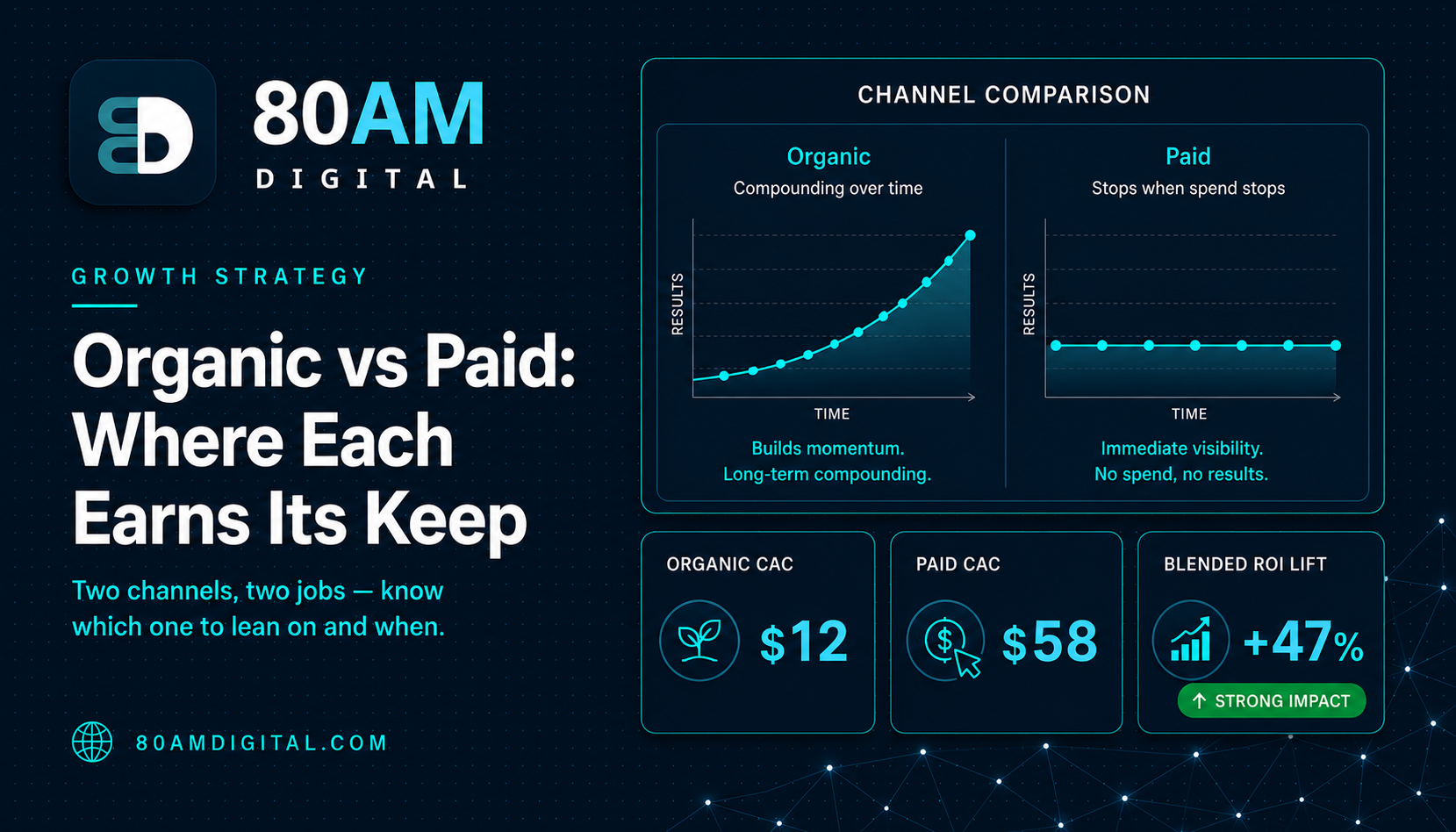
Paid search is rented visibility: fast, precisely targetable, stops the moment spend stops. Organic is owned visibility: slow to build, but compounds and produces a lower cost per acquisition at scale. Most growth-stage businesses run both, shifting allocation over time — heavy paid early while organic builds, then reducing paid on queries where organic now ranks well. Running ads doesn’t help or hurt organic rankings; the two systems are independent. Paid conversion data is one of the best inputs for prioritising organic content investment, since it shows exactly which queries convert.
Table of Contents
What Each Channel Is Actually Good For
Paid search (PPC/SEM): Fast to launch, immediately visible, precisely targetable, and directly measurable — you know what each click cost and can trace the conversion path. Paid search scales with budget linearly: double the spend, roughly double the traffic (up to a point). The limitation is permanence: pause the spend, and the traffic stops immediately. Paid search is rented visibility. It’s ideal for validating demand quickly, capturing high-intent traffic during a growth push, testing messaging before investing in organic content, and maintaining visibility for high-value commercial terms while organic builds.
Organic search (SEO): Slow to build, difficult to attribute precisely, and impossible to control with the precision of paid. But the economics are fundamentally different at scale: once content ranks, it generates traffic without ongoing spend. Organic search compounds — a piece of content that ranks and earns backlinks over time becomes progressively more valuable without proportional cost increases. At scale, organic search typically produces a significantly lower cost per acquisition than paid search for the same queries because you’re no longer paying per click. Organic is owned visibility. It’s ideal for long-term CAC reduction, building topical authority that paid can’t replicate, and driving acquisition at scale when the business can’t sustain paid search economics.
| Dimension | Paid search | Organic search |
|---|---|---|
| Time to results | Days | Months to a year+ |
| Cost per acquisition over time | Stable or rising with competition | Falls as content compounds |
| Stops generating traffic when… | Budget is paused | Rarely — persists after publication |
| Attribution precision | High — per-click tracking | Lower — multi-touch journeys |
| Best for | Validating demand, urgent growth pushes | Long-term CAC reduction, topical authority |
When to Prioritise Paid Search
- Early stage, validating demand: Paid search gives you traffic data within days. Knowing which queries actually convert before investing in content infrastructure is worth the cost of the paid experiment.
- High-urgency growth periods: A product launch, a seasonal peak, a competitive window where speed matters more than efficiency. Paid search responds to budget increases immediately; organic doesn’t.
- High-margin, high-LTV products where the paid economics work: If a customer is worth £10,000 over their lifetime, a £200 CPC converting at 5% (40 clicks producing 2 conversions, an £8,000 spend, £4,000 cost per acquisition) is potentially viable depending on the payback window. If the margin supports it, paid search can be permanently efficient.
- Queries you can’t rank for organically: If a competitor has a 10-year head start and dominant organic rankings on your most important commercial terms, paid search may be the only viable way to appear for those queries near-term.
When to Prioritise Organic Search
- Paid search economics are deteriorating: CPC costs for your target queries are rising faster than conversion rates, making paid search increasingly expensive per acquisition. Organic is the long-term answer to rising paid search costs.
- You have a content moat opportunity: Your topic area has significant search volume and weak existing content — an opportunity to establish topical authority before competitors do. Organic content investment now creates a competitive barrier that’s difficult to replicate.
- Long research cycles in your buying process: Buyers who research for weeks before purchasing are served by organic content that reaches them early in the journey. Paid search captures them at purchase intent; organic content can reach them at awareness and consideration stages that paid often misses.
- The business is optimising for long-term unit economics: Once organic generates a meaningful percentage of acquisition, each marginal conversion costs significantly less than paid. The investment in organic pays back over a 2–4 year horizon for most businesses and continues generating returns indefinitely.
Running Both: How to Allocate
For most growth-stage businesses, the right answer is both — with allocation shifting over time. A common pattern: heavy paid search in years 1–2 while organic builds, gradually reducing paid spend on terms where organic is now ranking well, maintaining paid on high-value commercial terms where organic ranking is competitive, and using organic for the broader informational and consideration content that paid typically doesn’t cover well.
One useful allocation framework: run paid search on your highest-intent, highest-value commercial queries (where paying per click is worth the conversion rate). Run organic content on the informational and consideration queries that are too low-CPC to justify paid but have significant volume and buying intent when aggregated. The two channels then cover different parts of the search journey rather than competing for the same budget on the same queries.
For how to measure organic search’s true contribution to revenue and compare it to paid performance, see organic search attribution. For how to forecast when organic investment will produce returns, see how to forecast SEO results.
A Worked Example
A home services marketplace had been running paid search exclusively for three years, spending heavily on broad category terms with no organic content programme. CPCs in their category had risen nearly 60% over that period as more competitors entered paid auctions, and the finance team was asking why CAC kept climbing while growth targets stayed flat.
Rather than guessing where to start an organic programme, the team pulled 18 months of paid search conversion data by query and ranked every query by conversion rate, not just volume. A handful of mid-volume queries converted at 3–4x the average rate of the broad category terms the paid budget had been concentrated on — informational and comparison-style queries that paid had been mostly ignoring in favour of high-volume category terms.
The organic content programme was built starting with exactly those high-converting query clusters, using the paid data as the prioritisation input rather than search volume alone. Within a year, the highest-converting cluster had moved into organic’s top 5 positions, and paid spend on those specific queries was reduced by 70% while overall lead volume from that cluster held steady — the conversions simply shifted from paid to organic, with the freed budget redirected to the high-urgency campaigns paid is genuinely better suited for.
Frequently Asked Questions
The Channel That Matches Your Timeline
The real question with organic vs paid isn’t which is better — it’s which better matches your current business situation. If you need acquisition this quarter, paid search is the answer. If you’re optimising for unit economics 24 months from now, organic is the investment to make today. The businesses that win at search over time are usually the ones that treat paid and organic as a portfolio rather than a trade-off — using paid for speed and testing, organic for compounding returns, and adjusting the balance as the data warrants.
If you’d like help thinking through the right organic vs paid allocation for your specific business model, get in touch.