SEO for Lead-Gen B2B: Ranking for Buyers, Not Browsers
B2B SEO isn’t about volume; it’s about the few buyers who convert. Learn to target bottom-funnel intent and rank for terms that generate qualified leads.
B2B SEO operates by different economics than ecommerce or media. The traffic volumes are lower, the conversion cycles are longer, and a single keyword ranking that generates two qualified leads per month can be worth more than an ecommerce category page with thousands of organic sessions. The question isn’t how much traffic the site gets — it’s whether the traffic is from buyers.
This guide covers the B2B-specific approach to SEO that prioritises qualified leads over traffic volume — starting with the types of keywords that produce buyers, not browsers, and including a worked example of a site that reoriented around exactly this principle.
The Short Version
In B2B lead gen, the service page — not the blog — is the primary SEO asset, because it’s directly visible to buyers at the decision stage. Target bottom-funnel and commercial-investigation queries over high-volume informational terms; a site with 400 sessions from high-intent queries routinely outperforms one with 3,000 sessions and no leads. Lead attribution is complicated by long B2B research cycles, so pair GA4 conversion tracking with a “how did you hear about us?” field on the contact form to close the gap analytics alone can’t.
Table of Contents
The Right Keywords for B2B Lead Gen
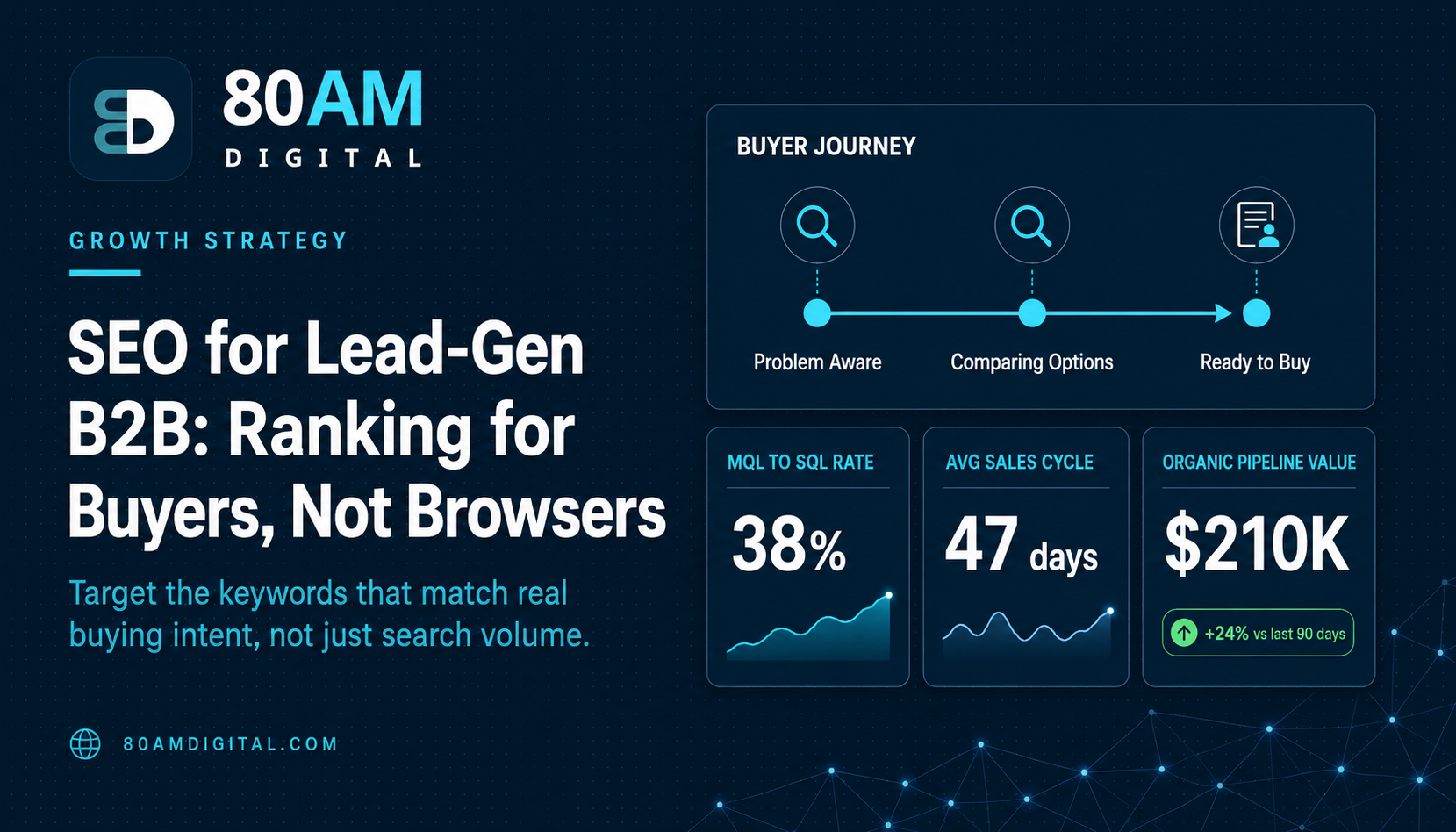
B2B buyers search differently than B2C consumers. They tend to be more specific in their queries, more patient in their research, and more likely to compare options before making a decision. The keywords worth targeting reflect this:
Bottom-funnel queries: “hire SEO consultant”, “SEO audit service pricing”, “ecommerce SEO agency” — these are searches from buyers who’ve already decided they need the solution and are evaluating providers. Low volume, high intent, and directly tied to a purchase decision.
Commercial investigation queries: “best SEO tools for B2B”, “how to evaluate an SEO agency”, “SEO vs content marketing ROI” — buyers comparing options or building an internal case. These lead to content that earns trust, not immediate conversion, but they’re researched by the same people who eventually request audits or demo calls.
Problem-aware queries: “why is my site traffic dropping”, “why don’t my blog posts rank” — buyers who understand they have a problem but haven’t yet identified the solution. These search high volume relative to the commercial queries and convert at lower rates, but they’re the entry point for buyers who will eventually recognise your solution as the answer.
| Query type | Volume | Conversion likelihood |
|---|---|---|
| Bottom-funnel | Low | High — already decided, evaluating providers |
| Commercial investigation | Medium | Medium — building trust, not yet ready |
| Problem-aware | High | Low — but valuable as an entry point |
The mistake most B2B SEO programmes make: targeting high-volume informational terms that attract large audiences with little commercial intent, while underinvesting in the lower-volume, higher-intent queries that produce actual leads.
The Service Page as Primary SEO Asset
In B2B lead gen, the service page is the most important SEO asset — not the blog. A service page ranking for “SEO audit for ecommerce” or “technical SEO consultant” is directly visible to buyers at the decision stage. A blog post ranking for “what is technical SEO” is visible to people who may not be buyers for months, if ever.
Most B2B service pages aren’t optimised for the specific transactional and commercial queries that buyers actually use. They’re optimised for the category terms the agency chose (“SEO services”) rather than the specific problem or solution terms buyers search for (“how to fix traffic drop after core update” followed by “hire SEO consultant for recovery”).
Specific service page improvements for B2B SEO:
- Target the most specific, high-intent variation of your service term in the H1 and title tag
- Include the industries or use cases you work with — “ecommerce SEO” outperforms “SEO services” in specificity and in attracting the right buyer
- Add FAQ schema addressing the questions buyers ask before hiring — this both earns rich results and provides the social proof content the page needs
- Link the service page to the most relevant pillar content in the blog cluster — authority flows both directions
Content Strategy for the Buyer Journey
Blog content in B2B SEO earns value in a different way than in ecommerce. The primary purpose isn’t traffic volume — it’s building topical authority around the problems your buyers have, demonstrating expertise before a buyer is ready to make a decision, and nurturing the long purchase cycle through content they can bookmark and return to.
The cluster structure works particularly well for B2B: a pillar page on the primary problem your service solves (“why organic traffic isn’t converting”) connected to spokes on each of the specific subtopics buyers research (“landing page structure”, “technical SEO audit”, “content refresh strategy”). By the time a buyer has read three articles in the cluster, they have a clear sense of your expertise — and a clearer path to contacting you than if they’d only seen one post.
Lead Attribution for B2B Organic
B2B lead attribution through organic is complicated by long research cycles. A buyer who eventually fills out the contact form may have visited the site five times over three months — first via a blog post, then a service page, then back to another blog post, then direct, then converting. Last-click attribution shows “direct” as the source; the real origin was the first blog post visit from organic search.
Practical approaches: track form submissions as conversion events in GA4 (see conversion events that map to revenue); use UTM parameters on all paid and email campaigns to isolate organic more cleanly; and review the Path Exploration in GA4 Explorations for converting users to see the full journey, not just the last touchpoint. For high-value B2B deals, asking “how did you hear about us?” on the contact form provides qualitative data that fills the attribution gap analytics can’t close.
For the full organic growth strategy that connects content, SEO, and conversion, see organic search attribution and leading and lagging SEO indicators.
A Worked Example
A B2B compliance software company had spent a year building a blog around broad industry topics — “what is regulatory compliance,” “history of data protection law” — and had grown organic sessions to over 6,000 per month. Sales reported almost no inbound leads they could trace to organic, and the SEO budget was under review.
An audit reclassified the existing content and target keyword list by funnel stage using the three-category model above: nearly 90% of published content and target keywords sat in the broad problem-aware or purely informational category, with almost nothing addressing bottom-funnel or commercial-investigation queries like “compliance software for healthcare” or “[competitor] alternative.” The service pages themselves were optimised only for the generic category term “compliance software,” not the specific use cases the company actually served.
The team rebalanced the next two quarters of content toward bottom-funnel and commercial-investigation topics, rewrote the service pages around specific industry use cases with FAQ schema addressing real buyer objections, and added a “how did you hear about us” field to the contact form to close the attribution gap. Organic sessions actually fell slightly to around 5,200 per month — but qualified organic leads went from roughly 2 per month to 14, because the traffic that remained was overwhelmingly higher-intent.
Frequently Asked Questions
B2B Organic Converts Buyers, Not Just Visitors
The measure of B2B SEO success is qualified leads, not sessions. A programme that attracts 3,000 sessions from generic informational queries with zero leads is outperformed by one that attracts 400 sessions from high-intent commercial queries and produces 12 qualified conversations.
The difference is the targeting strategy: ranking for the queries that buyers use when they’re evaluating solutions, not the queries that interested people use when they’re broadly learning about a topic.
If you’d like help mapping your content and keyword strategy to the actual buying journey of your ideal client, request a site review.